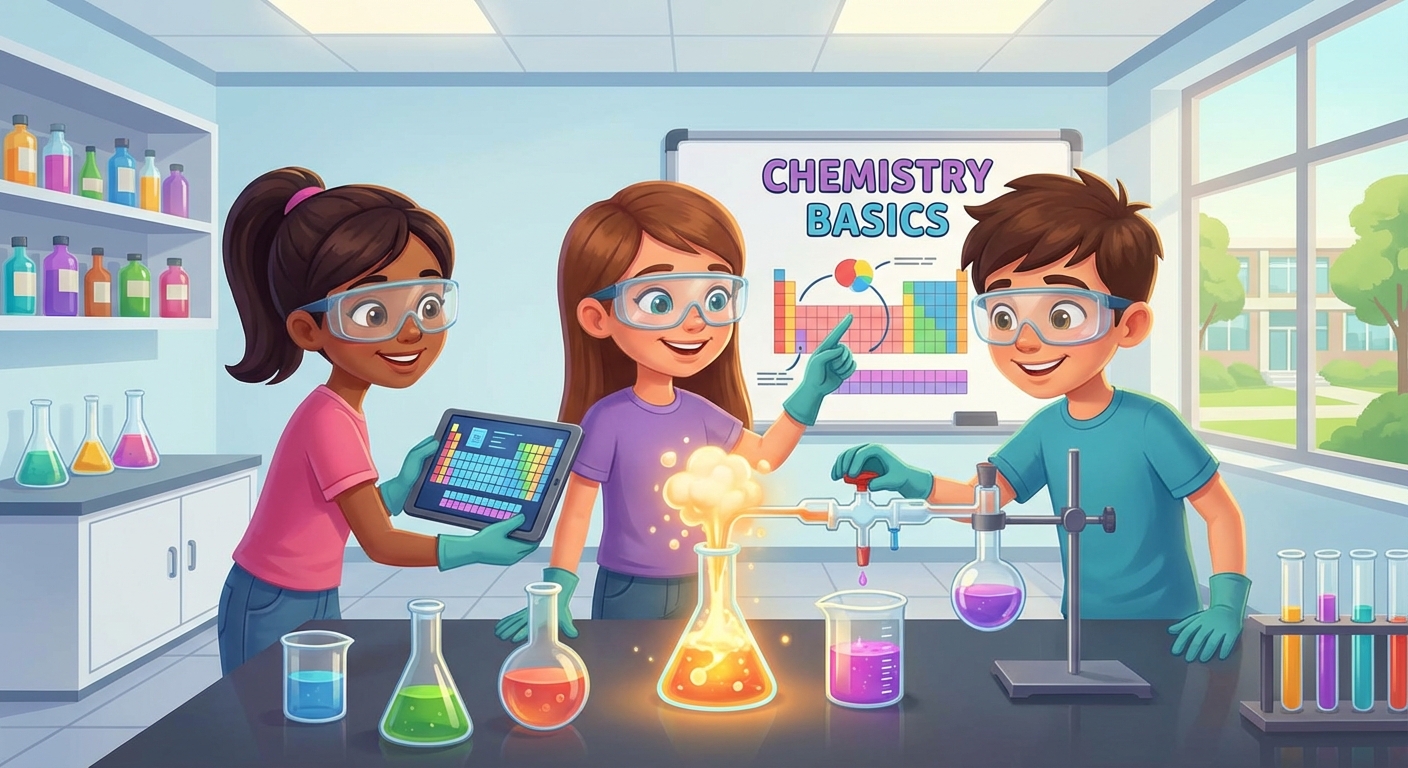
Chemistry Basics
What Is Chemistry?
Chemistry is the science that studies what everything around us is made of. Everything you see – water, air, chocolate, even the air in a balloon – is made of tiny building blocks called Atoms. Atoms join together to form Molecules, and the way they stick together decides what a material looks, smells, and behaves like.
Matter and Its Parts
Matter is anything that has mass and takes up space. It can be a solid (like a rock), a liquid (like juice), or a gas (like the air we breathe).
- Atoms – the smallest pieces that still keep the identity of an element.
- Elements – pure types of atoms. There are about 118 known elements, such as hydrogen, carbon, and iron.
- Molecules – groups of two or more atoms bonded together. Water (H₂O) is a molecule made of two hydrogen atoms and one oxygen atom.
When atoms combine, they form Chemical Bonds. The most common bonds are:
- Ionic Bonds – one atom gives away an electron, another atom takes it. This creates a strong attraction, like the bond between sodium and chlorine in table salt.
- Covalent Bonds – atoms share electrons. This is how the atoms in water share electrons to stay together.
Simple Chemical Reactions
A chemical reaction happens when the bonds between atoms break and new ones form. The substances you start with are called Reactants, and the new substances created are called Products.
Example: Baking Soda and Vinegar
- Reactants: Baking soda (sodium bicarbonate) and vinegar (acetic acid).
- What Happens: The acid and the base smash into each other, breaking old bonds and making new ones.
- Products: Carbon dioxide gas, water, and a little bit of sodium acetate.
You can see the reaction because the mixture fizzes – the carbon dioxide gas forms bubbles that rise to the surface.
Why Reactions Matter
- Energy Changes: Some reactions give off heat (exothermic) like a fire, while others absorb heat (endothermic) like melting ice.
- Everyday Uses: Cooking, cleaning, breathing, and even the way our bodies get energy all involve chemical reactions.
Keeping It Safe
Chemistry can be fun, but it’s important to stay safe:
- Always ask an adult before mixing chemicals.
- Wear goggles or gloves when handling unknown substances.
- Work in a well‑ventilated area and never taste anything you’re not sure about.
Understanding the basics of chemistry helps you see the hidden world of atoms and molecules that make up everything you touch, eat, and breathe. Keep exploring, ask questions, and you’ll discover how amazing science really is!