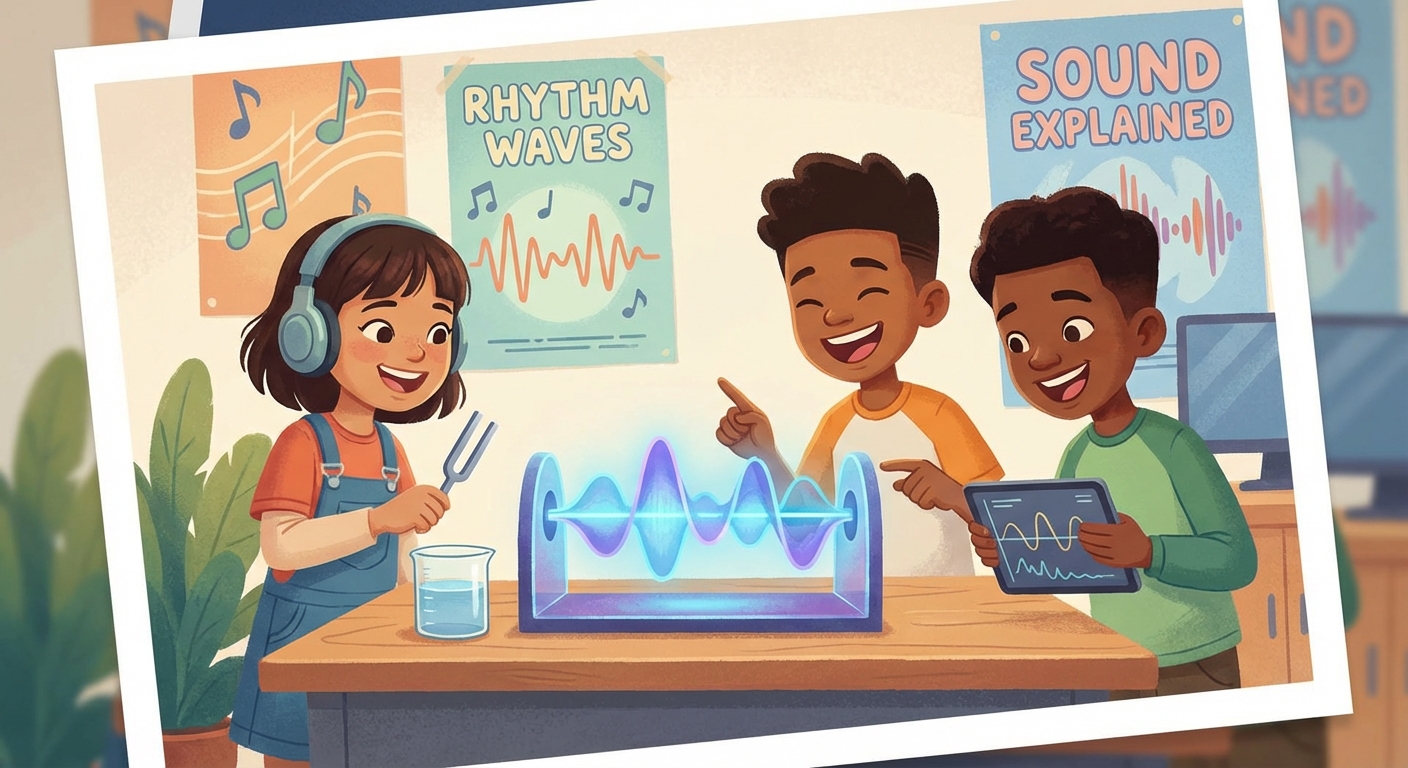
Riding the Rhythm: Waves and Sound Explained
Waves move energy without carrying the material itself.
Understanding waves helps us explain music, earthquakes, and modern technology.
1. What Is a Wave?
A wave is a repeating disturbance that travels through space or matter.
Imagine dropping a stone into water; concentric circles illustrate wave motion.
Waves have two main directions: the direction they travel and the direction they vibrate.
When the vibration is up‑and‑down, the wave is called Transverse.
When the vibration moves forward, the wave is Longitudinal.
Both types appear in nature, from light beams to sound pulses.
2. How Sound Travels
Sound is a longitudinal wave that compresses and rarefies air molecules.
When a guitar string vibrates, it pushes nearby air, creating pressure changes.
These pressure changes travel outward until they reach our ears.
Our eardrum vibrates in response, turning the wave into electrical signals.
The brain interprets these signals as pitch, loudness, and timbre.
Because air density influences speed, sound travels faster in water than in air.
3. Wave Properties and Everyday Tech
Frequency measures how many cycles occur each second, expressed in hertz (Hz).
Higher frequency produces higher pitch; lower frequency produces deeper sounds.
Amplitude describes the wave’s height and determines loudness.
Scientists use these properties to design musical instruments, speakers, and microphones.
In medical imaging, high‑frequency ultrasound waves create detailed pictures of internal organs.
Engineers also use low‑frequency waves to monitor ocean floor earthquakes.
4. Waves in the Modern World
Renewable energy farms harvest wind‑generated waves to generate electricity.
Scientists study atmospheric waves to improve climate‑change predictions.
Recent research uses Acoustic Levitation to move tiny objects without touching them.
During the 2024 Mars rover mission, engineers employed sound‑based sensors to detect rock composition.
Mini Quiz & Quick Experiment
Quiz:
- What distinguishes transverse from longitudinal waves?
- Why does sound travel faster in water than in air?
- How does frequency affect the pitch we hear?
Experiment:
- Stretch a rubber band and pluck it while holding a ruler nearby.
- Observe the standing wave pattern forming on the ruler.
- Change the tension to see how frequency and pitch shift.
- Record your observations and explain the relationship between tension and frequency.
Waves connect music, medicine, and planetary science in surprising ways.
Keep asking “what if” questions, and you’ll discover new wave applications.
Explore, experiment, and let curiosity guide your scientific journey!