Moon Phases and Tides
How the Moon Looks from Earth
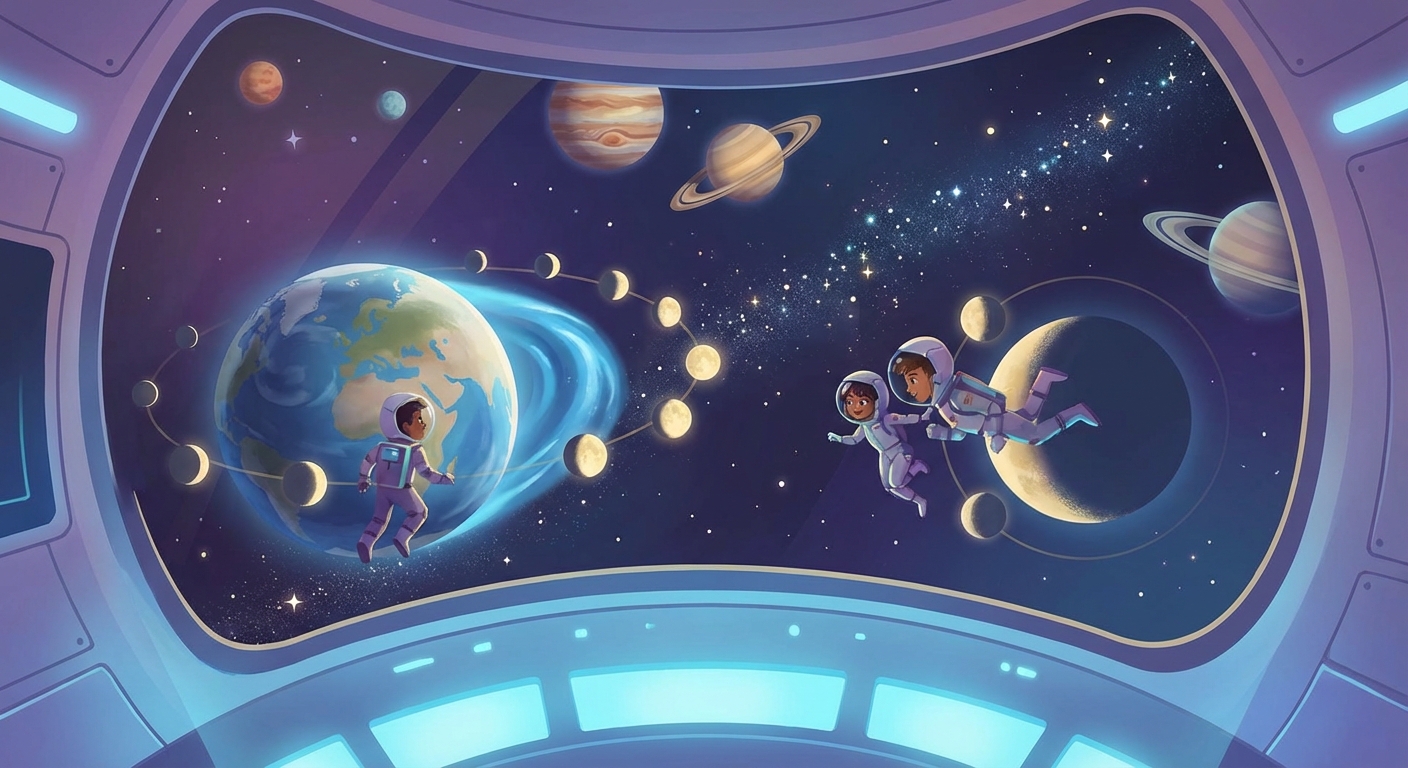
The Moon does not shine on its own. Sunlight reflects off its surface. As the Moon travels around Earth, we see different amounts of the bright side. This creates the familiar phases.
- New Moon – the Moon is between Earth and the Sun; we see no illuminated part.
- Waxing Crescent – a thin slice of light appears on the right side.
- First Quarter – half of the Moon is lit; the right half shines.
- Waxing Gibbous – most of the Moon is bright, but not yet full.
- Full Moon – Earth is between the Sun and the Moon; the whole face glows.
- Waning Gibbous – the light starts to shrink from the left side.
- Last Quarter – the left half is illuminated.
- Waning Crescent – only a thin crescent remains before the cycle starts again.
Each phase lasts about three to four days, and the whole cycle repeats every 29.5 days.
Why the Phases Change
The Moon orbits Earth in the same direction that Earth rotates. As it moves, the angle between the Sun, Moon, and Earth changes. That angle determines how much of the Sun‑lit side we can see. The cycle is regular because the Moon’s orbit is stable. No other planets interfere with the view from our planet.
Moon’s Pull on the Oceans
The Moon’s gravity reaches far enough to tug on Earth’s water. When the Moon is overhead, its pull lifts the water, creating a high tide. On the opposite side of Earth, another high tide forms because the planet itself is pulled slightly away from the water.
- Two High Tides and Two Low Tides happen each day.
- When the Sun, Moon, and Earth line up (during new and full moons), the tides are especially strong. These are called Spring Tides.
- When the Moon is at a right angle to the Sun (first and last quarters), the tides are weaker. These are Neap Tides.
Why Tides Matter
Tides affect coastal life. Many animals time feeding or breeding with the rise and fall of water. Humans use tides for navigation, fishing, and even generating electricity in some places. Understanding the Moon’s phases helps us predict when tides will be high or low.
By watching the sky and feeling the sea, we can see how the Moon’s steady dance shapes life on Earth.