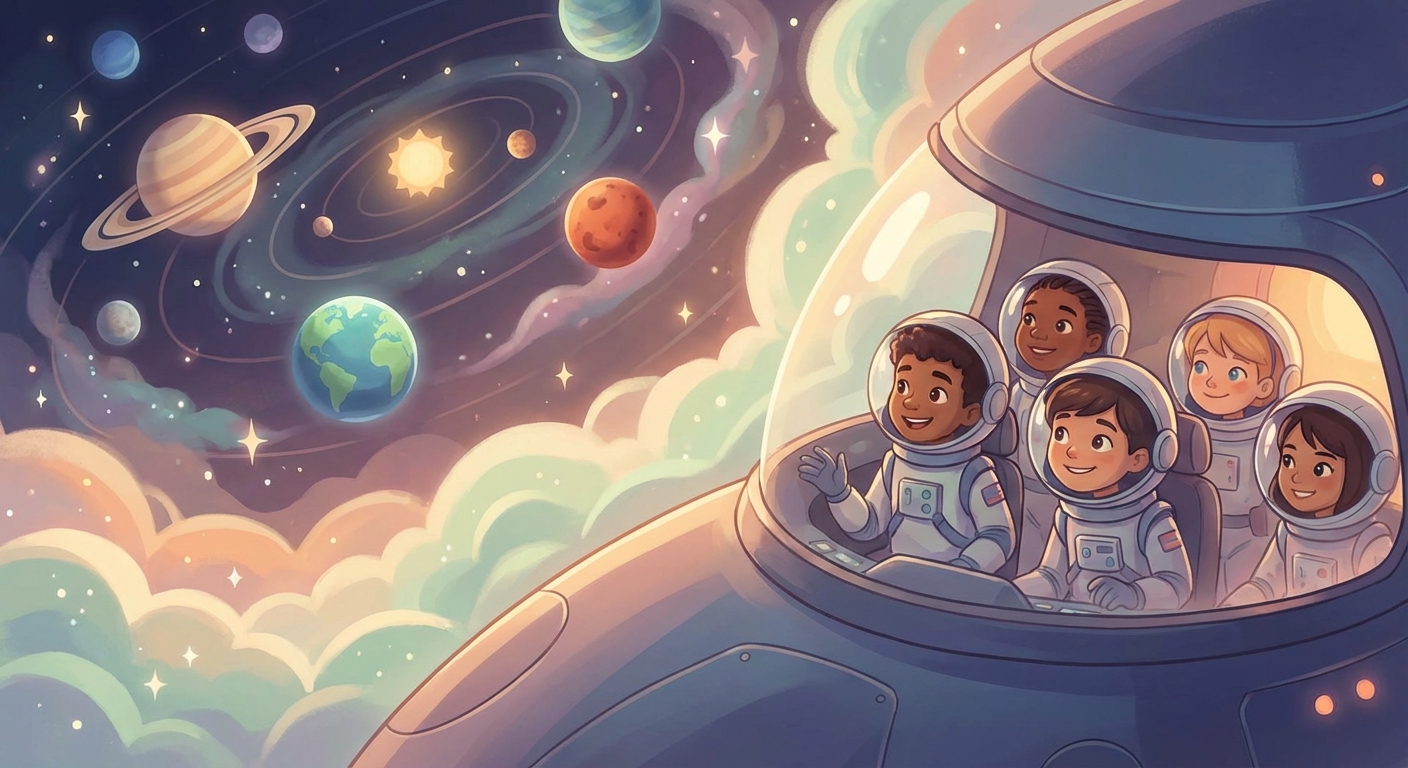
Journey Through Our Solar System 🌌
Our solar system contains eight unique planets that orbit the Sun.
Each world differs in size, composition, and temperature, shaping its own story.
Understanding these planets helps us grasp Earth’s place in the cosmos.
1. The Planetary Line‑up
From closest to farthest, the planets are Mercury, Venus, Earth, Mars, Jupiter, Saturn, Uranus, and Neptune.
Mercury’s surface resembles a scorched metal pan, while Venus hides thick, acidic clouds.
Earth supports life because of its stable climate and protective magnetic field.
Mars, the “Red Planet,” shows evidence of ancient rivers and possible underground water.
Jupiter, the largest planet, boasts a storm larger than Earth called the Great Red Spot.
Saturn’s iconic rings consist of ice particles ranging from dust‑size to mountain‑size chunks.
Uranus rotates on its side, giving it extreme seasonal swings.
Neptune, the farthest giant, blows winds faster than sound across its deep blue atmosphere.
Critical thinking: If a planet’s distance from the Sun determines its temperature, why does Uranus stay colder than Neptune despite being closer?
2. Rocky Worlds Vs. Gas Giants
The inner four planets—Mercury, Venus, Earth, and Mars—are called terrestrial because they have solid surfaces.
Their cores are metal‑rich, surrounded by silicate mantles and thin atmospheres.
The outer four are gas giants (Jupiter, Saturn) or ice giants (Uranus, Neptune), composed mostly of hydrogen, helium, and volatile ices.
These massive envelopes create strong gravity, preventing solid surfaces from forming.
Real‑world application: Engineers use knowledge of planetary density to design spacecraft trajectories that conserve fuel.
3. Tools That Reveal Planetary Secrets
Space telescopes, such as the James Webb Space Telescope, capture infrared light to study distant atmospheres.
Orbiters like NASA’s Juno probe dive deep into Jupiter’s magnetic field, measuring pressure and composition.
Rovers on Mars, including Perseverance, analyze rocks for organic molecules that hint at past life.
Ground‑based observatories track exoplanet transits, comparing them to our solar system’s patterns.
Deeper science: Spectroscopy splits light into colors, allowing scientists to identify gases like methane or oxygen on other worlds.
4. Recent Discoveries and Their Impact
In 2023, the James Webb Telescope detected phosphine gas in Venus’s cloud layers, sparking debate about possible microbial life.
NASA’s Artemis program plans to return humans to the Moon, using it as a launchpad for Mars missions.
The Europa Clipper, set for launch in 2026, will explore Jupiter’s icy moon Europa for subsurface oceans.
These missions illustrate how planetary research drives technology, from advanced robotics to new materials.
Critical thinking: How might discovering life on another planet change our responsibilities toward Earth’s environment?
Mini Quiz & Hands‑on Experiment
Quiz (Choose One Answer):
- Which planet has the shortest day?
- A) Venus B) Jupiter C) Mercury D) Neptune
- What mainly composes Saturn’s rings?
- A) Rock B) Ice C) Dust D) Gas
**Experiment – Build.