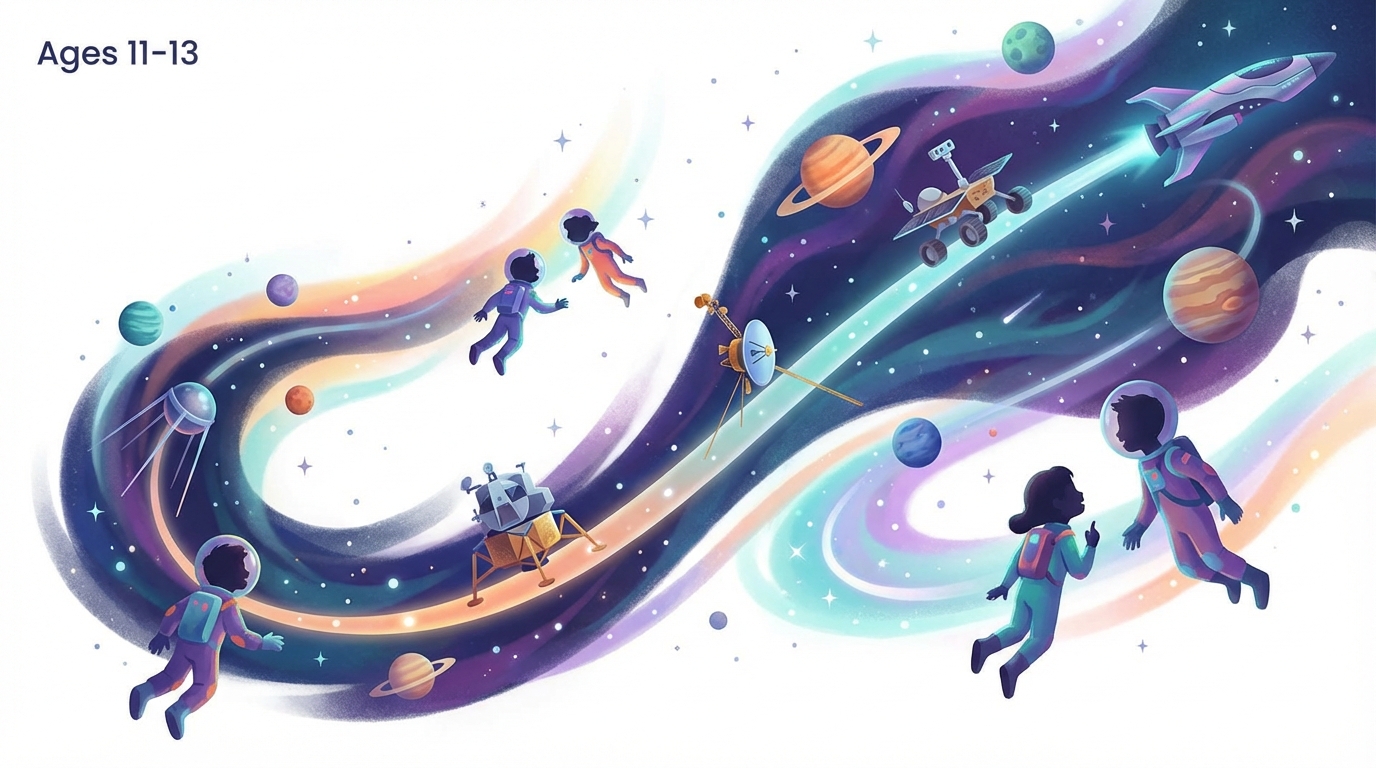
Space Missions Timeline
Early Pioneers (1950s‑1960s)
The first artificial satellite, Sputnik 1, launched in 1957 from the Soviet Union. It was only a metal sphere with a radio beep, but it proved that humans could send objects into orbit. The United States responded with Explorer 1 in 1958, which discovered the Van Allen radiation belts around Earth.
In 1961, Soviet cosmonaut Yuri Gagarin became the first person to travel into space, orbiting Earth once in a Vostok spacecraft. A year later, American astronaut Alan Shepard made a short sub‑orbital flight, and John Glenn became the first American to orbit the planet in 1962. These early missions sparked a global interest in space travel.
The Moon Race (1960s‑1972)
President John F. Kennedy announced in 1961 that the United States would land a person on the Moon before the decade ended. NASA’s Apollo Program turned that promise into reality.
- Apollo 8 (1968) was the first crewed mission to orbit the Moon.
- Apollo 11 (July 1969) saw Neil Armstrong and Buzz Aldrin walk on the lunar surface, while Michael Collins stayed in orbit.
- Six more Apollo missions followed, each bringing new scientific data and lunar samples back to Earth.
The final Moon landing, Apollo 17, occurred in December 1972, ending the era of crewed lunar exploration.
Space Shuttle Era (1981‑2011)
The Space Shuttle was the first reusable spacecraft. Its first flight, Columbia, lifted off in 1981. The shuttle fleet could carry astronauts, satellites, and even parts of the International Space Station (ISS).
Key achievements include:
- Launching the Hubble Space Telescope in 1990, giving us clearer views of the universe.
- Building the ISS piece by piece from 1998 onward, creating a permanent home for scientists from many countries.
The shuttle program ended in 2011 after 135 missions, paving the way for new commercial spacecraft.
Modern Exploration (2010s‑present)
Today, both governments and private companies send missions beyond low Earth orbit.
- NASA’s Orion capsule supports the Artemis program. NASA currently plans an Artemis III demonstration in low Earth orbit in 2027 and targets a crewed lunar landing in 2028 on a later mission.
- SpaceX regularly reuses Falcon 9 first stages, while Starship is being developed and tested for extensive reuse.
- Probes like Voyager 1 and Voyager 2, launched in 1977, are now traveling beyond the solar system, sending back data about interstellar space.
These missions show that space exploration is an ongoing adventure, inspiring the next generation to look up and imagine what comes next.