Stars and Constellations
What Are Stars?
Stars are gigantic balls of hot gas. Inside them, nuclear reactions fuse hydrogen into helium, releasing huge amounts of energy that we see as light. Our Sun is a star, the closest one to Earth.
A star’s colour tells us its temperature: blue stars are the hottest, red stars are cooler. Stars come in many sizes. Some are similar to the Sun, while others are many times larger or smaller. Over millions of years a star is born, lives, and eventually dies, often in spectacular ways such as supernova explosions.
What Is a Constellation?
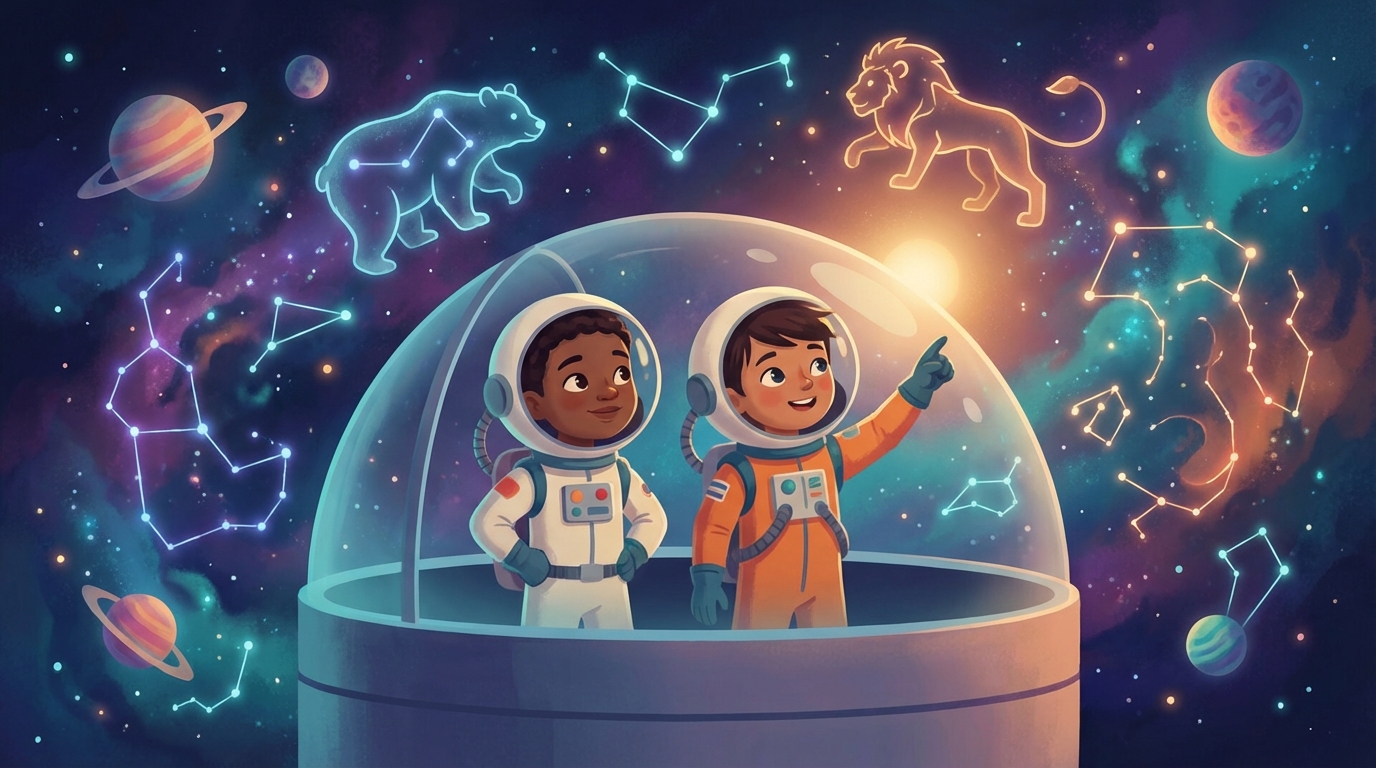
A constellation is a pattern that people have drawn by connecting bright stars in the night sky. The stars in a pattern are usually far apart in space; they only appear close because we view them from Earth. Different cultures imagined different pictures—animals, heroes, tools—based on their stories and surroundings.
The International Astronomical Union (IAU) has officially defined 88 constellations, covering the entire sky. These constellations give us a common map for talking about the heavens.
How to Find Constellations
- Pick A Clear, Dark Night – away from city lights.
- Start With Easy Shapes – Orion’s belt (three bright stars in a line) and the Big Dipper (part of Ursa Major).
- Use “Star‑hopping.” Find a bright star, then move to the next one that matches the picture you’re looking for.
- Use A Simple Star Chart or a printed sky map. Hold it overhead and match the dots to the stars you see.
Remember that the night sky slowly shifts over centuries because Earth wobbles on its axis—a motion called precession. The shapes look the same to us now, but they will change very gradually over thousands of years.
Why We Study Stars and Constellations
- Science: The light from stars tells astronomers how far away they are, how old they are, and what they are made of.
- Navigation: Before GPS, sailors and travelers used constellations like the Big Dipper to find north and to keep track of the seasons.
- Culture: Myths and art across the world are inspired by the stories people told about the patterns they saw.
Looking up at the night sky connects us with the same stars that guided ancient explorers and that scientists study today. It reminds us that we share a universe that stretches far beyond our everyday world.