Quantum Physics Intro
What Is Quantum Physics?
Quantum physics is the part of science that studies the tiniest things in the universe – atoms, electrons, photons, and even smaller particles. While everyday objects follow the rules of classical physics (the physics of cars, planets, and basketballs), the world of the very small behaves in surprising ways. Particles can be in many places at once, they can act like waves, and they can affect each other instantly over long distances. These strange behaviours are what make quantum physics both fascinating and challenging.
Key Ideas to Know
1. Particles Are Also Waves
In the early 1900s, scientists discovered that light, which we usually think of as a wave, can also act like a particle called a photon. Later experiments showed that tiny particles such as electrons behave the same way – they can spread out like a wave and create interference patterns. This dual nature is called Wave‑particle Duality.
2. Superposition – Being in Many States at Once
A quantum particle can exist in a combination of different states at the same time. For example, an electron in an atom can be in a “spin‑up” and “spin‑down” state together. Only when we measure the particle does it “choose” one of the possibilities. This idea is often illustrated by the famous thought experiment called Schrödinger’s Cat, where a cat in a sealed box is simultaneously alive and dead until someone opens the box.
3. Entanglement – Instant Connection
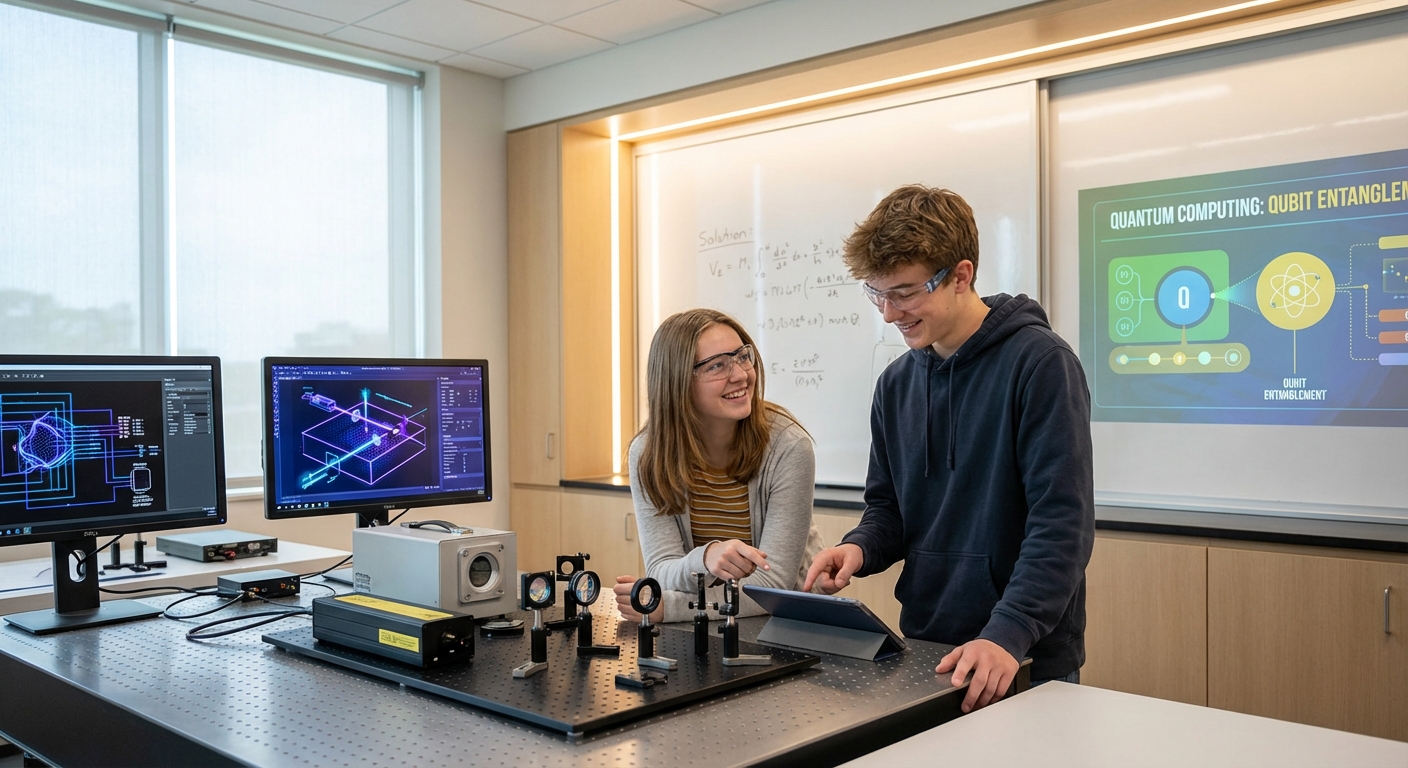
When two particles interact, they can become Entangled. Entangled particles share a link so strong that measuring one instantly tells you the state of the other, even if they are far apart. Albert Einstein called this “spooky action at a distance.” Entanglement is now a real resource used in emerging technologies.
Experiments That Changed the Game
The Double‑slit Experiment
When a beam of electrons passes through two narrow slits, it creates an interference pattern on a screen, just like water waves. But if we watch which slit each electron goes through, the pattern disappears and the electrons behave like tiny balls. This shows how observation can change the behavior of quantum particles.
Bell’s Inequality Tests
John Bell devised a way to test whether entanglement could be explained by hidden variables. Experiments in the 1970s and 1980s measured entangled photons and found results that matched quantum predictions, confirming that the universe truly allows non‑local connections.
Why Quantum Physics Matters
Quantum physics isn’t just a weird curiosity – it powers many modern technologies. Semiconductors in computers and smartphones rely on quantum principles. Lasers, MRI Machines, and Solar Cells also use quantum effects. Researchers are now building Quantum Computers, which could solve certain problems far faster than today’s computers by exploiting superposition and entanglement.
Understanding quantum physics also teaches us how to think carefully about measurement, uncertainty, and the limits of what we can know. It shows that the world is deeper and more surprising than everyday experience suggests.
Looking Ahead
The next decade promises exciting developments. Scientists aim to create larger, more stable quantum computers, develop ultra‑secure Quantum Communication, and explore quantum sensors that can detect tiny forces or fields. As you study physics, you might join the next generation of researchers who turn quantum mysteries into everyday tools.
Keep asking questions, experiment with ideas, and remember: the quantum world may be strange, but it’s also full of possibilities waiting to be discovered.