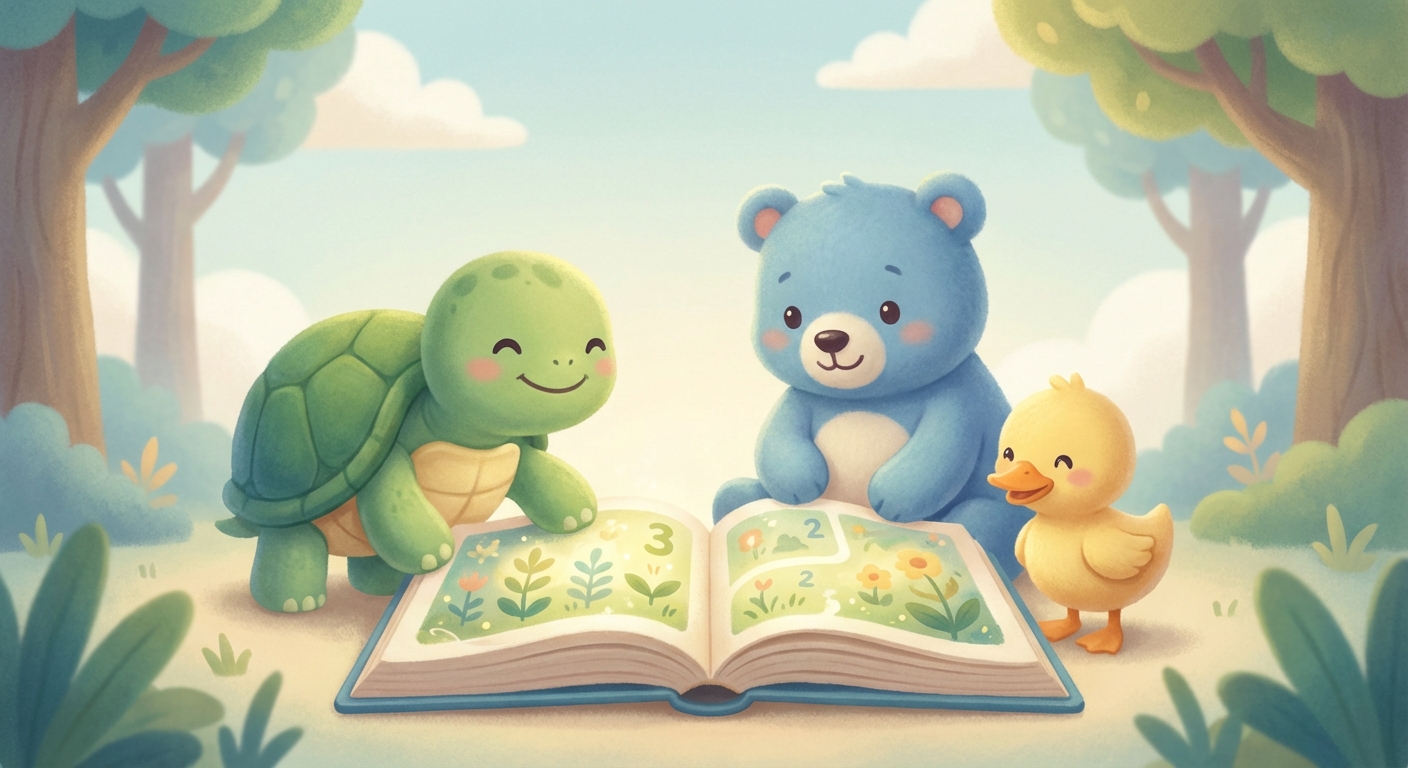
🐢 Turtle Tales
Hello, little friends! Today we meet a Turtle. A turtle has a round, hard shell and a friendly smile. Let’s learn about this cool animal together!
1. What a Turtle Looks Like
- A turtle has a Hard shell that can be brown, green, black, or other colors.
- It has Four Short Legs – One, Two, Three, Four – that it moves slowly.
- Its head pops out, then hides back in the shell. Pop! Pop!
2. How a Turtle Moves and Sounds
- On land the turtle walks Slow, Slow, Slow.
- In water it swims with a Flap‑flap of its front legs.
- It holds its breath underwater and comes to the surface for air.
- A calm turtle may rest quietly or move its head slowly.
3. Turtle Feelings
- A turtle can be Happy when it finds tasty lettuce.
- It can be Sleepy after a long swim.
- It can feel Curious when it sees a bright flower.
Simple Activity – Turtle Counting Game
- Gather Four small toy turtles or draw four circles.
- Count them out loud: “One Turtle, Two Turtles, Three Turtles, Four Turtles!”
- Move each turtle slowly across the floor, saying “Slow, Slow, Slow.”
Turtles are gentle, colorful, and fun to watch. Look for turtles in books, pictures, or at the park pond. Keep asking questions and discover more animal friends! 🌟
Continue the adventure
Download Surprise Button for iPad
A simple, safe way for kids to explore the internet. With one tap, they discover something new — a fun fact, a science experiment, a story, or a place in the world they never would've searched for.
Download on the App StoreYour child explores safely on Surprise Button App
How Volcanoes Form
From Magma to Mountain
Volcanoes grow where tectonic plates collide or drift apart. Heat melts rock into light, buoyant magma that rises, cools, and hardens near the surface, building the cone layer by layer.
Know exactly what to talk about tonight