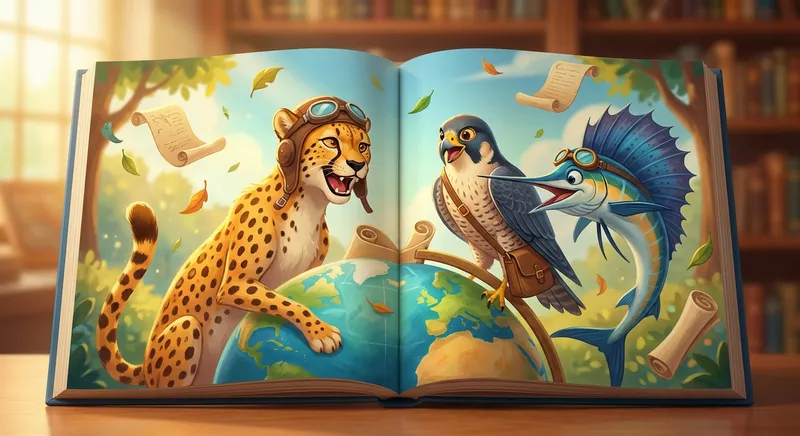
🐾 the Fastest Animals on Earth
Some animals can move faster than a car, a bike, or even a fast runner! Let’s discover four speedsters and learn why they are so quick.
1. Cheetah – The Land Sprinter
- Speed: Up to 70 miles per hour (about as fast as a city bus on the highway).
- How They Run: Long, strong legs and a flexible spine let the cheetah stretch its body with each stride.
- Fun Comparison: A cheetah can go from a standing start to the speed of a school bus in just a few seconds!
2. Peregrine Falcon – The Sky Racer
- Speed: Over 200 miles per hour when it dives (called a “stoop”).
- How It Flies: Sharp wings and a sleek body cut through the air like a paper airplane.
- Fun Comparison: It’s faster than a race car on a track when it swoops down to catch its dinner.
3. Sailfish – The Ocean Flash
- Speed: About 68 miles per hour in the water.
- How It Swims: A long, pointed bill and a big, sail‑like fin help it slice through the sea.
- Fun Comparison: Imagine a fish that can zoom past a speedboat!
4. Rabbit – The Quick Hopper
- Speed: Up to 35 miles per hour on the ground.
- How It Hops: Strong back legs and a fluffy tail for balance.
- Fun Comparison: A rabbit can outrun a child running a sprint!
Did You Know?
A cheetah’s spots are like fingerprints—no two cheetahs have the same pattern!
Animals show us many ways to be fast: running, flying, swimming, and hopping. Next time you’re outside, imagine you’re a cheetah racing across the savanna or a falcon soaring through the clouds. Keep exploring, ask questions, and maybe you’ll discover a new speed champion! 🚀