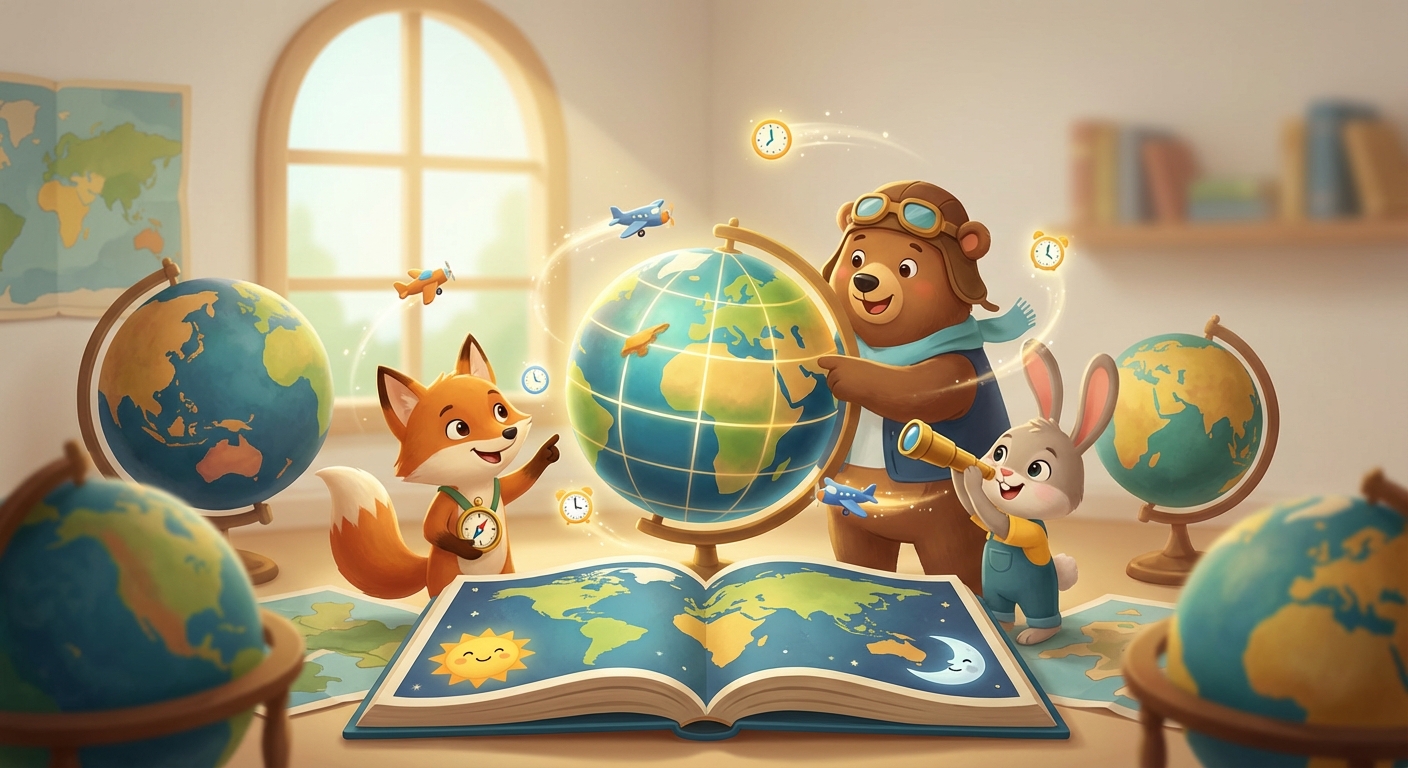
🌍 What Is a Time Zone?
Every place on Earth has its own clock. A Time Zone is a big slice of the world that all tells the same time. It helps people know when to eat, play, and sleep, even if they are far apart.
1. Why We Need Different Times
The Sun moves across the sky. When it is bright in one part of the world, it may be dark somewhere else. To match the Sun’s light, the Earth is split into 24 time zones—one for each hour the Earth turns.
2. How a Time Zone Works
Imagine the Earth as a round orange. Draw a line from the top to the bottom; that line is the Prime Meridian (0°). Starting there, each zone moves 15 degrees east or west. If you move one zone east, you add one hour; move west, you subtract one hour.
3. Traveling Across Time Zones
If you fly from New York to Los Angeles, you cross three time zones. That’s why you might feel sleepy on the plane—your body’s clock is still set to the time you left!
4. Fun Comparison
Think of time zones like a giant “clock cake.” Each slice is a different flavor (time). When one slice gets a cherry (noon), the next slice is still waiting for its cherry (11 am).
Did You Know? 🤔
The International Date Line, a line in the Pacific Ocean, is where the calendar day changes. If you cross it from east to west, you Skip A Day!
Time zones are the Earth’s way of sharing the Sun’s light with everyone. Next time you look at a world map, imagine the moving clock hands and think about where the Sun is shining. Grab a globe, point to a country, and guess what time it might be there—then check! 🌟