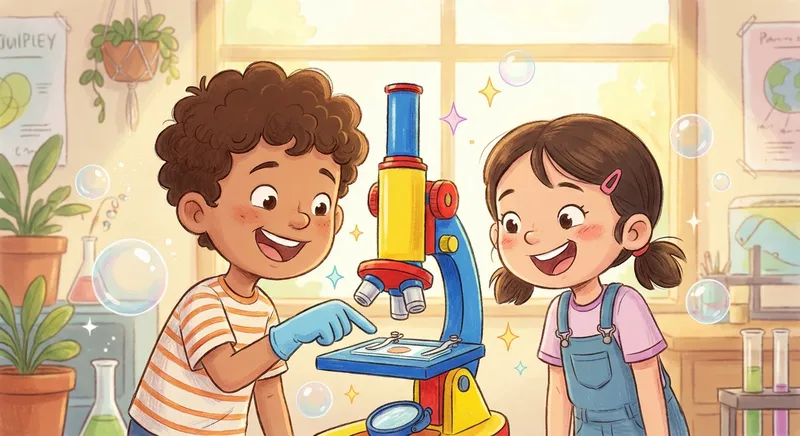
🔬 Microscope Fun!
Have you ever wondered what tiny things look like up close? A microscope lets us see things that are so small we can’t see them with our eyes alone. Let’s explore the tiny world together!
1. What Is a Microscope?
A microscope is a special tool that makes tiny objects look big. Think of it like a magic window that shows you a secret world of tiny shapes and colors.
2. What Can We See?
- A Leaf’s Tiny Cells – they look like little boxes.
- A Drop Of Pond Water – you might see tiny swimmers called protozoa.
- A Strand Of Hair – it looks like a thick rope when it’s magnified!
It’s like looking at a LEGO set from far away, then zooming in to see each tiny brick.
3. How Does It Work?
- Light Shines on the object.
- Lenses (glass pieces) bend the light, making the picture bigger.
- You look through the Eyepiece (the little hole) and see the magnified image.
Imagine holding a magnifying glass over a picture and the picture gets bigger—that’s what the lenses do, but even stronger!
4. Make Your Own Magic (simple Diy)
You can make a tiny microscope at home:
- Take a clear plastic bottle, cut off the bottom, and place a tiny drop of water on a slide (a thin clear piece of plastic).
- Look through a small magnifying glass held over the slide.
- See the tiny world you’ve created!
Did You Know? 🤔
A single human hair is about 100,000 times thinner than a piece of rope. With a microscope, that hair looks as big as a thick tree branch!