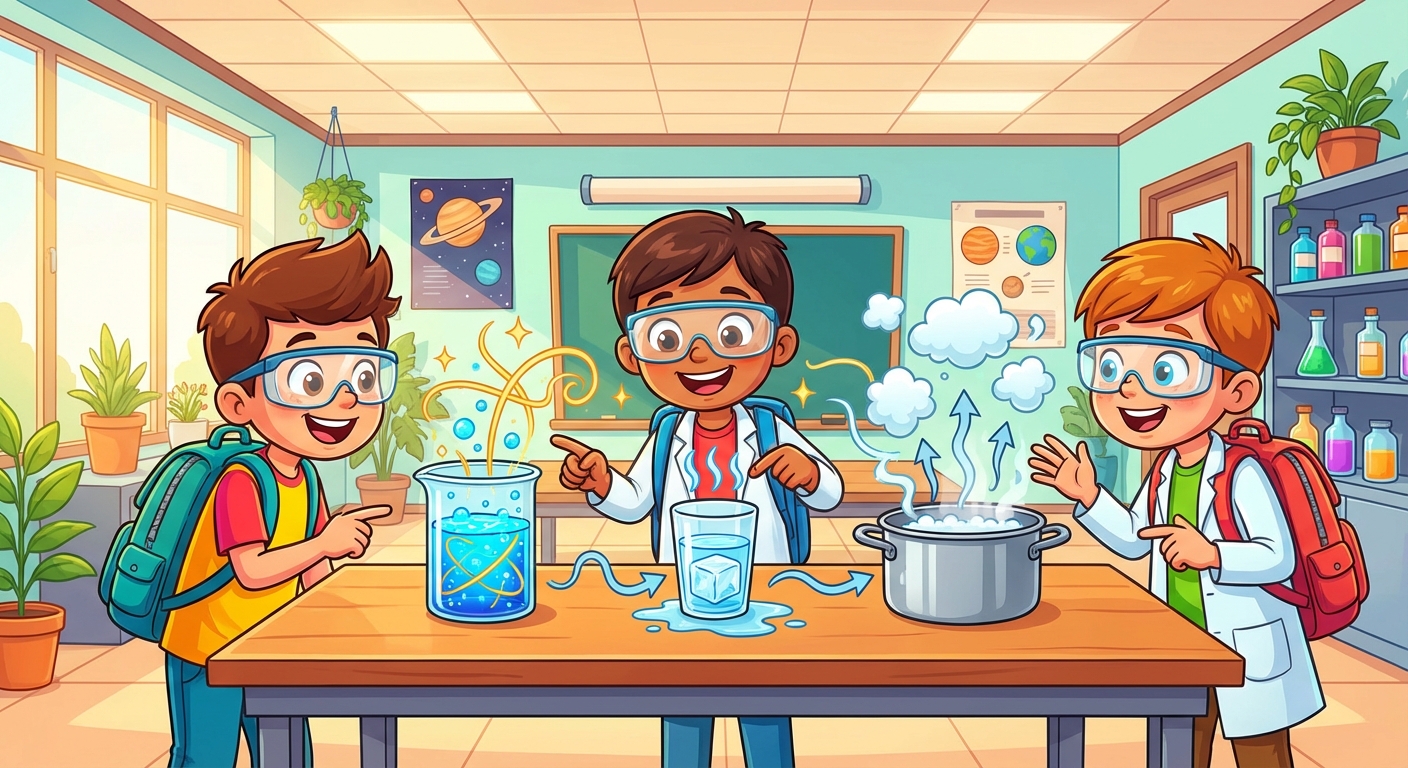
🌟 Solids, Liquids, and Gases
Everything around us is made of tiny pieces called Matter. Matter can be Solid, Liquid, or Gas. Let’s explore how they feel, move, and change!
1. Solid – The Sturdy Shape
- Solids keep their shape. A rock, a toy block, or an ice cube stays the same size unless you break it.
- The tiny pieces inside a solid are packed close together, like a crowded classroom.
- How It Works: Because the pieces are so close, they can’t slide past each other, so the solid stays firm.
2. Liquid – The Flowing Friend
- Liquids take the shape of the container they’re in, like water in a cup or juice in a bottle.
- The pieces are still close, but they can slide around each other. That’s why liquids can Flow.
- How It Works: When you tilt a glass, the pieces move and the liquid spills out.
3. Gas – The Invisible Explorer
- Gases spread out to fill any space, like the air we breathe or steam from hot cocoa.
- The pieces are far apart and move fast in every direction.
- How It Works: Because they have lots of room, gases can squeeze through tiny holes (think of a balloon inflating).
4. Changing Between States
- Melting: Ice (solid) warms up and becomes water (liquid).
- Evaporation: Water (liquid) heats up and turns into steam (gas).
- Freezing: Steam cools down and becomes ice again!
Did You Know? 🤔
A single snowflake is a tiny solid made of ice, but when it lands on warm skin it can melt into a droplet of water in just a few seconds!
Now you’re a matter detective! Look around your home—find solids, liquids, and gases. Try melting an ice cube or watching steam rise from a cup of hot chocolate. Keep asking “why?” and discover matter! 🌈