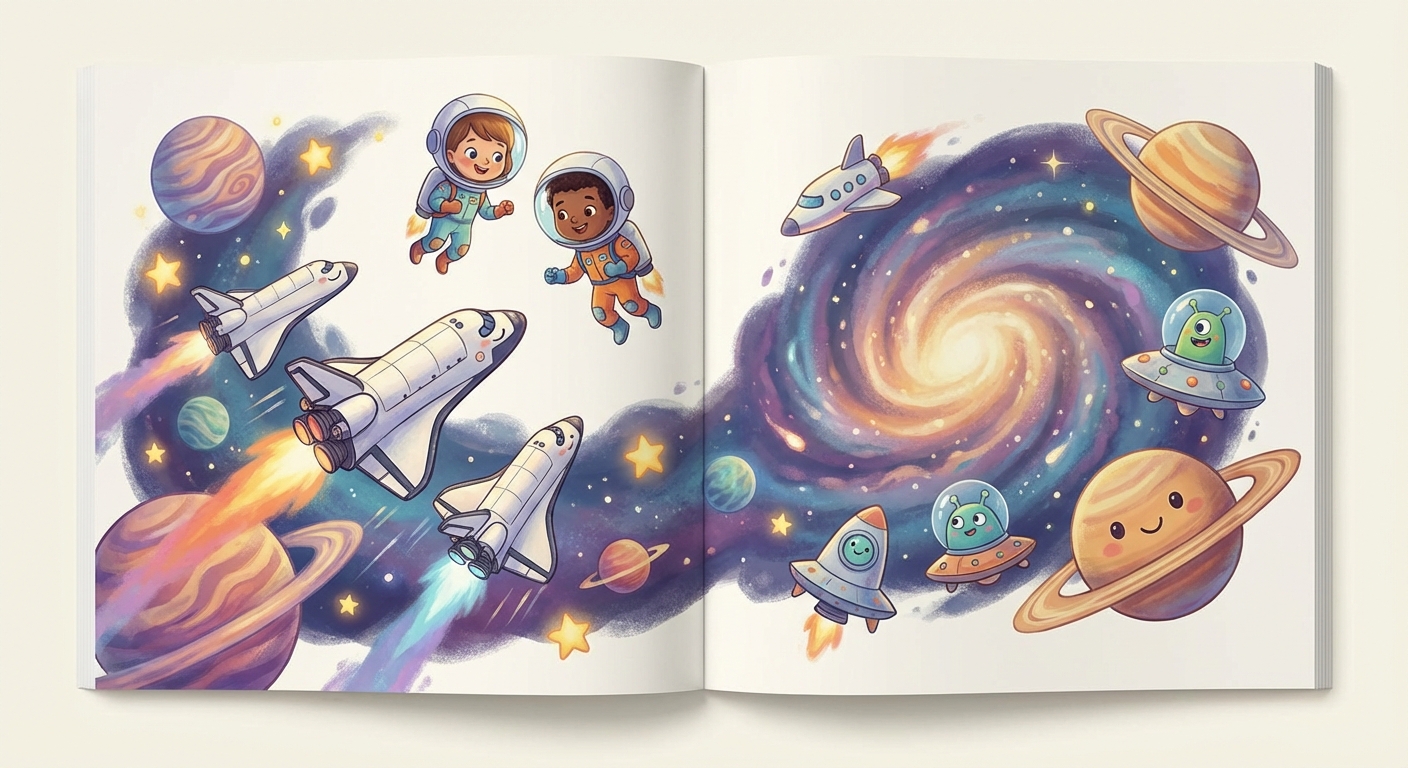
🚀 Zooming Up: Space Shuttles
NASA’s space shuttles were reusable spacecraft that carried people and equipment into orbit from 1981 to 2011. They helped scientists study space and our planet Earth.
1. What a Space Shuttle Looks Like
- A shuttle system had a winged orbiter for the crew, a large orange fuel tank, and two solid rocket boosters.
- Before launch, the parts stood together on a launch pad.
2. How It Gets into Space
- The shuttle’s engines and boosters burned fuel to push it up, up, up.
- Hot gas rushed downward, pushing the shuttle upward.
- After about eight and a half minutes, the orbiter reached space and continued around Earth.
3. What It Does in Space
- It carried astronauts and supplies.
- It launched and repaired satellites, including the Hubble Space Telescope.
- It carried science experiments and helped build the International Space Station.
4. Coming Back Home
- The orbiter turned back toward Earth and slowed down in the atmosphere.
- Its wings helped it glide to a runway. It had no engines to power another landing attempt.
Did You Know? 🤔
The winged orbiter was reused for many flights. NASA flew 135 space shuttle missions before retiring the program in 2011.
Space shuttles show how people learned to explore the unknown. When you look at the night sky, remember the shuttles that once orbited Earth and the spacecraft that explore today. 🌟