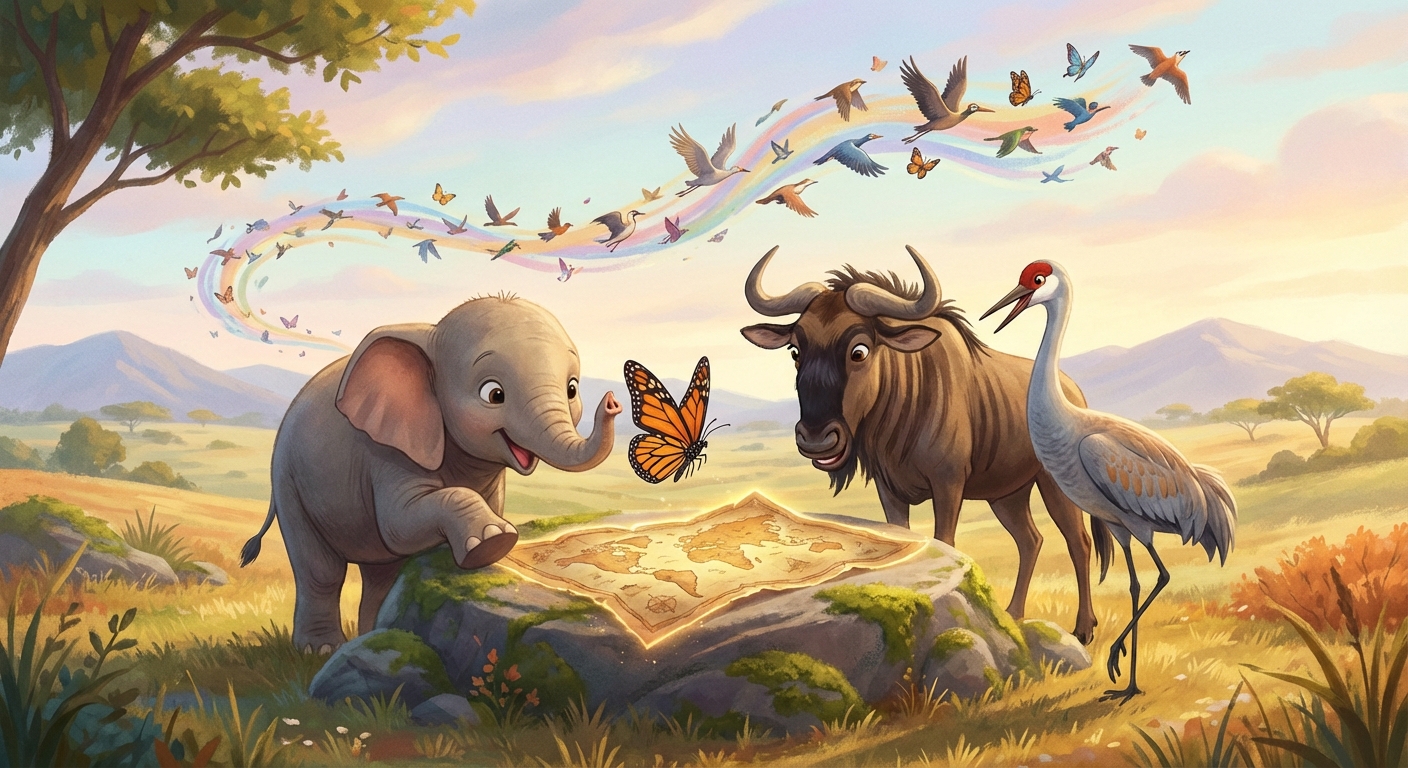
Amazing Animal Migration
Every year, many animals travel long distances.
They move to find food, safe homes, or babies.
Why Animals Migrate
Animals migrate to survive harsh seasons and find fresh food.
When winter freezes, insects disappear, so birds fly south.
Mammals such as caribou follow fresh grass in summer.
Fun Fact: Some butterflies travel 3,000 miles from Canada to Mexico!
Great Travelers
The Arctic tern holds the longest migration record.
It flies from the Arctic to Antarctica and back each year.
That journey covers about 50,000 miles—twice around Earth.
Deeper Explanation: Terns use the sun’s position and Earth’s magnetic field to navigate.
How They Find Their Way
Animals use several tools: the sun, stars, and magnetic cues.
Sea turtles hatch on beaches, then head straight toward the ocean.
They sense the Earth’s magnetic field like a built‑in compass.
Fun Fact: Monarch butterflies rest on trees, then follow the sun’s path across continents.
Human Impacts on Migration
Roads, cities, and climate change can block migration routes.
When habitats shrink, animals may lose safe resting spots.
Scientists study migration to protect corridors and keep species healthy.
Mini Quiz & Simple Experiment
Quiz
- Which bird travels farther each year, the Arctic tern or the swallow?
- What do sea turtles use to find the ocean after hatching?
- Name one reason why animals migrate.
Experiment – “Paper Compass”
Materials: a magnet, a small piece of paper, a pin, a bowl of water.
- Draw a tiny arrow on the paper.
- Stick the pin through the arrow’s center.
- Place the magnet near the pin, then float the paper on water.
- Observe how the arrow points north, just like migrating birds.
Animal migration shows nature’s incredible teamwork and navigation skills.
Grab a notebook, watch local birds, and note their movements.