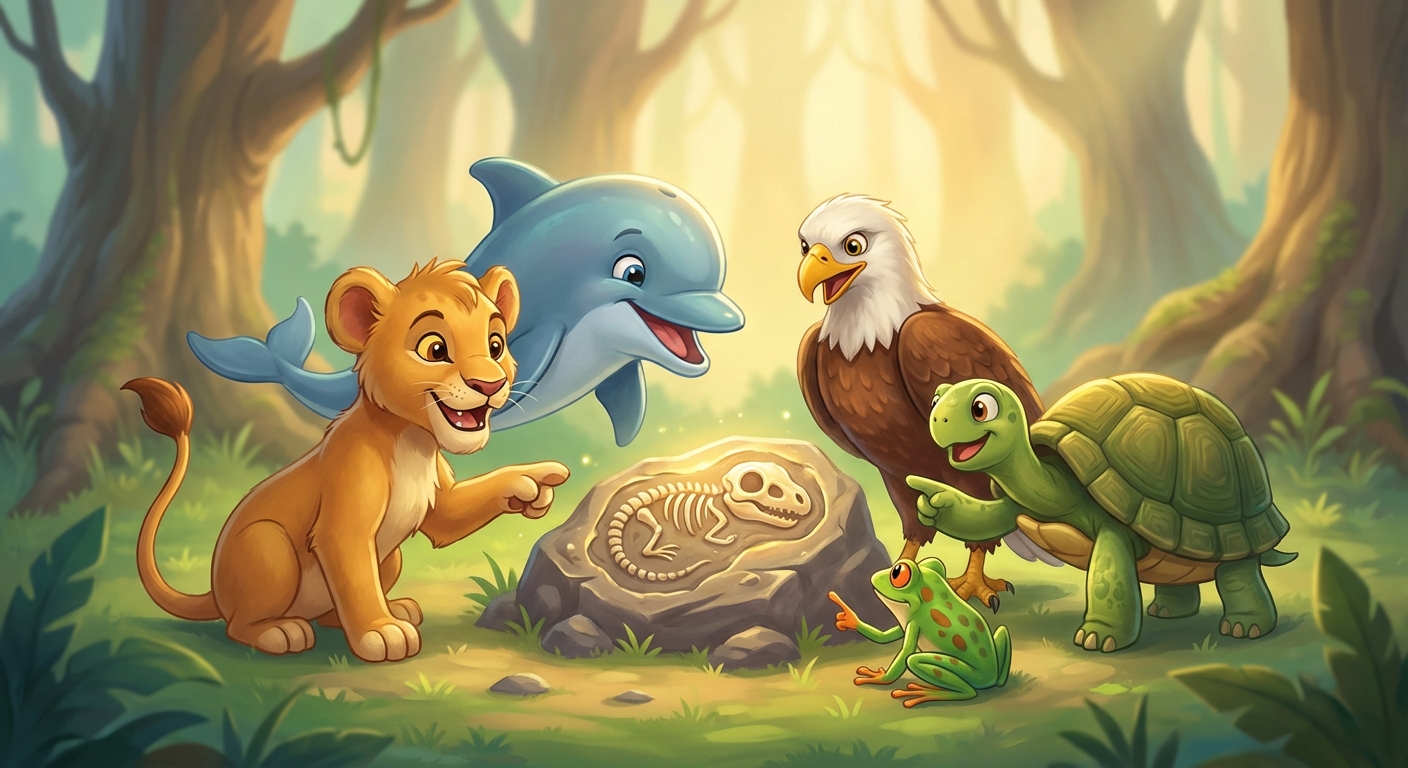
Meet the Vertebrates: Animals with a Backbone!
Have you ever wondered why some animals can stand up straight, while others slither on the ground? The secret is a Backbone (also called a Spine). Animals that have a backbone are called Vertebrates. In this adventure we’ll explore what makes vertebrates special, meet some famous members, and even try a tiny experiment you can do at home!
1. What Is a Backbone?
A backbone is a column of Bones called Vertebrae that runs from the head to the tail. It protects the Spinal Cord, a bundle of nerves that sends messages between the brain and the rest of the body.
- Vertebrae – the individual “building blocks” of the spine.
- Spinal Cord – the highway for signals that tell your muscles to move.
Cause And Effect: If a vertebrate’s backbone is damaged, the spinal cord can’t send messages properly, so the animal might lose the ability to move certain body parts.
Did You Know? The blue whale is the longest animal alive today. Its body can be more than 30 meters (100 feet) long, with a backbone extending through much of that length.
2. Five Familiar Groups of Vertebrates
| Group | Example | Cool Fact |
|---|---|---|
| Fish | Goldfish, shark | Most fish breathe with gills that take dissolved oxygen from water. |
| Amphibians | Frog, salamander | Many change body form as they grow, but their life cycles vary. |
| Reptiles | Lizard, turtle | Reptile skin has scales, and most species lay eggs on land. |
| Birds | Eagle, sparrow | Birds have feathers. Many bird bones contain air spaces, while the bone tissue and skeleton remain strong. |
| Mammals | Elephant, human | Mammals have hair and produce milk for their young. |
Body features evolve across many generations as populations reproduce in particular environments. Flight depends on a combination of feathers, wings, muscles, lungs, and a strong skeleton—not simply “hollow bones.”
3. Vocabulary Boost
| Word | Meaning (Kid‑Friendly) |
|---|---|
| Skeleton | The whole set of bones inside an animal. |
| Adaptation | A special feature that helps an animal survive. |
| Predator | An animal that hunts and eats other animals. |
| Habitat | The place where an animal lives (like a forest or pond). |
| Endangered | A species that is at risk of disappearing forever. |
Try using these words in a sentence today! Example: “The turtle’s hard shell is an adaptation that protects it from predators.”
4. Mini Experiment: Build a Simple Spine
What You Need
- 6–8 plastic drinking straws (different colors are fun)
- Scissors, used with adult supervision
- Tape or a rubber band
Steps
- Ask an adult to cut each straw into three equal pieces.
- Stack the pieces on top of each other, aligning them like a tiny column.
- Tape or wrap a rubber band around the whole stack – this is your Vertebral Column.
- Gently bend the “spine.” Notice how it can flex but still holds together, just like a real backbone protects the spinal cord while allowing movement.
What You Learned: The backbone gives both Support (so the animal stays upright) and Flexibility (so it can swim, crawl, or fly).
Quick Quiz (or Play!)
- True Or False: All vertebrates have hair.
- Which group of vertebrates can live both in water and on land as they grow?
- Name one reason why a bird’s bones are different from a turtle’s bones.
Answers:
1️⃣ False – hair and fur are mammal traits. Birds have feathers.
2️⃣ Which Group Of Vertebrates Can Live Both In Water And On Land As They Grow?
a) Fish
b) Amphibians ✓
c) Reptiles
d) Birds
3️⃣ Name one reason why a bird’s skeleton is different from a turtle’s skeleton.
Possible answer: A flying bird’s skeleton has features such as fused bones and air spaces that help make a strong frame for flight.
Now you’re a vertebrate expert—keep exploring the amazing animal kingdom!