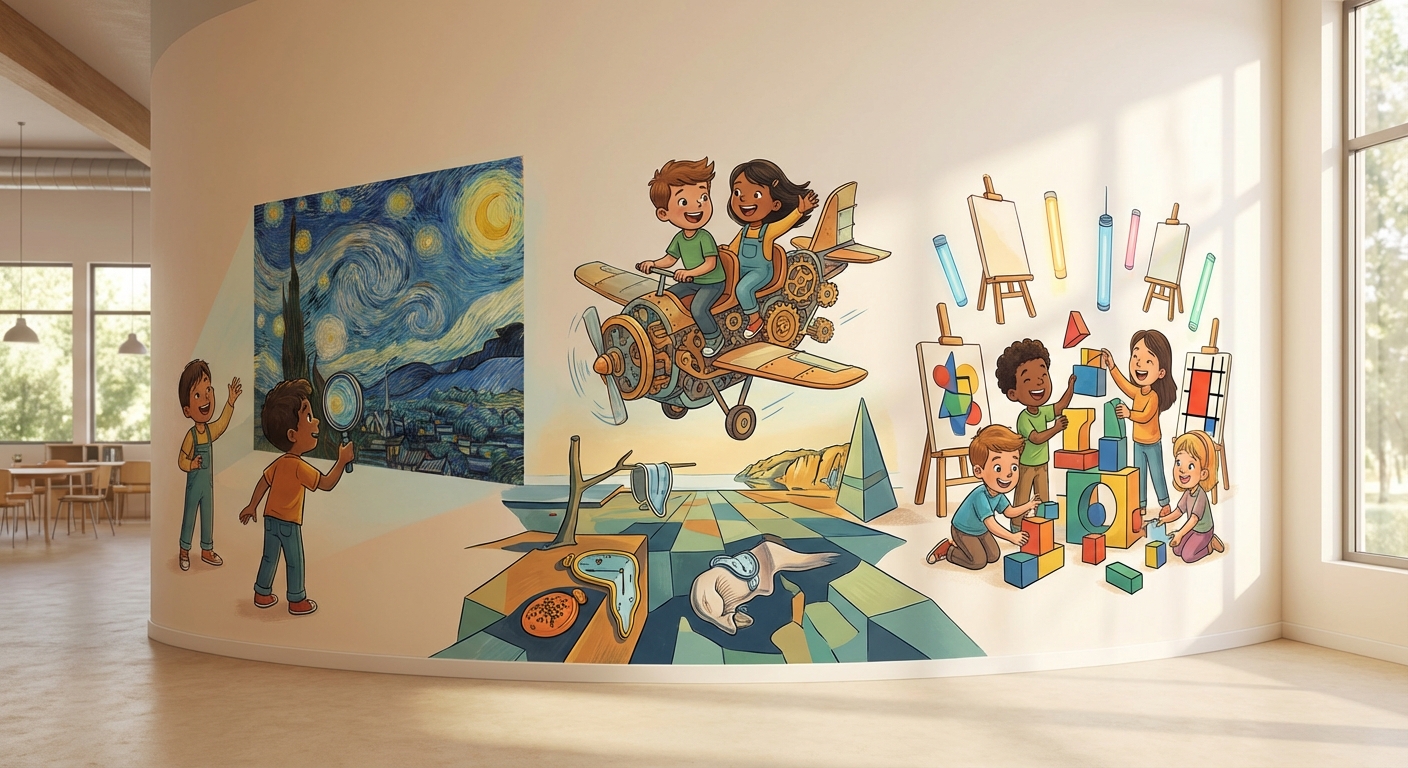
Famous Artists Who Changed the Way We See the World
Art isn’t just pretty pictures on a wall—it’s a time‑traveling story that tells us how people felt, thought, and imagined long ago. By meeting a few famous artists, you’ll discover new words, learn how ideas can Cause big changes, and even try a tiny experiment of your own!
1. Leonardo Da Vinci – The Master of Curiosity
Leonardo (1452‑1519) was an Italian painter, scientist, and inventor. He loved to ask “Why?” and then Experiment to find answers.
- Famous Work: Mona Lisa – a portrait with a mysterious smile.
- Cause & Effect: Leonardo studied how light and shadow work on the human face (cause). This led him to create Sfumato, a technique where colors blend so softly you can’t see hard edges (effect).
- New Word: Sfumato – a smoky, hazy way of painting that makes objects look three‑dimensional.
Did You Know? Leonardo could write his notes backward, a skill called Mirror Writing, so nobody could read them easily!
2. Vincent Van Gogh – Color as Emotion
Vincent (1853‑1890) was a Dutch painter who used bright, swirling colors to show feelings.
- Famous Work: Starry Night – a night sky that seems to swirl like a whirlpool.
- Cause & Effect: Van Gogh painted while staying in a mental hospital (cause). The strong emotions he felt made his brushstrokes bold and his colors vivid (effect).
- New Word: Impasto – thick layers of paint that stick out from the canvas, giving texture you can almost feel.
Did You Know? Van Gogh only sold one painting while he was alive, but today his works are worth millions!
3. Frida Kahlo – Painting Her Own Story
Frida (1907‑1954) was a Mexican artist who turned her life’s hardships into powerful self‑portraits.
- Famous Work: The Two Fridas – shows two versions of herself holding hands.
- Cause & Effect: After a terrible bus accident, Frida was in pain for the rest of her life (cause). She painted her feelings and her Mexican heritage to cope (effect).
- New Word: Surrealism – an art style that mixes reality with dream‑like images, often surprising the viewer.
Did You Know? Frida’s eyebrows were famously thick and connected, and she kept them exactly the way she was born!
4. Claude Monet – The Father of Impressionism
Claude (1840‑1926) was a French painter who wanted to capture a Moment—the way light changes a scene in an instant.
- Famous Work: Water Lilies series – paintings of his garden pond, showing reflections and shifting light.
- Cause & Effect: Monet painted the same pond at different times of day (cause). The changing sunlight made each painting look unique (effect).
- New Word: Impressionism – an art movement that focuses on the artist’s Impression of a scene rather than perfect detail.
Did You Know? Monet’s garden in Giverny was designed especially for his paintings; he grew the exact flowers he wanted to paint!
Mini Experiment: Make Your Own “impression” Painting
What You Need
- Thick watercolor paper or a cheap canvas
- Watercolors or thick acrylic paint
- A paintbrush (any size)
- A small object (a toy, a leaf, a cup)
Steps
- Place the object on the paper and look at it for 30 seconds.
- Quickly dab paint onto the paper, trying to capture How The Object Looks In That Moment—don’t worry about perfect lines!