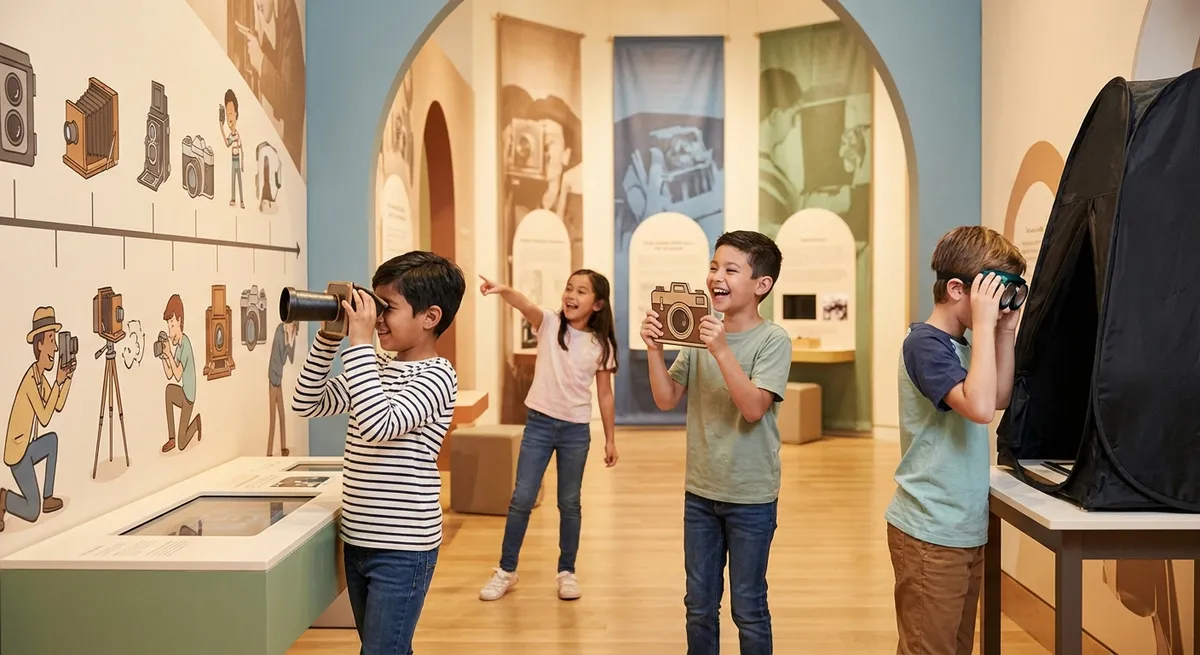
Snapshots Through Time: A Kid’s Journey into the History of Photography
Imagine holding a tiny box that can trap a moment forever—like a firefly caught in a jar. That’s what photography does! From dark rooms with mysterious chemicals to the smartphones in our pockets today, the story of photography is a mix of science, art, and a lot of curiosity. Let’s travel back in time, meet the inventors, and even make our own picture‑making device.
1. The First Light: Camera Obscura
Long before any camera existed, people discovered a simple trick called the Camera Obscura (Latin for “dark room”). If you poke a tiny hole in one side of a dark box, light from outside pours in and projects an upside‑down image of the scene onto the opposite wall.
- Cause → Effect: The tiny hole lets light rays pass straight, so each ray keeps its direction and creates a reversed picture.
- Vocabulary Boost: Projection – the act of casting an image onto a surface.
Did You Know? Artists like Leonardo da Vinci used camera obscura to help them draw realistic landscapes!
2. The First Photograph: Daguerreotype
In 1839, a French chemist named Louis‑daguerre announced the first practical photograph, called the Daguerreotype. He coated a silver‑plated copper sheet with a light‑sensitive chemical called iodine vapor. When the plate was exposed in a camera, the light created an invisible pattern. Developing it in mercury vapor revealed a sharp, mirror‑like image.
- Cause → Effect: Light hits the iodine‑treated silver; the areas that receive more light become “fixed” and turn into metallic silver, forming the picture.
- Vocabulary Boost: Sensitive – easily changed by something (here, light).
Did You Know? A daguerreotype had to be viewed from the side because the image was reflected like a tiny mirror.
3. From Film to Digital
A. Film Photography
By the late 1800s, inventors like George Eastman created Cellulose Nitrate Film, a flexible strip coated with light‑sensitive chemicals. You could load the film into a camera, snap many pictures, then develop the whole roll in a darkroom.
- Cause → Effect: Each exposure changes the chemicals on the film; developing turns those changes into visible pictures.
B. the Digital Revolution
In the 1970s, engineers built the first Digital Camera that used tiny light sensors called Ccd Chips (Charge‑Coupled Devices). Instead of chemicals, the sensor turns light into electrical signals that a computer stores as data.
- Vocabulary Boost: Sensor – a device that detects and measures something (here, light).
Did You Know? The first digital camera weighed about 8 pounds—much heavier than most kids’ backpacks!
4. Photography as Art
Photography isn’t just about capturing reality; it’s a way to Express Feelings and tell stories. Famous photographers like Ansel Adams used black‑and‑white landscapes to show the power of nature, while Dorothea Lange photographed people during the Great Depression to evoke empathy.
- Cause → Effect: By choosing what to include (or exclude) in a frame, a photographer can guide the viewer’s emotions.
Mini Experiment: Make a Pinhole Camera
You can create a simple camera with a cardboard box!
Materials
- An empty oatmeal box (or similar)
- Aluminum foil
- A pin
- Black tape
- Photographic paper (or a piece of white paper for a “shadow” picture)
Steps
- Darken The Box – Line the inside with black paper or tape so stray light can’t sneak in.
- Cut A Window – Near one end of the box, cut a square opening and cover it tightly with aluminum foil.
- Make The Pinhole – Use the pin to poke a tiny hole in the center of the foil; this acts as your lens.
- Create A Screen – Tape a piece of white paper to the inside wall opposite the pinhole.
- Take A Peek – Point the pinhole toward a bright scene and look at the screen from the back of the box to see an upside-down image!