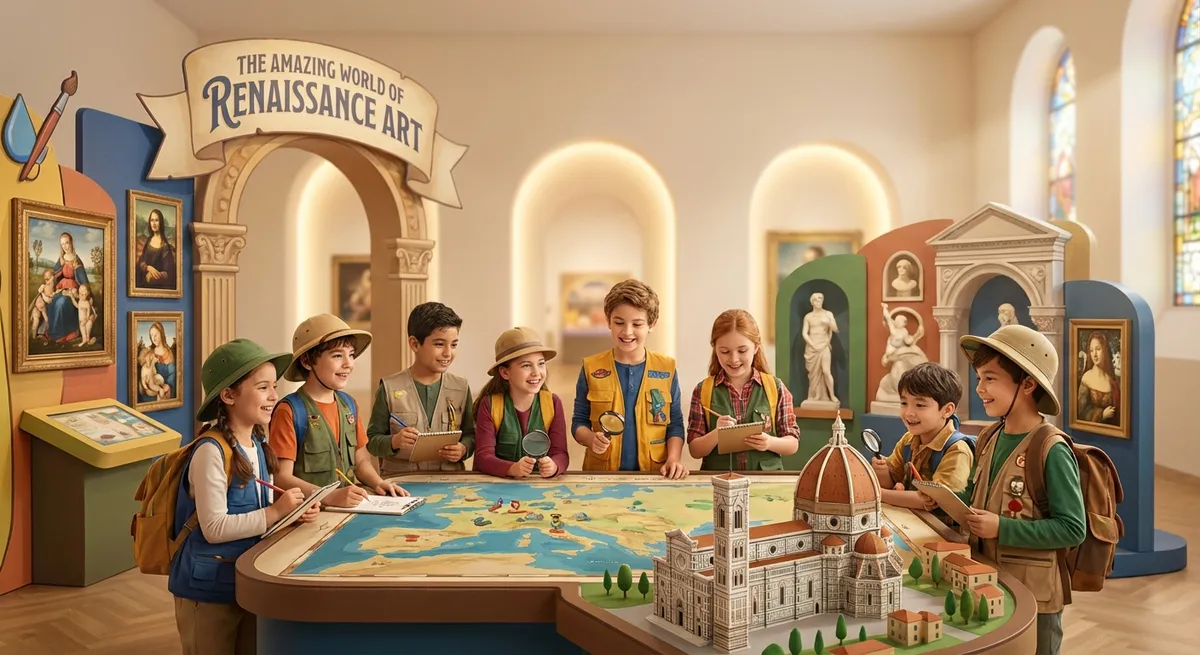
Renaissance Art
Welcome, young explorers! The Renaissance (pronounced “reh‑nah‑sahnss”) was a bright, exciting time in Europe about 500 years ago when people started to Re‑discover ideas from ancient Greece and Rome. Artists began to paint and sculpt in new ways, making pictures that look almost three‑dimensional! In this adventure you’ll learn new words, meet famous creators, see cause‑and‑effect in action, and even try a tiny art experiment yourself.
1. What Was the Renaissance?
| Word | Meaning (kid‑friendly) |
|---|---|
| Renaissance | A “rebirth” of learning, art, and science after the Middle Ages. |
| Humanism | A way of thinking that puts people and their feelings at the center of art and ideas. |
| Patron | A person (often rich) who pays artists to make works of art. |
During the 14th‑17th centuries, Humanism encouraged artists to study the real world and the human body. Wealthy merchants and rulers acted as Patrons, giving artists money, studios, and cool projects. Because of this support, artists could experiment and improve their skills—Cause And Effect: more money (cause) → more time to practice and invent (effect).
2. Famous Artists & Their Masterpieces
| Artist | Famous Work | Why It’s Special |
|---|---|---|
| Leonardo Da Vinci | Mona Lisa (portrait) | Uses Sfumato, a soft blending technique that makes the face look hazy and lifelike. |
| Michelangelo | David (marble statue) | Shows perfect Anatomy (body parts) and a powerful pose that tells a story of bravery. |
| Raphael | The School of Athens (wall fresco) | Uses Perspective—parallel lines that meet in the distance—to make a flat wall look like a deep hallway. |
| Sandro Botticelli | The Birth of Venus (painting) | Combines myth (Greek goddess Venus) with graceful, flowing lines that feel like movement. |
Did You Know? Leonardo could write with his left hand Mirror‑writing—the letters look backwards, like in a mirror!
3. How Artists Changed Their Techniques (cause & Effect)
-
Discovery Of Linear Perspective
Cause: Artists wanted to draw scenes that looked realistic, like standing on a road that vanished into the distance.
Effect: Filippo Brunelleschi invented a math‑based method using a Vanishing Point. Paintings after that, like Raphael’s, show deep, believable space. -
Improved Paint Materials
Cause: Earlier paints dried quickly and cracked.
Effect: Artists began using Oil Paint, which stays wet longer, letting them blend colors smoothly (think of Leonardo’s soft shadows). -
Study Of Anatomy
Cause: Humanism sparked curiosity about the human body.
Effect: Michelangelo dissected cadavers (with permission!) to learn muscles and bones, making his sculptures look alive.
4. Mini Experiment: Create Your Own “vanishing Point” Drawing
Materials
- A sheet of white paper (A4 size)
- A ruler
- A pencil
- Colored crayons
Steps
- Draw A Horizon Line – Lightly draw a straight line across the middle of the paper. This is where the sky meets the ground.
- Mark The Vanishing Point – Put a small dot in the center of the horizon line.
- Add Parallel Lines – From the bottom corners draw straight lines to the vanishing point to make a road or hallway.
- Sketch Buildings Or Trees along the sides, keeping their tops and bottoms lined up with the guide lines.
- Color Your Scene and watch how the drawing suddenly looks like it has real depth!