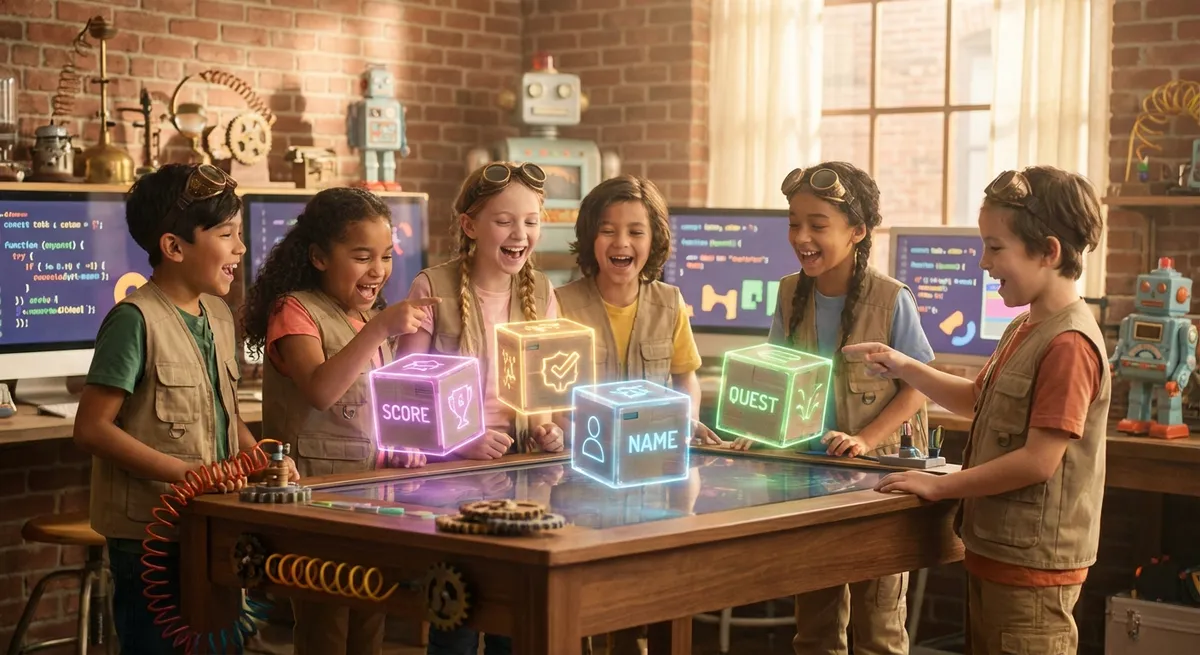
Discovering Arrays: the Magic Boxes of Computer Science
Imagine a row of Mailboxes, each with its own number, where you can store a letter, a picture, or a secret code. In computer science, an Array works just like that—it’s a special box that holds many items, all neatly organized by position. In this adventure, we’ll open these magic boxes, see how they help computers solve problems, and even build our own tiny array experiment!
1. What Is an Array?
An array is a Collection (a group) of items stored side‑by‑side in memory. Each item has an Index—a number that tells the computer where to find it.
- Indexing Starts At 0 – the first slot is 0, the second is 1, and so on.
- All items in an array usually share the Same Data Type (e.g., all numbers or all words).
Example:
scores = [85, 92, 78, 90] # a list of four test scoresHere scores[0] is 85, scores[2] is 78, etc.
Did You Know? The word array comes from the French “arrayer,” meaning “to arrange in order.”
Cause & Effect
- Cause: You put a new value into a specific index.
- Effect: The array now holds that value, and any program that reads that index will see the new value instantly.
2. Why Do Programmers Love Arrays?
- Speed – Accessing an element by its index is lightning fast (O(1) time).
- Organization – They keep related data together, making code easier to read.
- Reusability – One array can be used in many different tasks, from games to scientific calculations.
Real‑world analogy: Think of a Classroom Roster. Instead of writing each student’s name on a separate sheet, the teacher writes them in a single column. When the teacher needs to call on the third student, she simply looks at row 3. The same principle works for computers.
3. Mini Experiment: Build Your Own Array with Cups
Materials: 5 clear plastic cups, 5 different colored beads, a marker, a sheet of paper.
Steps
- Label the cups 0‑4 with the marker.
- Place a bead in each cup—choose any colors you like.
- Write the bead colors in order on the paper, like an array:
["red", "blue", "green", "yellow", "purple"]. - Test: Ask a friend to “Give me the bead in cup 2.” Retrieve the green bead and note how quickly you found it.
Observation: Because each cup had a number, you didn’t have to search all cups—just go straight to the right one. That’s exactly how computers use arrays!
4. Did You Know? Fun Facts About Arrays
- Multidimensional Arrays are like a Chessboard—rows and columns. They let programmers store data in a grid, perfect for games or image processing.
- The first high‑level language to support arrays was FORTRAN (1957), used for scientific calculations.
- In many languages, you can Resize an array, but behind the scenes the computer often creates a new, larger box and copies the old items over—a process called Reallocation.
Simple Activity: “array Story Builder”
- Write a short story (5–7 sentences) on a sheet of paper.
- Number each sentence from 0 upward.
- Shuffle the sentences, then ask a friend to Reorder them using the numbers—just like sorting an array.
- Discuss how the story changes when the order is wrong and how important the correct index is for meaning.
Arrays are the Foundation of many cool computer projects—think video games, music playlists, and even the way your smartphone stores photos. By understanding how these magic boxes work, you’ve unlocked a powerful tool for solving puzzles and building new inventions. Keep experimenting, ask “what if” questions, and soon you’ll be creating your own programs that dance, draw, and discover with arrays! 🌟