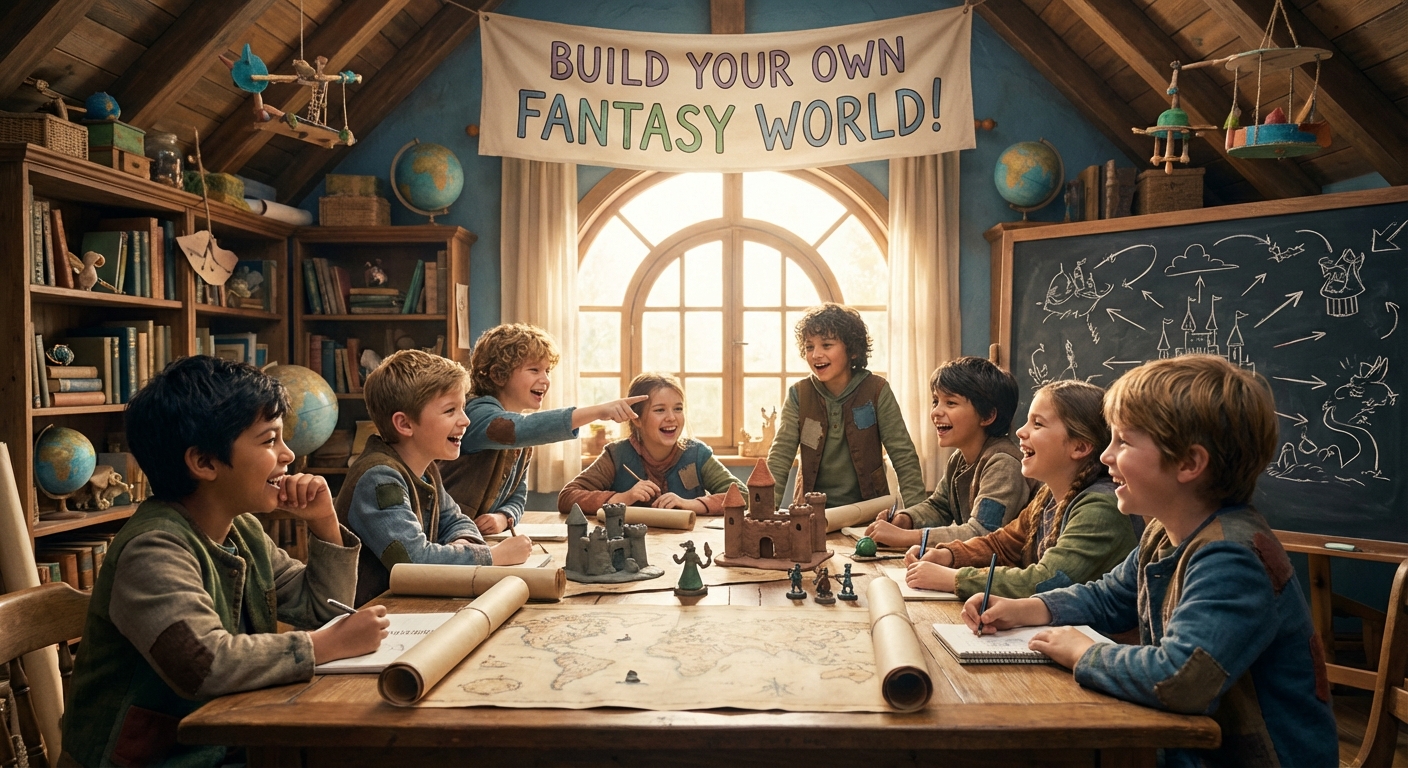
How to Build Your Own Fantasy World
Creative‑Writing for Kids (Ages 8‑10)
Imagine a place where dragons glide over crystal lakes, trees whisper secret songs, and brave heroes quest for hidden treasure. That place lives inside Your Imagination—and you can give it shape, rules, and history just like a real country! In this guide you’ll learn the basics of Fantasy Worldbuilding: the art of creating a whole new world for your stories.
1. Map the Land – Setting the Scene 🌍
Why It Matters:
If you know where the mountains, rivers, and villages are, you can decide how characters travel and what adventures they face.
How It Works (Cause → Effect):
- Cause: You draw a mountain range.
- Effect: People living nearby might be Mountain‑dwellers who are strong climbers and have myths about hidden caves.
Vocabulary Boost:
- Topography – the shape and features of the land (e.g., hills, valleys).
- Climate – the typical weather; a cold climate can lead to Snow‑covered villages.
Mini Example:
Draw a simple map on a sheet of paper. Mark a Forest, a River, and a Castle. Think about how the river helps the castle get fresh water, and how the forest might hide magical creatures.
2. Create Cultures & Creatures 🐉
Why It Matters:
Different groups of people (or creatures) give your world flavor and conflict.
Cause → Effect Chain:
- Cause: You invent a race of talking foxes that love riddles.
- Effect: Their villages are built in Burrows and they trade riddles for food, leading to clever heroes who must solve puzzles to get help.
New Words:
- Mythology – a collection of stories that explain how the world works (think of Greek myths).
- Ecosystem – all living things in an area and how they depend on each other.
Did You Know?
The word “dragon” comes from the Greek “drákōn,” meaning “serpent.”
Mini Experiment:
Pick an animal (e.g., a rabbit). Write three magical abilities it could have and describe how those powers would change the Ecosystem of your world.
3. Set the Rules – Magic & Technology ⚡️
Every fantasy world needs Rules so the story stays believable.
- Magic System: Decide How magic works. Does a wizard need a special stone? Can anyone learn it?
- Technology Level: Are people using swords, steam engines, or flying ships?
Cause → Effect:
- Cause: Magic can only be used at night.
- Effect: Night‑time markets become bustling hubs, while daytime towns are quieter.
Vocabulary:
- Arcane – mysterious or secret; often used for hidden magical knowledge.
- Artifact – an object made by people that has special powers (like a glowing sword).
Example:
In your world, the Arcane Crystal powers all lanterns. If the crystal cracks, the whole kingdom falls into darkness, prompting a hero’s quest to repair it.
4. History & Legends – The Past Shapes the Present 📜
A world with a past feels real.
- Historical Events (e.g., a great flood) explain why a city sits on high ground.
- Legends give characters goals, like finding the lost Phoenix Feather.
Cause → Effect:
- Cause: A war destroyed the ancient library.
- Effect: Knowledge about old spells is rare, making any recovered scroll a treasure.
Mini Quiz:
| Question | Answer |
|---|
|
| 1. What happens if the Arcane Crystal cracks? | a) Lanterns glow brighter b) Night‑time markets close c) All lanterns go dark ✓ d) Dragons appear | | 2. Why might a village be built on a hill after a great flood? | a) To be closer to clouds b) To stay dry and safe ✓ c) To see the stars better d) To find treasure | | 3. In a world where magic works only at night, when do heroes most often start their quests? | a) At sunrise b) At noon c) At sunset ✓ d) At midnight |
Now you have the tools to start building your own magical world—let your imagination soar!