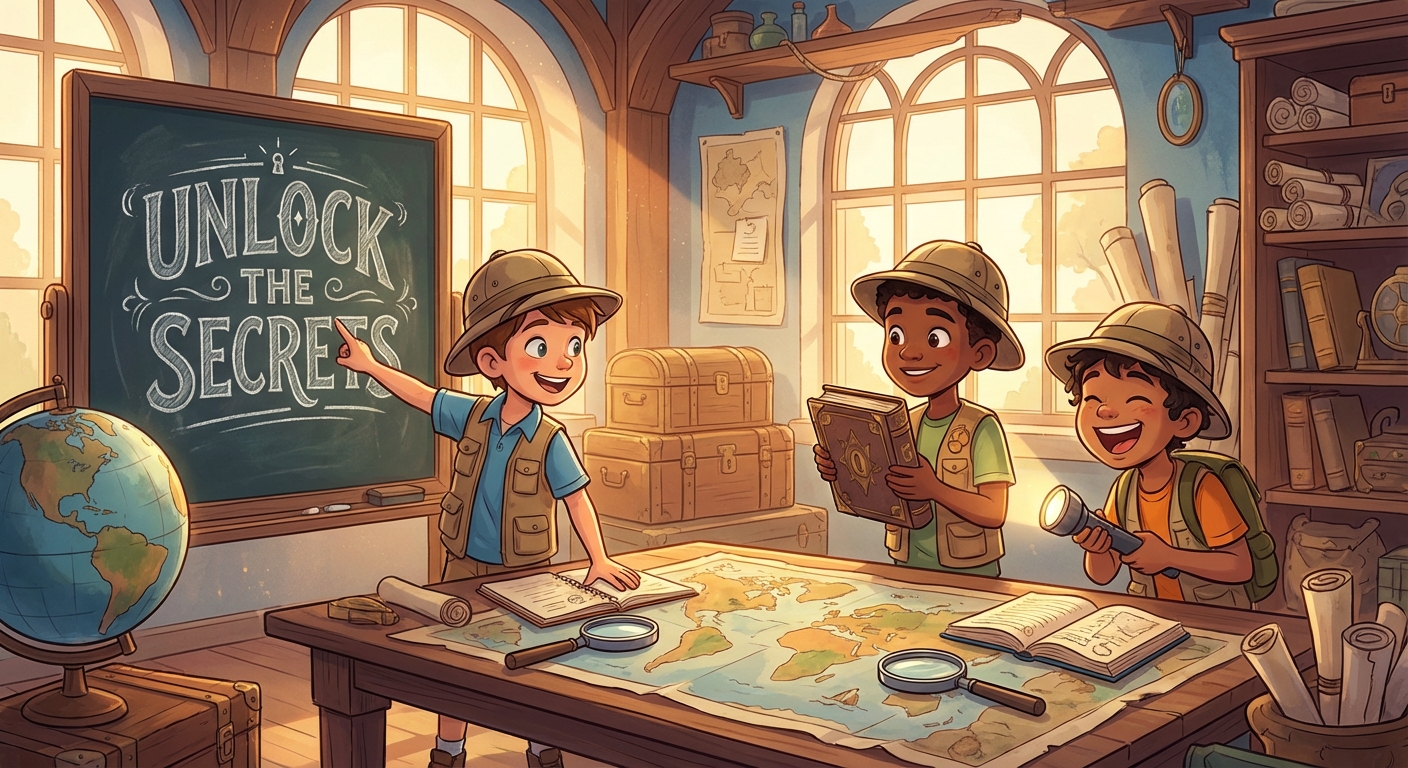
Unlock the Secrets: Write Your Own Mystery!
Do you love stories where something hidden is finally uncovered? Mystery writing lets you become the detective‑author who plants clues, builds suspense, and surprises readers with a brilliant reveal. In the next few pages you’ll learn new words, see how cause → effect works in a mystery, and even try a mini‑experiment to create your own whodunit.
1. What Makes a Mystery?
A mystery is a story that starts with a Puzzle (something unknown) and ends with a solution.
- Enigmatic (adj.): puzzling or mysterious. The enigmatic note on the desk made everyone curious.
- Detective: a person who finds out the truth by looking for clues.
Example:
The lights went out, and the prized trophy vanished. Everyone wondered Who took it and Why.
Did You Know? The word mystery comes from the Greek mystērion, meaning “a secret rite” that was hidden from the public.
2. Building Suspense – Cause and Effect
Suspense keeps readers on the edge of their seat. It works by linking Cause (what happens) to Effect (what follows).
| Cause (What Happens) | Effect (What the Reader Feels) |
|---|---|
| A strange sound at midnight | Readers feel uneasy and want to know the source. |
| A clue is hidden in a locked drawer | Readers become curious about how the hero will open it. |
When you write, think: If I make this happen, what will the reader think or feel? That chain of cause → effect creates tension that pulls the story forward.
3. Clues and Red Herrings
Clue – a piece of information that helps solve the puzzle.
Red Herring – a false clue that leads the reader (or detective) the wrong way.
Example:
- Clue: A muddy bootprint near the window.
- Red Herring: A torn piece of a chocolate bar found in the garden (it looks tasty, but it’s not related to the theft).
Using both makes the mystery Intriguing (adj.): it grabs attention and makes the final answer feel earned.
Mini‑experiment: The Treasure Trail
- Choose three objects in your room (e.g., a pencil, a sock, a book).
- Write a short note that points to the next object, but add one false direction (red herring).
- Hide the objects in order and give the note to a friend. See if they can find the “treasure” by following the real clues while ignoring the fake one!
What you’ll notice: The real clues Lead to the prize, while the red herring Delays the discovery—just like in a mystery story.
4. Plot Twists and the Big Reveal
A Plot Twist is an unexpected change that flips the story’s direction. It should feel surprising But also make sense after the reveal.
- Foreshadow (verb): to give a hint about something that will happen later.
- Culminate (verb): to reach the highest point or final result.
Cause → Effect For A Twist:
- Cause: You reveal that the quiet neighbor found and protected the missing pet.
- Effect: Earlier clues suddenly make sense, so the surprise feels earned rather than random.