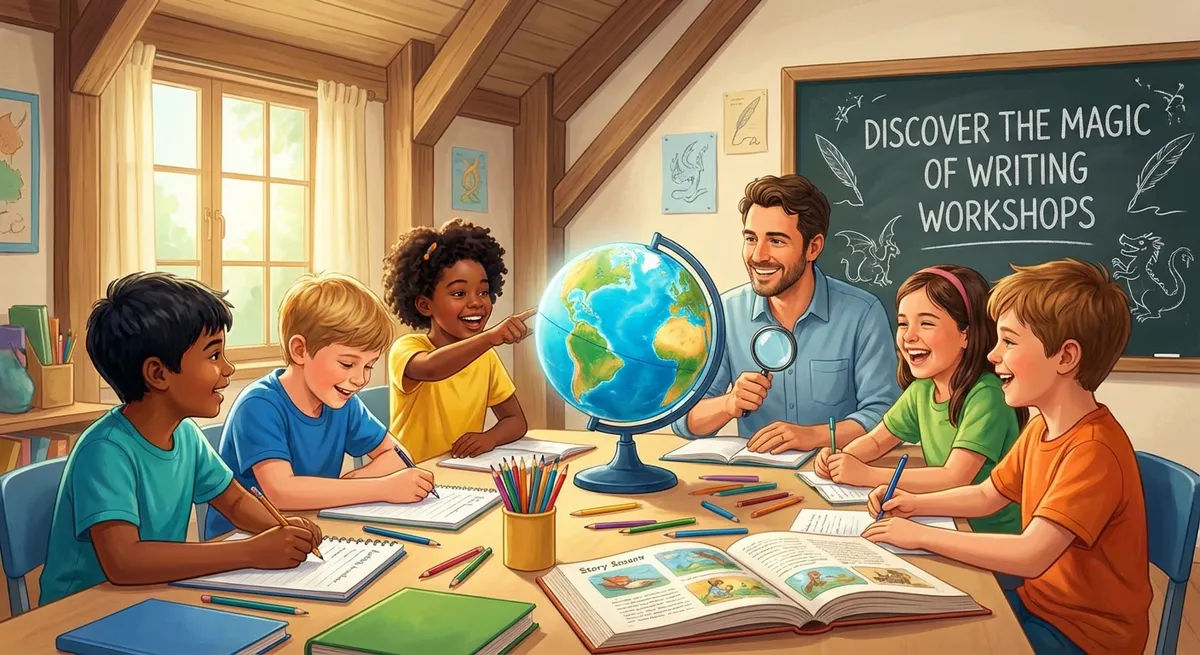
️ Discover the Magic of Writing Workshops
Imagine a place where ideas bounce around like popcorn, where you can turn a simple thought into an exciting adventure, and where friends help you polish your stories until they shine. That place is a Writing Workshop—a fun, friendly gathering where budding writers like you learn to create, share, and improve their creative‑writing pieces.
1. What Happens in a Writing Workshop?
| Activity | What It Means | Why It Helps |
|---|---|---|
| Warm‑up Games | Quick, playful exercises (e.g., “One‑Word Story”) | Gets your brain ready and builds confidence. |
| Sharing Drafts | Reading a piece you’ve written to the group. | You receive Feedback (helpful suggestions) that shows what works and what can be stronger. |
| Mini‑lessons | Short lessons on topics like Genre (type of story) or Dialogue (conversation between characters). | Gives you new tools to use in your writing. |
| Revision Time | Re‑writing parts of your story based on ideas you heard. | Turns a good story into a great one! |
Cause And Effect:
When you share your story → you get ideas from friends → you rewrite with those ideas → your story becomes clearer and more exciting.
2. Building a Bigger Vocabulary
A writing workshop is a perfect spot to learn new words. Here are three “power words” you might hear, plus easy explanations:
| Word | Simple Definition | Example in a Story |
|---|---|---|
| Metaphor | A comparison that says something is something else, not just like it. | “The moon was a silver boat sailing across the night sky.” |
| Perspective | The point of view from which a story is told. | First‑person: “I ran to the tree.” Third‑person: “She ran to the tree.” |
| Climax | The most exciting part of the story where the main problem reaches its peak. | In a mystery, the climax is when the detective finally finds the hidden clue. |
Try using one of these words in your next story!
3. Did You Know? 🤔
- The First Writing Workshop for children was held in 1915 at a school in England.
- Famous authors like J.k. Rowling and Roald Dahl attended workshops when they were young, helping them shape the magical books we love today.
- Writing workshops can be Online too! You can join a virtual room, type your story, and get feedback from classmates across the world.
4. Mini Experiment: The “story‑swap” Challenge
Goal: See how a fresh pair of eyes can change a story.
- Write A Short Story (about 150–200 words) on any topic you like.
- Fold The Paper and pass it to a friend (or a sibling).
- Ask them to Add One Sentence somewhere in the middle that makes the story more interesting.
- Read the new version aloud.
What To Notice:
- Did the added sentence make the story clearer?
- Did it introduce a new idea you hadn’t thought of?
Write down what you learned and try revising your original story using their suggestion.
Writing Workshops Quiz
Keep Exploring
Share one idea from your notebook with a family member and ask what question it leaves them with. That question can be the spark for your next workshop draft.