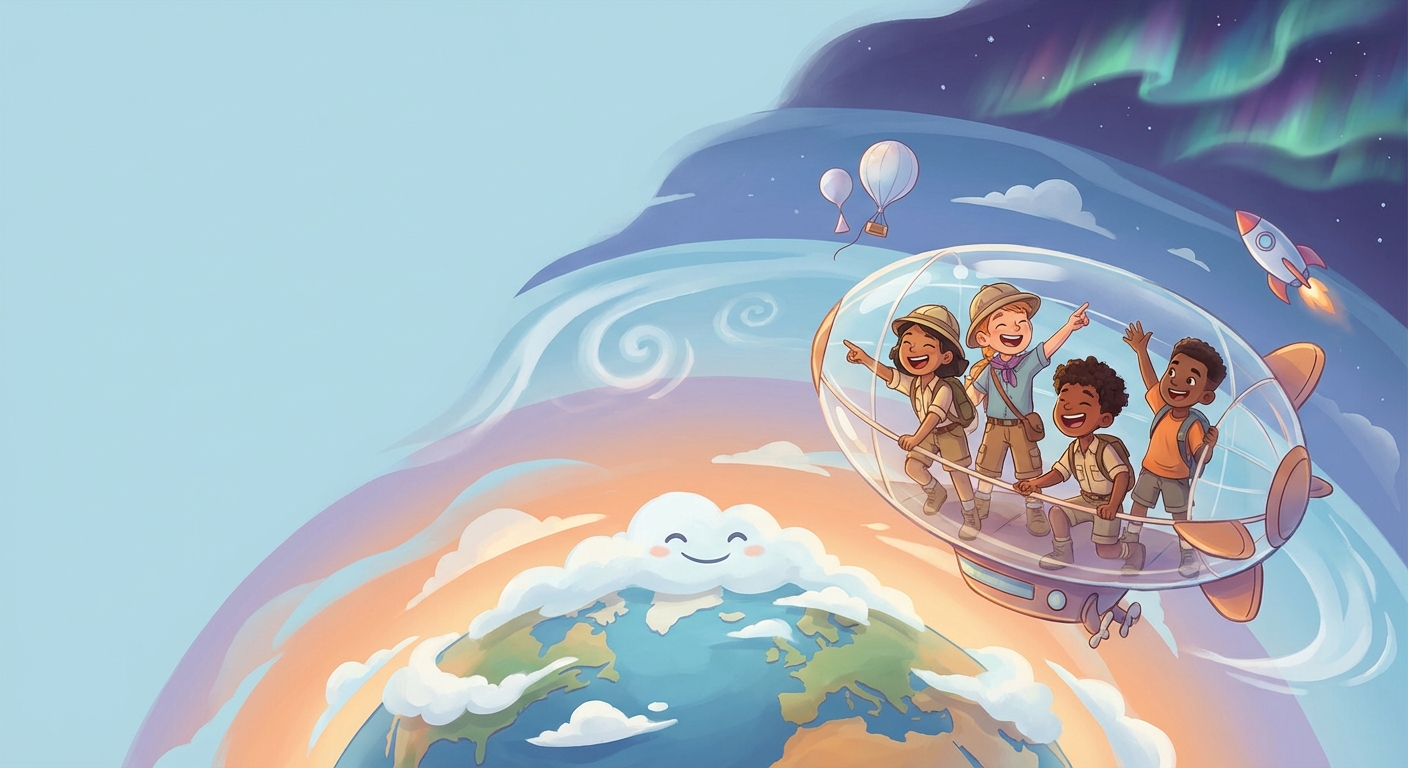
Journey Through the Sky: the Layers of Earth’s Atmosphere
Have you ever wondered why clouds float, airplanes soar, and the night sky sometimes glows with green curtains? All of these wonders happen in the Atmosphere—the blanket of gases that surrounds our planet. The atmosphere isn’t the same all the way up; it’s divided into different Layers, each with its own special characteristics. Let’s explore these layers, learn new words, and even try a simple experiment!
1. Troposphere – The Weather Workshop
- Where It Is: From the ground up to about 8–18 km (5–11 miles), depending on latitude and season.
- What Happens: This is the layer we live in. All the Weather (rain, snow, wind) forms here because the air is warmest at the bottom and cooler higher up.
- Cause & Effect: Warm air rises, cools, and creates clouds. When the air cools enough, water droplets join together and fall as rain.
- Cool Vocabulary:
- Density – how tightly packed the air molecules are. Air is most dense at the surface.
- Pressure – the force of air pushing down on everything; higher at sea level, lower up high.
Did You Know? The highest mountain on Earth, Mount Everest, stands in the troposphere, where the air pressure is only about one‑third of what it is at sea level.
2. Stratosphere – The Ozone Shield
- Where It Is: Roughly 12‑50 km (7‑31 miles) above us.
- What Happens: This layer holds the Ozone Layer, a thin region rich in ozone (O₃) that absorbs harmful Ultraviolet (UV) Radiation from the Sun.
- Cause & Effect: By soaking up UV rays, the ozone layer protects living things from DNA‑damaging radiation.
- Cool Vocabulary:
- Ultraviolet – a type of invisible light that can be dangerous in large doses.
- Absorb – to take in energy, like a sponge soaking up water.
Did You Know? Commercial jets usually fly near the top of the troposphere, and some flights enter the lower stratosphere, where there may be less weather-related turbulence.
3. Mesosphere – The Shooting Star Stage
- Where It Is: About 50‑85 km (31‑53 miles) up.
- What Happens: The air is extremely thin, and temperatures drop to around ‑90 °C (‑130 °F). When meteoroids enter this layer, they burn up, creating Meteors (shooting stars).
- Cause & Effect: A fast meteoroid compresses and heats the air in front of it. The hot gas and material shed from the meteoroid create the bright streak we call a meteor.
- Cool Vocabulary:
- Friction – the resistance that occurs when two surfaces rub together.
- Vaporize – to turn from solid or liquid into a gas.
Did You Know? The mesosphere is the only atmospheric layer where No Human-Made Objects (like satellites) routinely stay; it’s a “no‑parking zone.”
4. Thermosphere & Exosphere – The Space Edge
- Where It Is: From ~85 km (53 miles) up to 600 km (370 miles) and beyond.
- What Happens: The air is so thin that a single breath would take in very few air molecules, making it impossible to breathe without special equipment.
- Thermosphere: High-energy sunlight heats the few particles here. Auroras glow in this region, and the International Space Station orbits within it.
- Exosphere: This outermost region gradually fades into space. Some particles can travel far enough to escape Earth.
Quick Quiz
- In which layer does almost all weather occur? The troposphere.
- Which layer contains most atmospheric ozone? The stratosphere.
- Why do meteors glow? Their high-speed motion heats compressed air and removes hot material from the meteoroid.