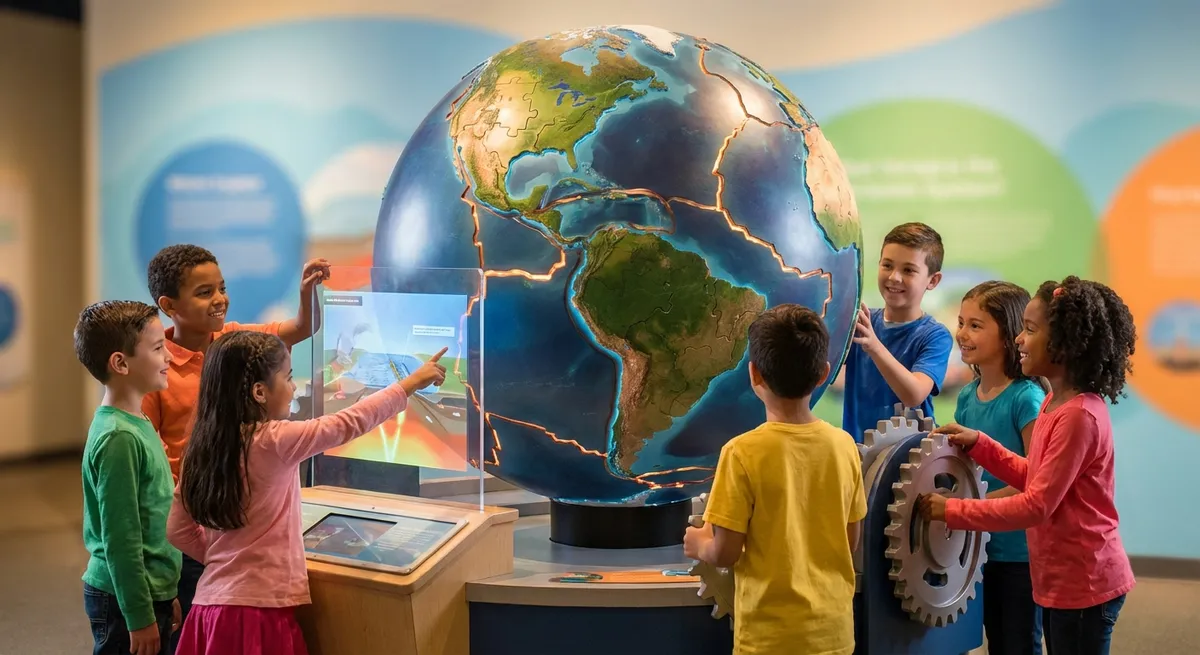
How the Puzzle Pieces of Earth Keep Moving: Continental Drift
Introduction
Have you ever looked at a world map and imagined the continents as pieces of a giant jigsaw puzzle? Long ago, those pieces weren’t stuck where they are today—they slowly drifted across the planet’s surface. This amazing movement is called Continental Drift. Let’s explore how it works, why it matters, and even try a tiny experiment in your own kitchen!
1️⃣ What Is Continental Drift?
Continental drift is the slow, sideways sliding of Earth’s huge land‑masses (the continents) over millions of years. Think of the continents as giant rafts floating on a thick, invisible ocean of hot rock called the Mantle.
- Mantle – the layer of rock beneath Earth’s crust that can flow very, very slowly (like thick honey).
- Crust – the thin, solid “skin” we walk on.
The continents sit on the crust, and the crust rides on the moving mantle. Because the mantle’s flow is so slow—about the speed of a snail’s crawl—people can’t feel the movement, but over millions of years the continents can travel thousands of kilometers!
2️⃣ How Did Scientists Discover It?
In the early 1900s, a German scientist named Alfred Wegener noticed something curious: the coastlines of South America and Africa look like they could fit together like puzzle pieces. He also found the same kinds of Fossils (remains of ancient plants and animals) on both continents.
- Fossil – the preserved remains or traces of organisms that lived long ago.
Wegener proposed that the continents were once joined in a super‑continent called Pangaea (“all lands”). At first, many people doubted him because they didn’t know why the continents could move. Later, with the discovery of Tectonic Plates—big slabs of crust that shift—Wegener’s idea became the foundation of modern Earth‑science.
3️⃣ Why Do Continents Move?
The mantle isn’t solid like a rock you can pick up; it behaves like a very thick, flowing liquid. Heat from Earth’s core makes the mantle material rise in some places and sink in others, creating Convection Currents (think of the way water circulates when you heat a pot). These currents push the tectonic plates around.
Cause → Effect
- Cause: Hot mantle material rises, cools, and sinks.
- Effect: The plates above it slide, causing continents to drift, mountains to rise, and earthquakes to happen.
4️⃣ Real‑world Examples
| Example | What Happens | Why It’s Cool |
|---|---|---|
| The Andes Mountains | Formed as the South American plate pushed against the Pacific plate. | Shows how drifting can build towering peaks! |
| The Great Rift Valley (Africa) | A huge crack where the African plate is splitting apart. | A living laboratory of continents pulling away. |
| Fossil Match | The extinct reptile Mesosaurus is found in both South America and Africa. | Proof that those lands were once together. |
Did You Know? 🤔
- The Atlantic Ocean is Getting Wider—about 2.5 centimeters (1 inch) every year—as the Americas drift away from Europe and Africa.
- Some scientists think the next super‑continent might be called “Pangaea Proxima.”
🧪 Mini Experiment: “continental Drift in a Bowl”
What You Need
- A shallow bowl or tray
- Water
- Two different colors of play‑dough or modeling clay (to represent continents