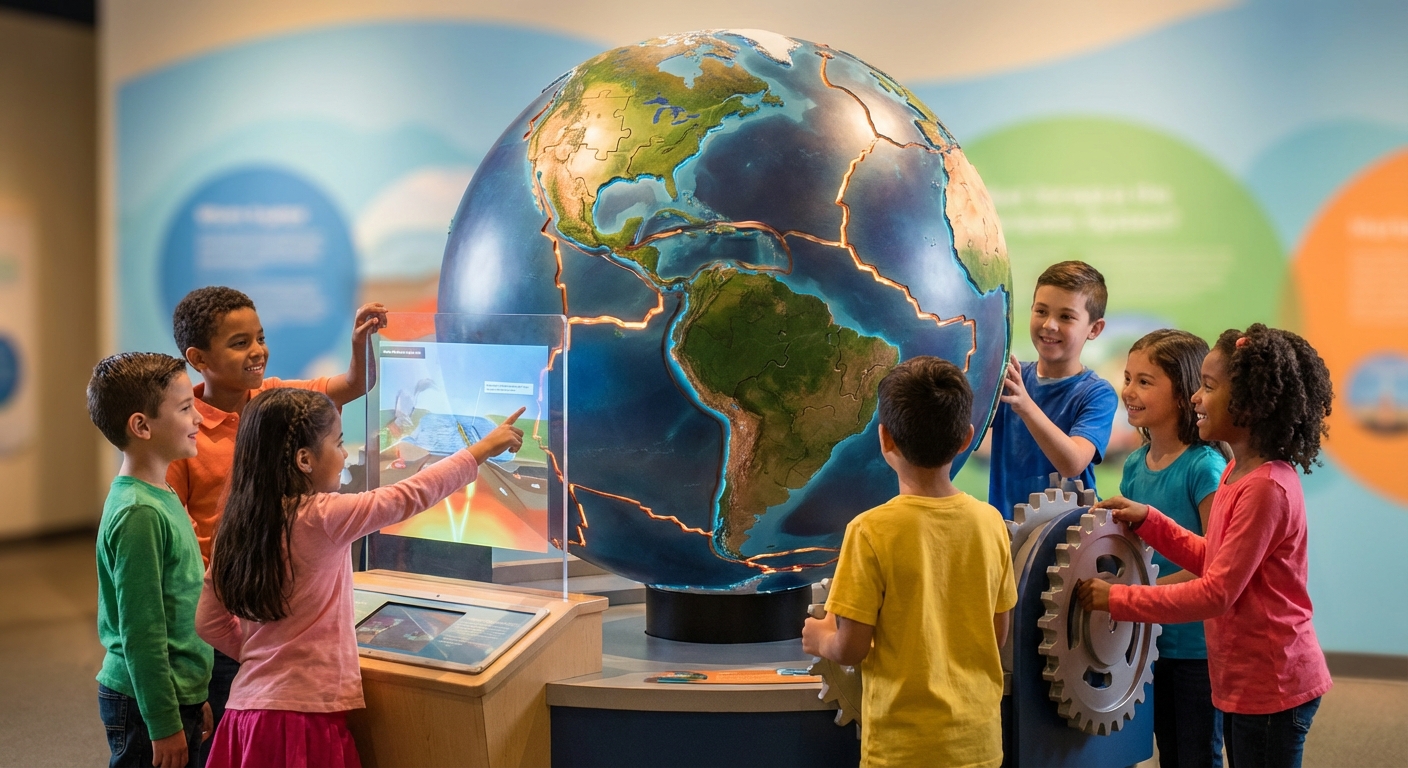
How the Puzzle Pieces of Earth Keep Moving: Continental Drift
Introduction
Have you ever looked at a world map and imagined the continents as pieces of a giant jigsaw puzzle? Long ago, those pieces weren’t stuck where they are today—they slowly drifted across the planet’s surface. This amazing movement is called Continental Drift. Let’s explore how it works, why it matters, and even try a tiny experiment in your own kitchen!
1️⃣ What Is Continental Drift?
Continental drift is the slow change in the positions of Earth’s continents over millions of years. Continents are parts of rigid Tectonic Plates that move over a hotter, weaker part of the mantle.
- Mantle – the thick layer of mostly solid rock beneath Earth’s crust. Over long periods, some of it can slowly deform and flow.
- Crust – the thin, solid “skin” we walk on.
Most plates move only a few centimeters each year, so people cannot feel the steady motion. Over millions of years, however, continents can travel thousands of kilometers.
2️⃣ How Did Scientists Discover It?
In the early 1900s, a German scientist named Alfred Wegener noticed something curious: the coastlines of South America and Africa look like they could fit together like puzzle pieces. He also found the same kinds of Fossils (remains of ancient plants and animals) on both continents.
- Fossil – the preserved remains or traces of organisms that lived long ago.
Wegener proposed that the continents were once joined in a super‑continent called Pangaea (“all lands”). At first, many people doubted him because they didn’t know why the continents could move. Later, with the discovery of Tectonic Plates—big slabs of crust that shift—Wegener’s idea became the foundation of modern Earth‑science.
3️⃣ Why Do Continents Move?
The mantle is mostly solid, but hot rock can deform very slowly. Plate motion is driven by several forces. A cold, dense plate can sink at a trench and pull the rest with it, while new crust forming at an ocean ridge can help plates move apart. Slow movement in the mantle also transfers heat and contributes to plate motion.
Cause → Effect
- Cause: Forces at ocean ridges, sinking plate edges, and slow mantle movement act on tectonic plates.
- Effect: Plates move, carrying continents and helping form mountains, volcanoes, and earthquakes at many plate boundaries.
4️⃣ Real‑world Examples
| Example | What Happens | Why It’s Cool |
|---|---|---|
| The Andes Mountains | Formed where the oceanic Nazca plate sinks beneath the South American plate. | Shows how plate movement can build towering peaks! |
| The Great Rift Valley (Africa) | A huge crack where the African plate is splitting apart. | A living laboratory of continents pulling away. |
| Fossil Match | The extinct reptile Mesosaurus is found in both South America and Africa. | Proof that those lands were once together. |
Did You Know? 🤔
- The Atlantic Ocean is Getting Wider—about 2.5 centimeters (1 inch) every year—as the Americas drift away from Europe and Africa.
- Scientists have proposed several possible future supercontinents, but their shapes and timing are uncertain.
🧩 Mini Model: Rebuild Pangaea
What You Need
- A printed world map or a map traced onto paper
- Scissors
- Pencil
Ask an adult to help with cutting if needed.
- Cut out the continent shapes.
- Move South America next to Africa and compare their coastlines.
- Mark where matching fossils, rocks, or mountain belts would give stronger evidence than coastline shape alone.
- Move the pieces to their modern positions.
This is a pattern-finding model. Real continents do not float freely on water; they are carried by moving tectonic plates.