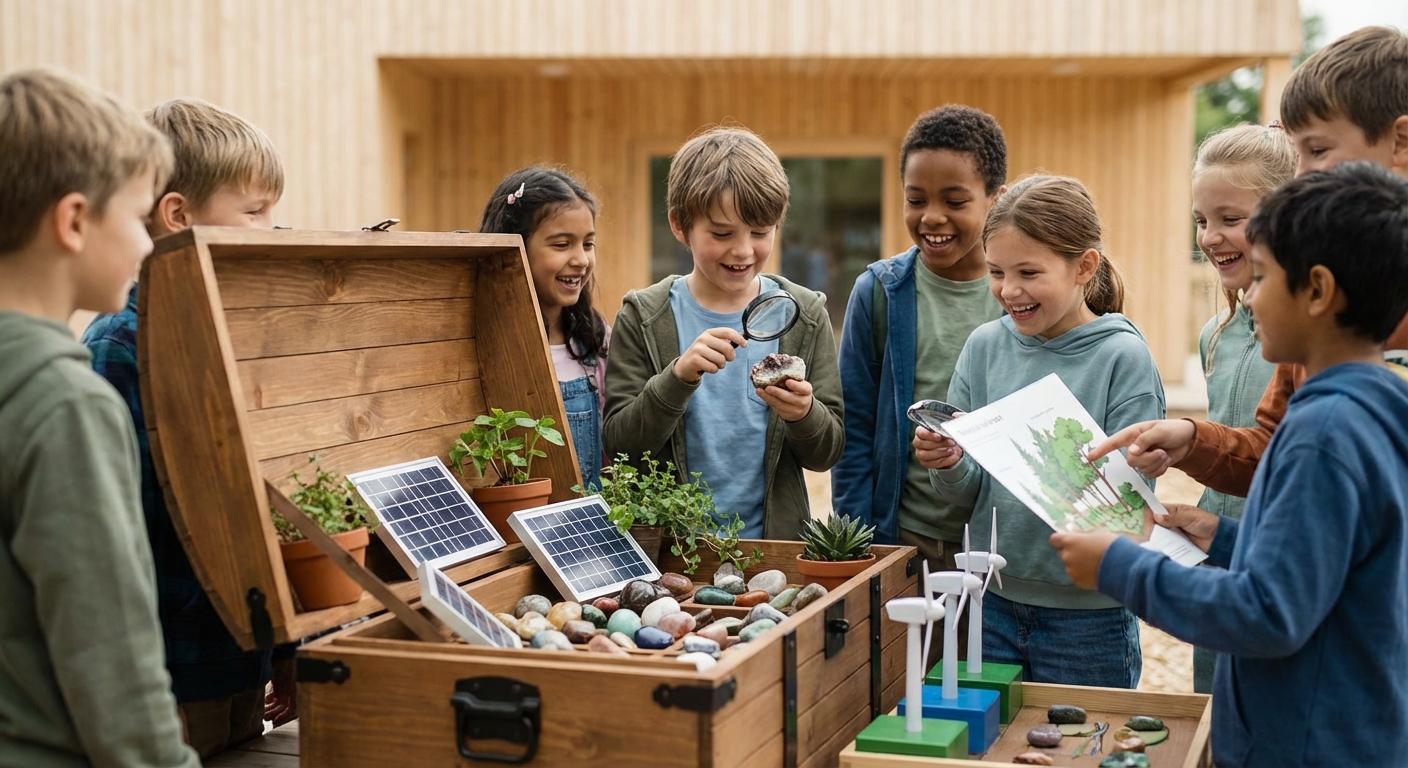
Natural Resources: Earth’s Treasure Chest
Every day we use things that come straight from our planet—water to drink, trees to build with, and minerals that make our phones work. These gifts are called Natural Resources. They’re the “stuff” Earth gives us without us having to make it. Let’s explore what they are, why they matter, and how we can protect them!
1. Types of Natural Resources
| Resource | Renewable or Non‑renewable? | Example | Why It Matters |
|---|---|---|---|
| Water | Renewable (if we take care of it) | Rivers, lakes, rain | Provides drinking water, grows food, powers turbines |
| Forests | Renewable (when trees are replanted) | Oak trees, pine forests | Give us oxygen, wood, homes for animals |
| Minerals & Metals | Non‑renewable (they form over millions of years) | Iron, copper, gold | Build cars, computers, jewelry |
| Sunlight | Renewable | Sun rays | Generates solar energy, helps plants grow |
Complex word: Renewable – a resource that can be used again and again if we manage it wisely.
Complex word: Non‑renewable – a resource that takes so long to form that we can’t replace it within a human lifetime.
2. Cause and Effect: How Our Choices Shape Resources
- Using Too Much Water → Water Scarcity: When we waste water (leaving the tap running, over‑watering gardens), rivers and lakes shrink, making it harder for people and animals to get enough.
- Cutting Down Forests → Habitat Loss: Removing trees destroys homes for birds, insects, and mammals, and reduces the amount of carbon dioxide the forest can absorb.
- Mining Minerals → Land Degradation: Digging deep pits can erode soil, pollute water, and make the land unusable for farming.
Understanding these cause‑and‑effect chains helps us make smarter choices!
3. “did You Know?” Fun Facts
- One Drop Of Ocean Water Contains About 3.5 % Salt, but the same amount of fresh‑water from a river has almost no salt at all!
- The Amazon Rainforest stores enormous amounts of carbon and supports remarkable biodiversity. Although its plants produce oxygen, organisms in the forest use nearly as much, so it is misleading to say the Amazon supplies 20% of the oxygen we breathe.
- Recycling aluminum can use about 95% less energy than producing aluminum from mined ore, although the exact saving depends on the process.
4. Mini Experiment: Build a Simple Water Filter
What You Need
- Two clear plastic bottles (ask an adult to cut the bottom off one)
- Coffee filter or clean cloth
- Sand, small stones, and aquarium activated carbon, handled with an adult
- Dirty water (mix tap water with a little soil)
Steps
- Place the coffee filter inside the neck of the top bottle.
- Layer the materials: first a thin layer of charcoal, then sand, then small stones.
- Slowly pour the dirty water onto the top.
- Watch the water drip down into the bottom bottle. Do not drink the water: looking clearer does not make it safe because germs and dissolved pollutants may remain.
Observation – The filtered water may look clearer than the original. The cloth, sand, and stones catch particles of different sizes. Activated carbon can adsorb some dissolved substances, but this model does not make water safe to drink.
Extension – Try the experiment with different layer orders. Which works best? Record your results in a table!
5. Quick Quiz – Test Your Knowledge!
-
Which Of These Is A Renewable Resource? a) Gold b) Sunlight ✅ c) Coal
-
What Happens When We Cut Down Too Many Trees? a) More animals have homes b) Habitat loss and less carbon storage ✅ c) Nothing changes
-
Why Is Recycling Aluminum So Helpful? a) It can use about 95% less energy than making aluminum from ore ✅ b) It makes the cans heavier c) It changes the color of the metal
-
What Does “Non-Renewable” Mean? a) Something that can be used forever b) Something that takes millions of years to form and can’t be replaced quickly ✅ c) Something that grows on trees
Wrap‑up
Earth’s natural resources are precious gifts that help us live, build, and grow. By understanding the difference between renewable and non-renewable resources—and by making smart choices like recycling and conserving water—we can help protect our planet for future generations. You’re now a natural resources expert!