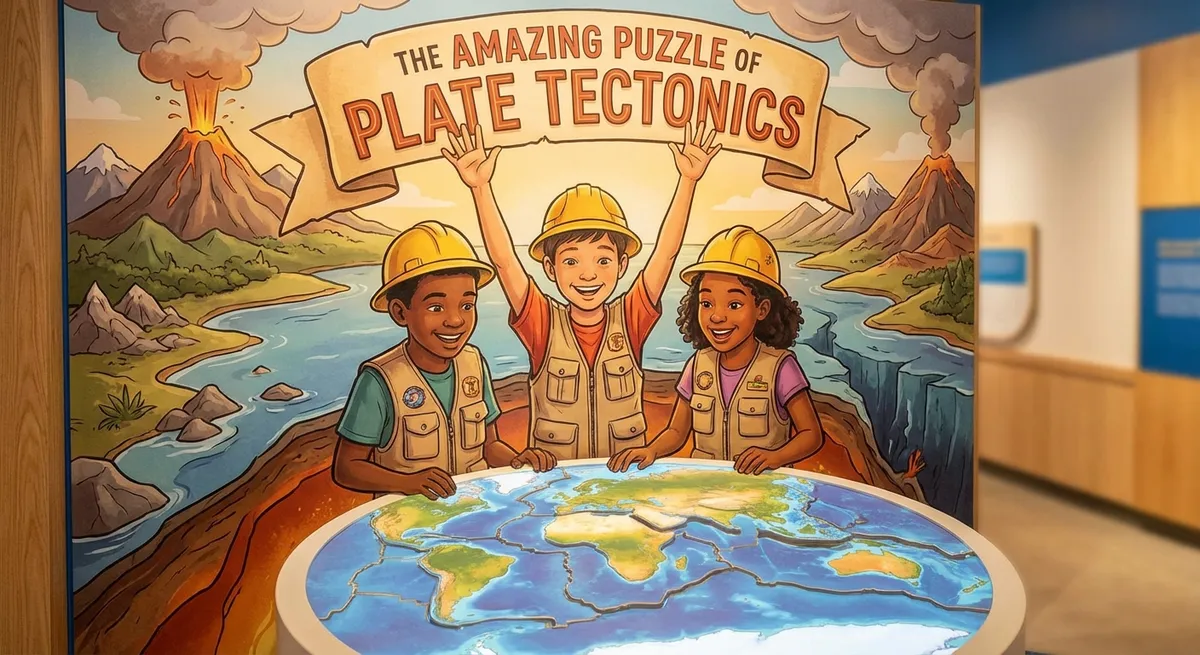
The Amazing Puzzle of Plate Tectonics
Our planet Earth isn’t a solid, unmoving ball. It’s more like a giant jigsaw puzzle made of huge pieces called Tectonic Plates. These plates drift, collide, and slide past each other, shaping mountains, oceans, and even causing earthquakes. Let’s explore how this spectacular process works!
1. What Are Tectonic Plates?
- Definition: Tectonic plates are massive slabs of the Earth’s outer shell (the Lithosphere) that fit together like a puzzle.
- Size: Some plates are as big as a continent (e.g., the African Plate), while others are only a few hundred kilometers across.
- Materials: They’re made of solid rock, but underneath them lies the semi‑molten Asthenosphere, which lets the plates move very slowly—about the speed of your fingernail growing (1–10 cm per year).
Vocabulary Boost
- Lithosphere – the rigid outer layer of Earth (crust + upper mantle).
- Asthenosphere – the softer, partly melted layer beneath the lithosphere that allows plates to glide.
2. How Do Plates Move? (cause & Effect)
The Driving Forces
- Convection Currents – Hot material rises from deep inside Earth, spreads out, cools, and then sinks again, creating a slow “circular” flow.
- Slab Pull – When a dense plate edge sinks into the mantle, it drags the rest of the plate behind it.
What Happens When Plates Interact?
| Interaction Type | What It Looks Like | Real‑World Example |
|---|---|---|
| Divergent – plates pull apart | New crust forms as magma rises and solidifies | Mid‑Atlantic Ridge (creates new ocean floor) |
| Convergent – plates smash together | One plate may dive beneath another (subduction) → mountains or deep ocean trenches | Himalayas (Indian Plate colliding with Eurasian Plate) |
| Transform – plates slide sideways | Earthquakes along a line called a Fault | San Andreas Fault in California |
Cause → Effect: When plates diverge, magma rises → new rock forms → ocean floor spreads. When they converge, crust crumples → mountains rise. When they transform, stress builds → sudden slip → earthquake.
3. Did You Know? 🤔
- Continents On The Move: 200 million years ago all land was one super‑continent called Pangaea. It split apart because of plate tectonics.
- Living On A Moving Carpet: If you could stand on a plate at the middle of the Pacific Ocean, you’d be drifting westward at about 5 cm per year—slow enough to be invisible, but over millions of years it adds up!
- Volcanoes Are Plate‑powered: Most of the world’s active volcanoes sit on plate boundaries, where molten rock (magma) finds a way to the surface.
4. Mini Experiment: “make Your Own Plate Puzzle”
Materials
- Two colors of play‑dough (or modeling clay)
- A flat tray or large piece of cardboard
- A marker
Steps
- Roll each color of dough into a flat “plate” about 1 cm thick.
- Place the plates on the tray so they touch but don’t overlap.
- Use the marker to draw a line where the plates meet – this is your Fault Line.
- Gently push the plates together (convergent), pull them apart (divergent), or slide them side‑by‑side (transform).
Observe
- When you push together, the dough may buckle—like mountain formation.
- When you pull apart, a gap appears—like a rift valley.
- When you slide, the edge