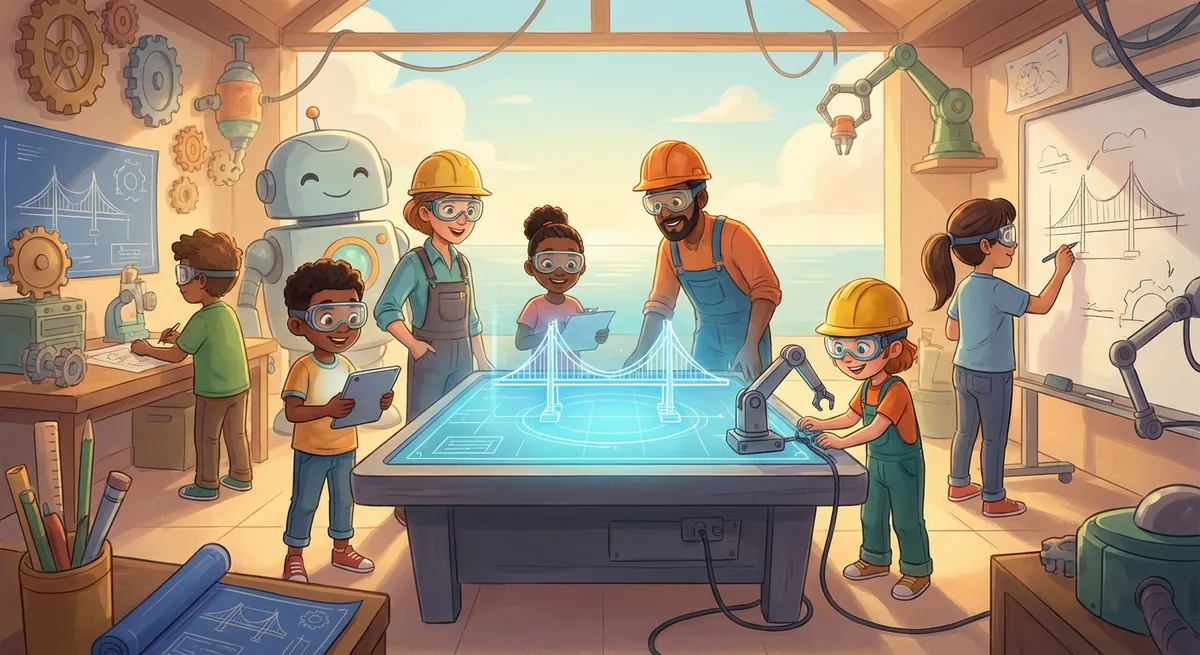
The Amazing Design Process: How Engineers Turn Ideas into Reality
Every cool gadget, bridge, or video game you love started as a spark—an idea in someone’s mind. Engineers use a special step‑by‑step plan called the Design Process to turn that spark into something you can touch, see, or use. Let’s explore how this clever recipe works, why each step matters, and even try a tiny experiment ourselves!
1. Ask & Define the Problem
What It Means: Before building anything, engineers ask questions like, “What do we need?” and “Who will use it?”
Example: Imagine you want a Paper‑airplane Launcher that can fly a paper plane 5 meters. The problem is: How can we make a simple, safe device that throws the plane that far?
Cause & Effect:
- Cause: You clearly state the goal (fly 5 m).
- Effect: You can measure success later—if the plane only goes 2 m, you know the design needs improvement.
Did You Know? The word engineer comes from the Latin ingeniator, meaning “one who devises clever devices.”
2. Brainstorm & Choose a Solution
What It Means: Generate lots of ideas—no idea is too wild! Then pick the one that looks most promising.
Example Ideas For The Launcher:
- A rubber‑band catapult
- A small wind‑tunnel made from a fan
- A spring‑loaded plunger
Choosing: You compare each idea for Feasibility (can you build it with available materials?) and Safety (will it hurt anyone?).
Vocabulary Boost: Feasibility – how possible or practical something is.
3. Build a Prototype (a Test Model)
What It Means: Create a simple version of your chosen idea. It doesn’t have to be perfect—just enough to see if it works.
Mini‑experiment: Build a Rubber‑band Catapult using a popsicle stick, a rubber band, and a plastic spoon.
Steps:
- Tape the rubber band tightly around the middle of the stick.
- Attach the spoon to one end with more tape (the spoon will hold the paper plane).
- Pull the spoon back, place a folded paper plane on it, and let go.
Observe: How far does the plane travel?
Cause & Effect:
- Cause: The rubber band stores elastic potential energy (energy stored when stretched).
- Effect: When released, that energy turns into kinetic energy (energy of motion), launching the plane.
Did You Know? Elastic potential energy is the same type of energy that powers a Slingshot and even some Space Rockets!
4. Test, Evaluate, & Improve
What It Means: Measure how well your prototype meets the goal, then tweak it.
Testing: Measure the distance with a ruler or tape measure. Record the result.
Evaluation Questions:
- Did the plane travel 5 m?
- Did the catapult break or wobble?
Improvement Ideas:
- Use a stronger rubber band for more launch power.
- Add a small piece of cardboard as a Guide Rail to keep the plane straight.
Vocabulary Boost: Prototype – an early model built to test a concept.
Mini Quiz & Experiment Corner
Quiz (circle the correct answer)
-
The first step of the design process is to:
a) Build a prototype
b) Ask questions and define the problem
c) Celebrate the finished product -
Elastic potential energy is stored when something is:
a) Heated
b) Stretched or compressed
c) Painted -
If your paper‑plane launcher only flies 2 m, the next step is to:
a) Give up
b) Test, evaluate, and improve