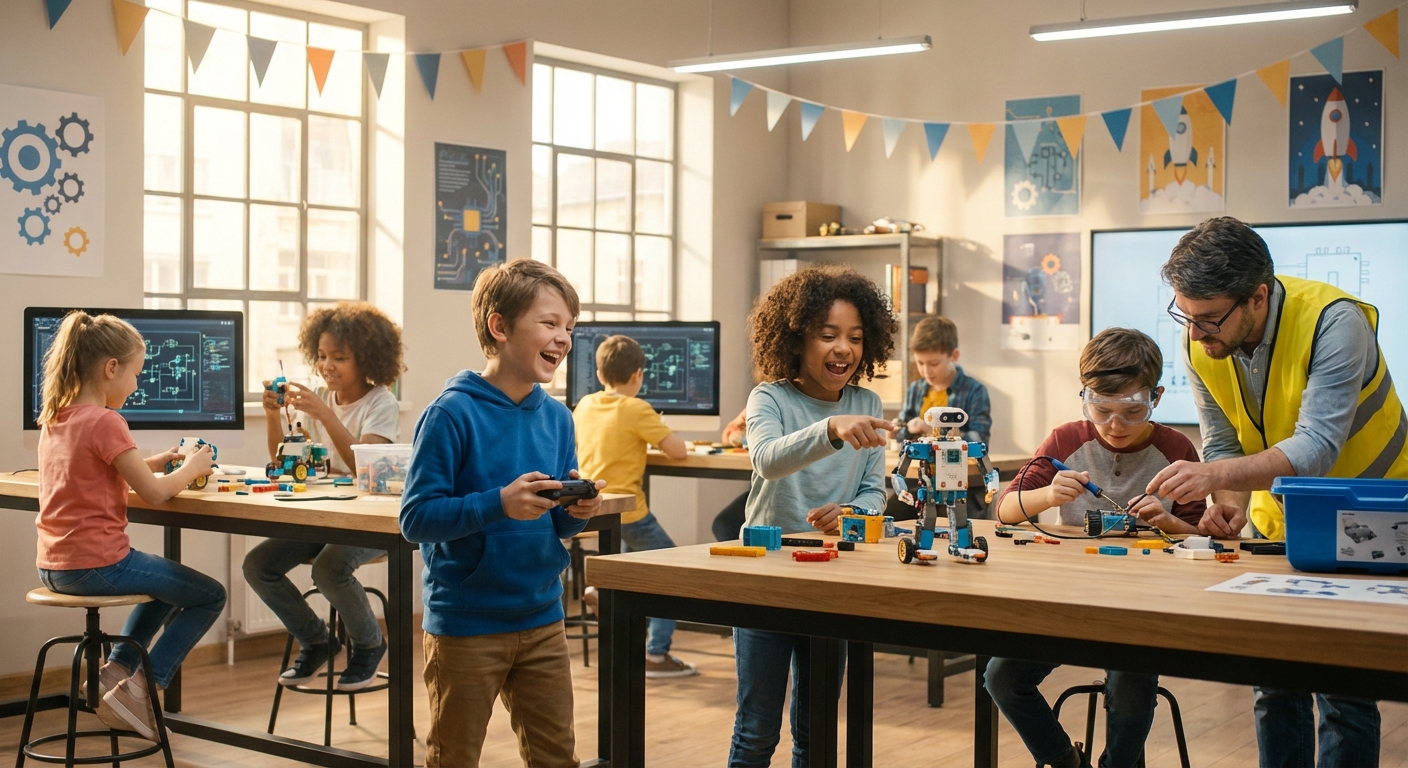
Robotics Basics: Building the Future!
Welcome, young engineers! Have you ever wondered how a robot can pick up a toy, draw a picture, or even explore Mars? In this short guide we’ll discover the Building Blocks of robots, learn new vocabulary, and try a tiny experiment you can do at home. By the end you’ll see how Cause And Effect makes robots move and think.
1. What Is a Robot?
A robot is a Machine that can sense its surroundings, follow programmed rules, and act. Some robots can complete tasks without a person guiding every movement, while others are remotely controlled.
- Machine – a device that uses energy to perform a task.
- Program – instructions that tell a robot how to respond to information from its sensors.
Example: A vacuum‑cleaning robot rolls across the floor, feels obstacles with its sensors, and changes direction to avoid bumping into furniture.
Cause And Effect:
- Cause: The robot’s sensor touches a wall.
- Effect: The robot’s brain tells the wheels to turn away.
2. The Brain and the Body: Sensors & Actuators
Every robot needs two main parts: a Brain (the controller) and a Body (the hardware).
| Part | What It Does | Vocabulary |
|---|---|---|
| Sensor | Gathers information (light, distance, temperature). | Sensor – a device that detects something and sends a signal. |
| Actuator | Moves something (motors, servos, pistons). | Actuator – a component that turns electrical energy into motion. |
| Controller | The “brain” that decides what the robot should do. | Controller – a tiny computer that runs the robot’s program. |
Did You Know? The word actuator comes from the Latin agere, meaning “to do.” It’s the part that makes the robot Do something!
Example: In a drawing robot, a light sensor (eye) tells the controller how dark the paper is. The controller then tells a motor (actuator) to lower the pen and make a line.
3. Giving Robots Instructions: Algorithms & Programming
Robots don’t “think” like we do; they follow an Algorithm—a step‑by‑step set of instructions written in a programming language.
- Algorithm – a precise list of actions to solve a problem.
- Programming – the act of writing these instructions for the robot’s controller.
Cause And Effect:
- Cause: The program says “if the sensor sees an object closer than 5 cm, turn left.”
- Effect: The robot turns left whenever something gets too close.
Example: Scratch is a block-based coding tool that lets you snap together commands such as “move 10 steps” or “turn right 90 degrees.” Other block-based tools can program small robots to follow a line, avoid obstacles, or draw a simple picture.