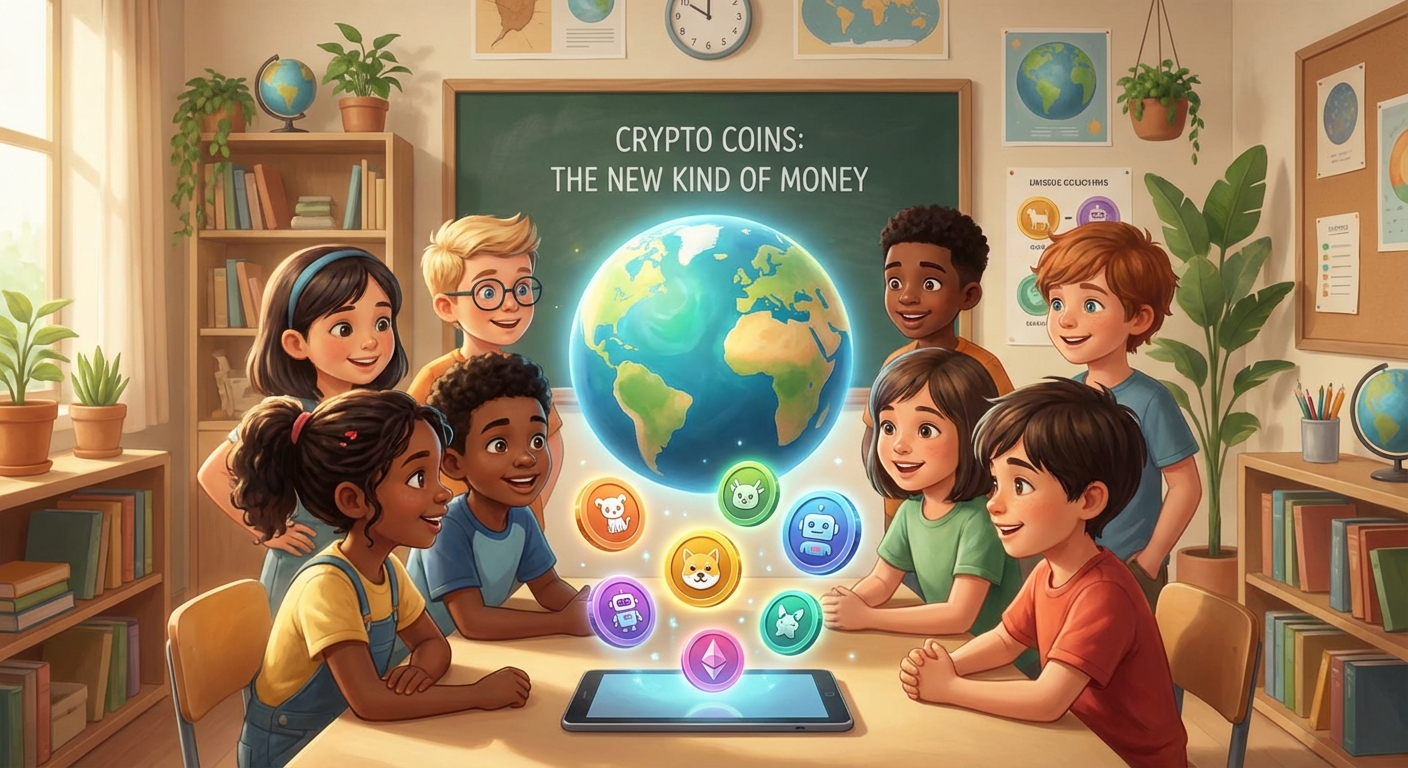
Crypto Coins: the New Kind of Money
Imagine you could send money to a friend on the other side of the world instantly, without needing a bank or a paper bill. That’s what Cryptocurrency (a digital form of money) tries to do. In this guide we’ll explore how it works, why people use it, and what you should watch out for—all while learning some new words!
1. What Is Money? (and Why It Changes)
| Traditional Money | Cryptocurrency |
|---|---|
| Paper bills and metal coins | Numbers stored on computers |
| Issued by governments | Created by computer code (called Software) |
| Physical – you can hold it | Digital – you see it on a screen |
Cause And Effect: When a country prints a lot of paper money, the Inflation (rise in prices) can make each bill worth less. With crypto, the amount that can exist is often Limited (e.g., Bitcoin caps at 21 million coins), which can help keep its value stable—if people keep wanting it.
Did You Know? The word cryptocurrency comes from the Greek word “Crypto” meaning hidden, because it uses clever, ‘hidden’ math (called cryptography) to keep transactions safe and secure.
2. How Does a Cryptocurrency Work?
- Blockchain – Think of a public notebook that records every transaction. Once a page (called a Block) is filled, it’s sealed with a special code and added to the chain.
- Encryption – Fancy math (called Cryptography) scrambles the data so only the owner can unlock it with a secret key (like a password).
- Mining – Some cryptocurrencies let people use computers to solve puzzles. When they solve one, they add a new block and earn new coins as a reward.
Vocabulary Boost
- Decentralized – Not controlled by a single person or bank; many computers share the power.
- Token – A digital representation of value, similar to a coin.
Cause And Effect: More miners solving puzzles → more blocks added → the network stays secure and trustworthy.
3. Why Do People Like Crypto?
- Speed: Send money in seconds, not days.
- Borders: No need for currency exchange when traveling.
- Privacy: Your name isn’t attached to the transaction (though the transaction is still visible on the blockchain).
Risks to Remember
- Volatility: Prices can jump up or down quickly—like a roller‑coaster.
- Scams: Some fake sites promise free coins but steal your personal info.
- Irreversibility: If you send crypto to the wrong address, you can’t get it back (no “undo” button).
Did You Know? The first cryptocurrency, Bitcoin, was created in 2009 by a mysterious person (or group) named Satoshi Nakamoto.
4. Mini Experiment: Make Your Own “crypto” Ledger
What You Need
- 10‑15 index cards (these are your “blocks”)
- A marker
- 5‑6 friends or family members
Steps
- Write “Block 1” on the first card.
- On the back, list a simple transaction: “Alice gives 2 tokens to Bob.”
- Seal the block by drawing a unique code (a simple hash) – for example, write the first three letters of the transaction plus the block number.
- Add the next block with a new transaction, using the previous block’s code as part of the new code.
- Keep adding blocks, forming a chain.
What You Learned:
- Each block depends on the previous one, so changing an old block would break the chain.
- The unique codes (hashes) make the ledger secure and trustworthy.
- This is exactly how real blockchains work—just with much more complex math!
Quick Quiz
| Question | Answer |
|---|---|
| What is cryptocurrency? | Digital money stored on computers |
| What is a blockchain? | A public notebook that records every transaction |
| What does “decentralized” mean? | Not controlled by a single person or bank |
| Who created Bitcoin? | Satoshi Nakamoto (in 2009) |
Wrap‑up
Cryptocurrency is a new way of thinking about money—digital, fast, and secured by clever math. While it has exciting possibilities, it also comes with risks like volatility and scams. Understanding the basics helps you stay curious and safe as technology continues to change how we use money. Welcome to the future of finance!