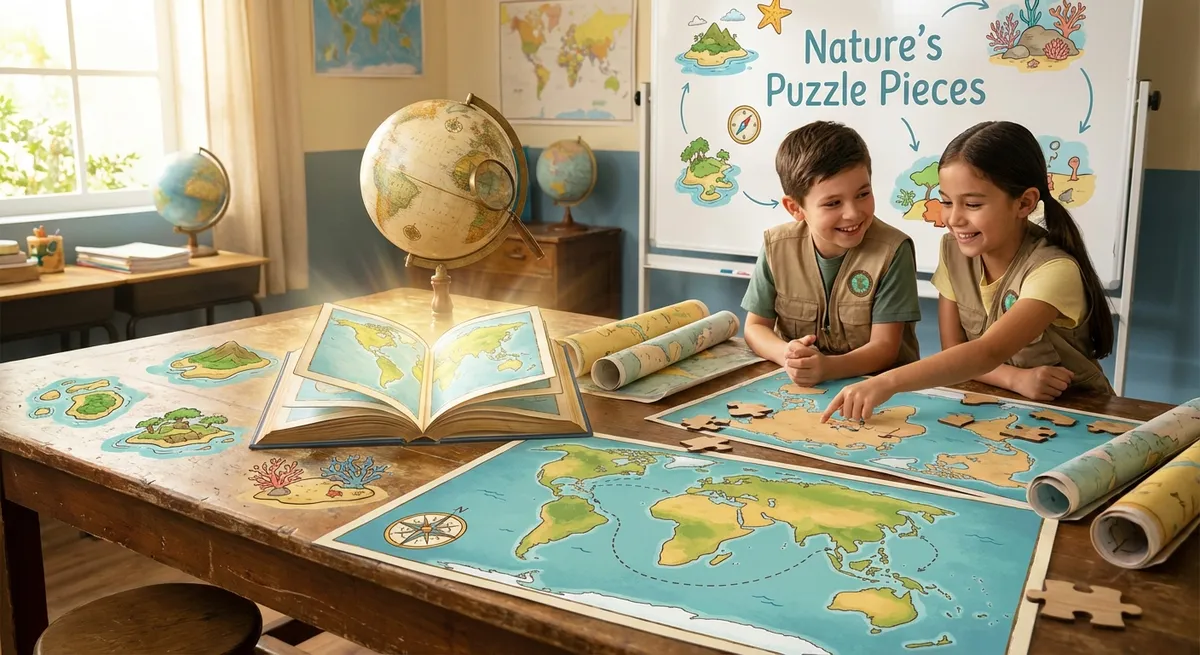
️ Islands & Archipelagos: Nature’s Puzzle Pieces
Have you ever looked at a map and seen a tiny dot of land surrounded by water? That’s an Island—a piece of Earth that rises up from the sea. When many islands live close together, they form an Archipelago. In this adventure we’ll explore how islands appear, why they’re important, and how you can discover more about them right at home!
1. What Exactly Is an Island?
- Definition: An island is a landmass completely surrounded by water.
- Key Vocabulary:
- Landmass – a large area of land.
- Surrounded – all around something.
Cause & Effect:
When the ocean water rises around a hill or a mountain, the high ground stays dry, creating an island. If the water level drops, that same piece of land might become part of the mainland again.
Did You Know? The word “island” comes from the Old English ī(e)gland, meaning “water‑land.”
2. How Do Islands Form?
| Type of Island | How It Forms | Example |
|---|---|---|
| Volcanic | A volcano erupts underwater, and lava piles up until it breaks the surface. | Hawaii (Big Island) |
| Continental | A piece of a continent breaks off due to Tectonic (Earth‑moving) forces. | Madagascar |
| Coral | Tiny sea animals called Corals build reefs that can become land over thousands of years. | Maldives |
| Erosional | Wind and water wear away a larger landmass, leaving a small piece behind. | Isle Of Wight (UK) |
Complex Word Spotlight:
- Tectonic – relating to the huge plates that make up Earth’s crust. When they shift, they can lift or split land, creating islands.
Cause & Effect:
- Volcanic Islands appear quickly (a few years) but can grow huge as more eruptions add layers of lava.
- Coral Islands need warm, clear water for corals to thrive; if the water gets too cold, the island may stop growing.
3. Archipelagos: Island Families
An Archipelago is a group of islands that belong together, like a family of siblings.
Famous Archipelagos
- Indonesia – Over 17,000 islands, including Java and Sumatra.
- The Philippines – About 7,600 islands, home to the world’s longest underground river.
- The Caribbean – A tropical chain of islands like Jamaica, Cuba, and Barbados.
Cause & Effect:
Because islands in an archipelago are close, animals and plants can travel between them on floating seeds, birds, or even on the backs of turtles. This leads to Biodiversity—a rich variety of life.
Did You Know? The word “archipelago” originally referred only to the Aegean Sea’s many islands. Now it means any island group!
4. Life on Islands: Unique and Fragile
Islands often host species that live nowhere else. For example, the Galápagos Giant Tortoise lives only on the Galápagos Islands.
- Isolation (being far from other lands) lets species evolve in special ways.
- Fragility – Because island ecosystems are small, they can be easily upset by pollution, invasive species, or climate change.
**Mini Experiment:.