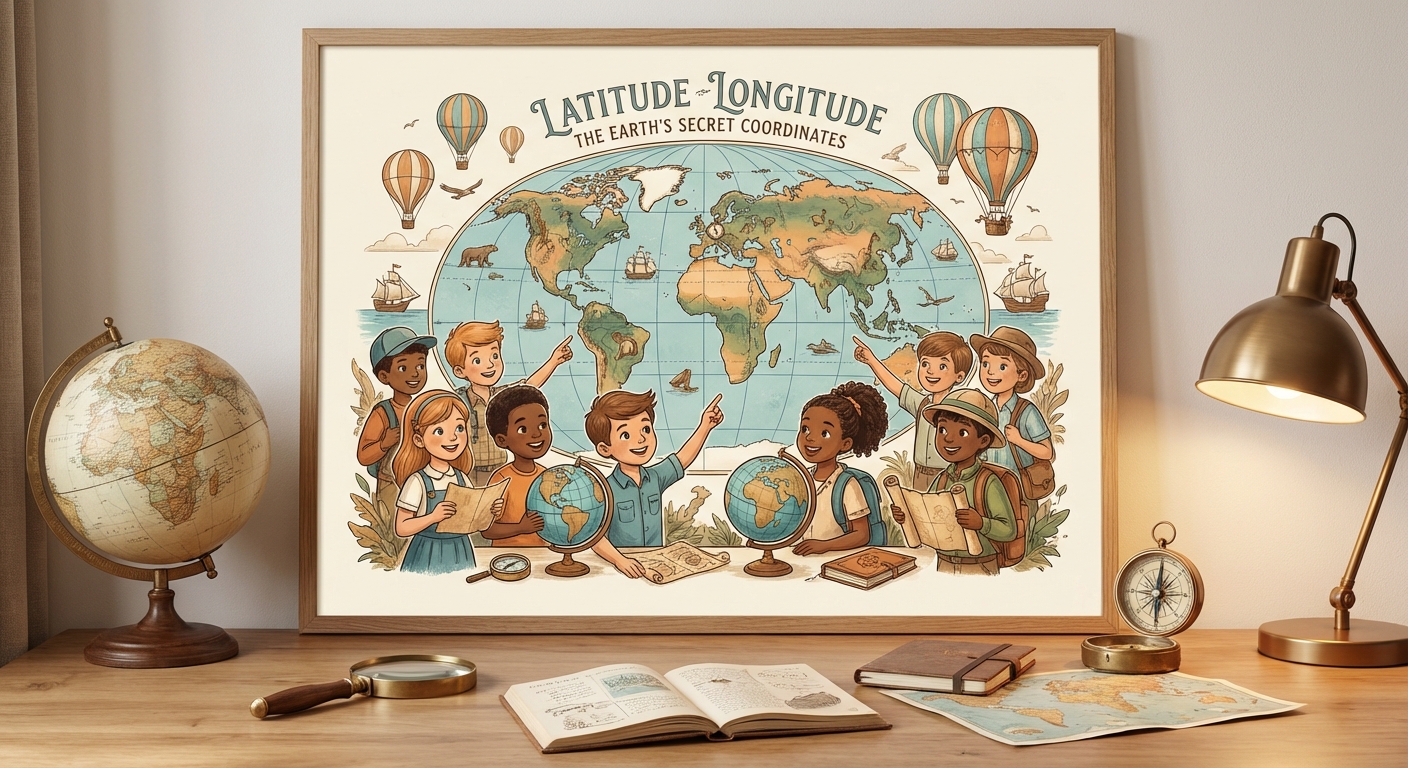
Latitude & Longitude: the Earth’s Secret Coordinates
Imagine you have a giant treasure map that covers the whole planet. To find any hidden spot—your home, the Eiffel Tower, or a distant volcano—you need a special “address.” That address is made of two numbers: Latitude and Longitude. In this guide we’ll explore what they are, how they work, and why they matter for everything from weather to travel.
1. What Is Latitude?
- Definition – Latitude tells you how far north or south a place is from the Equator, the invisible line that circles the middle of Earth.
- How It’s Measured – Think of the Earth as a sliced orange. The slices are called Parallels because they run parallel to each other. Each parallel is given a number of degrees (°) from 0° at the Equator up to 90° at the North Pole or South Pole.
- Vocabulary Boost
- Equator – the line that divides Earth into the Northern and Southern Hemispheres.
- Hemisphere – half of the Earth (north, south, east, or west).
Example:
- Singapore sits at about 1° N latitude—just a tiny bit north of the Equator, which is why it’s warm all year.
Cause & Effect:
Higher latitudes (closer to the poles) receive sunlight at a slant, making them colder. Lower latitudes (near the Equator) get direct sunlight, leading to hot, tropical climates.
2. What Is Longitude?
- Definition – Longitude tells you how far east or west a place is from the Prime Meridian, an imaginary line that runs from the North Pole to the South Pole through Greenwich, England.
- How It’s Measured – The Earth is split into 360° of longitude. The Prime Meridian is 0°, and the numbers increase up to 180° eastward and 180° westward.
- Vocabulary Boost
- Prime Meridian – the starting line for measuring longitude.
- Meridian – any line that runs north‑south on a globe.
Example:
- Los Angeles, Usa is about 118° W (west) longitude, placing it on the western side of the Prime Meridian.
Cause & Effect:
Because Earth rotates from west to east, the Sun rises in the east and sets in the west. This rotation makes local time depend on longitude—places far apart in longitude have different “clock times.”
3. Putting Latitude & Longitude Together
Every spot on Earth can be pinpointed with a pair of numbers, like a secret code: (Latitude, Longitude).
| Location | Latitude | Longitude |
|---|---|---|
| Nairobi, Kenya | 1° S | 36° E |
| Tokyo, Japan | 35° N | 139° E |
| Rio de Janeiro, Brazil | 23° S | 43° W |
Did You Know?
- The International Date Line roughly follows the 180° longitude line. Crossing it can make you “skip” a day!
4. Mini Experiment: Make Your Own Coordinate Map
What You Need:
- A printed world map or a printable globe template (available online)
- Two colored markers (one for latitude, one for longitude)
- Sticky notes
Steps:
- Choose a city you love (e.g., Paris). Look up its coordinates (≈ 48° N, 2° E).
- On the map, draw a horizontal line at 48° N (latitude) and a vertical line at 2° E (longitude).
- Place a sticky note where the two lines meet and write “Paris – 48° N, 2° E.”
- Repeat with two more cities. Notice how each pair of coordinates lands on a unique spot!