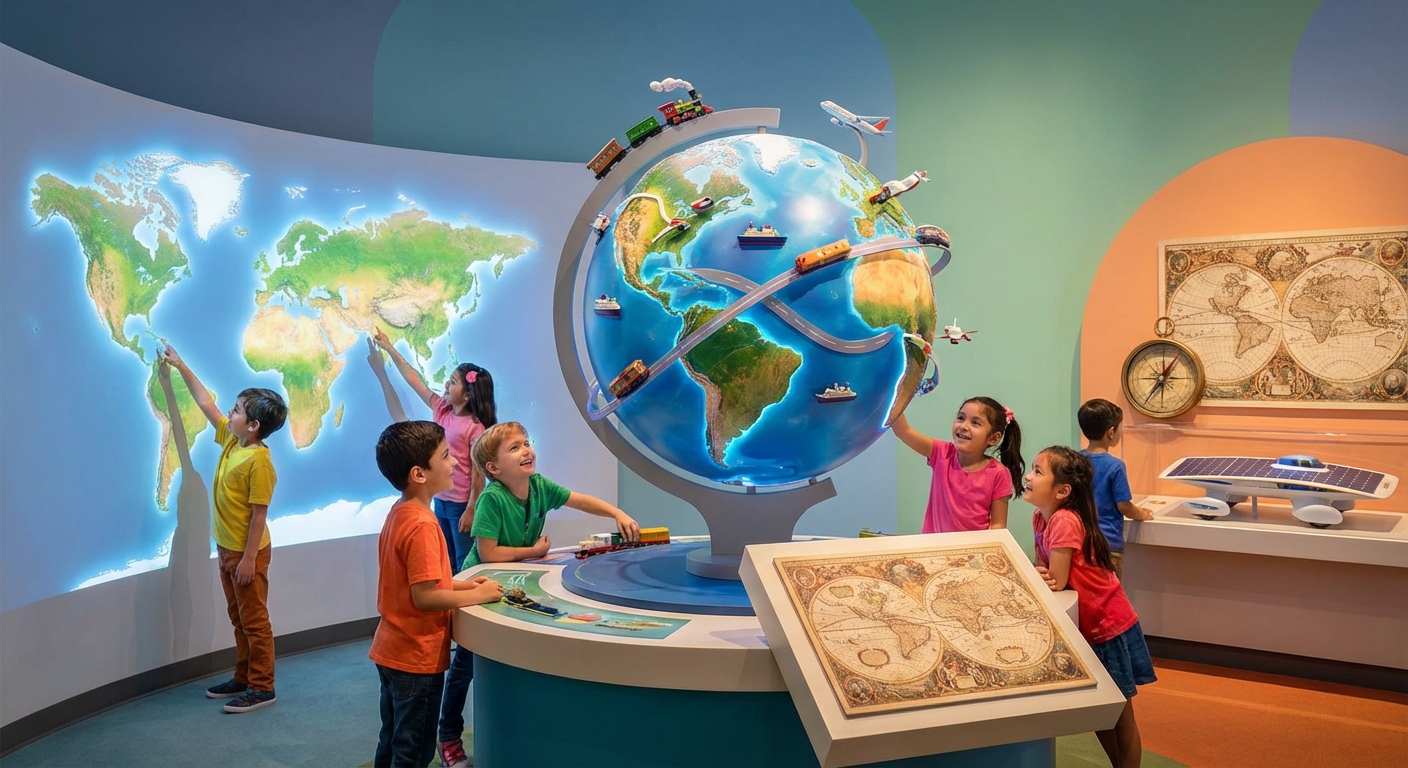
How People Move: Transportation Networks
Explore the roads, rails, rivers, and skies that connect towns, cities, and countries.
Every day you travel to school, the park, or a friend’s house. Behind each trip is a Transportation Network – a system of paths that lets people and goods move from one place to another. In geography, we study how these networks are built, why they matter, and how they shape the world around us.
1. Roads and Highways: The Land’s Lifelines
What They Are – Roads are paved routes for cars, buses, bikes, and even walking. When many roads join together, they form a Highway Network that can stretch across a whole country.
Why They Matter – A new road can make a distant village easier to reach, which often leads to more shops, schools, and jobs. This is called Cause And Effect: building a road → more visitors → more businesses.
Vocabulary Boost
- Infrastructure – the basic physical structures (roads, bridges, tunnels) a society needs.
- Congestion – when too many vehicles crowd a road, slowing traffic.
Example – The Trans‑canada Highway is the longest national highway in the world, stretching over 7,800 km from the Atlantic to the Pacific Ocean.
2. Rails and Trains: Speed on Steel
What They Are – Trains run on Railways, which are tracks made of steel rails. Because steel is very smooth, trains can travel faster and carry heavier loads than most trucks.
Why They Matter – Railways often link big cities and industrial areas, helping factories ship products quickly. When a railway is built, towns along the line can grow into bustling Urban Centers.
Vocabulary Boost
- Freight – goods or cargo that are transported, especially by ship, train, or truck.
- Commuter – a person who travels regularly between home and work or school.
Example – Japan’s Shinkansen (bullet train) can zoom at 300 km/h, connecting cities like Tokyo, Osaka, and Kyoto in just a few hours.
3. Waterways: Rivers, Canals, and Ships
What They Are – Rivers, lakes, and oceans are natural Waterways. Humans have also dug Canals—artificial channels—to connect bodies of water and create shortcuts for ships.
Why They Matter – Water can carry very heavy loads with less fuel than trucks or trains, making it an economical choice for international trade. A new canal can open up trade routes, changing the economic Balance of a region.
Vocabulary Boost
- Navigation – the act of planning and following a route, especially on water.
- Port – a harbor where ships load and unload cargo.
Example – The Panama Canal links the Atlantic and Pacific Oceans, letting ships avoid a long trip around South America.
4. Skies: Airports and Air Travel
What They Are – Airports are places where Aircraft (planes, helicopters) take off and land. Air routes create a Global Network that can connect the farthest corners of the Earth in just a few hours.
Why They Matter – Air travel is essential for fast delivery of perishable goods (like fresh fruit) and for people to reach remote locations quickly. However, planes also use a lot of Fuel, which can affect the environment.
Vocabulary Boost
- Aviation – the science, design, and operation of aircraft.
- Runway – a long, flat surface where planes land and take off.
Example – Dubai International Airport is one of the busiest airports for international passenger traffic, linking Asia, Europe, Africa, and the Americas.
Mini Quiz & Hands‑on Experiment
Quiz
- True Or False: Highways are designed to carry many vehicles between places.
- Which Word Means “Goods Transported By Ship”?
- Name one way air travel helps people or goods move quickly.
Write your answers and compare them with a friend to discover how transportation supports your community.
Answers: 1. True. 2. Freight. 3. For example, it can move people or time-sensitive goods over long distances quickly.