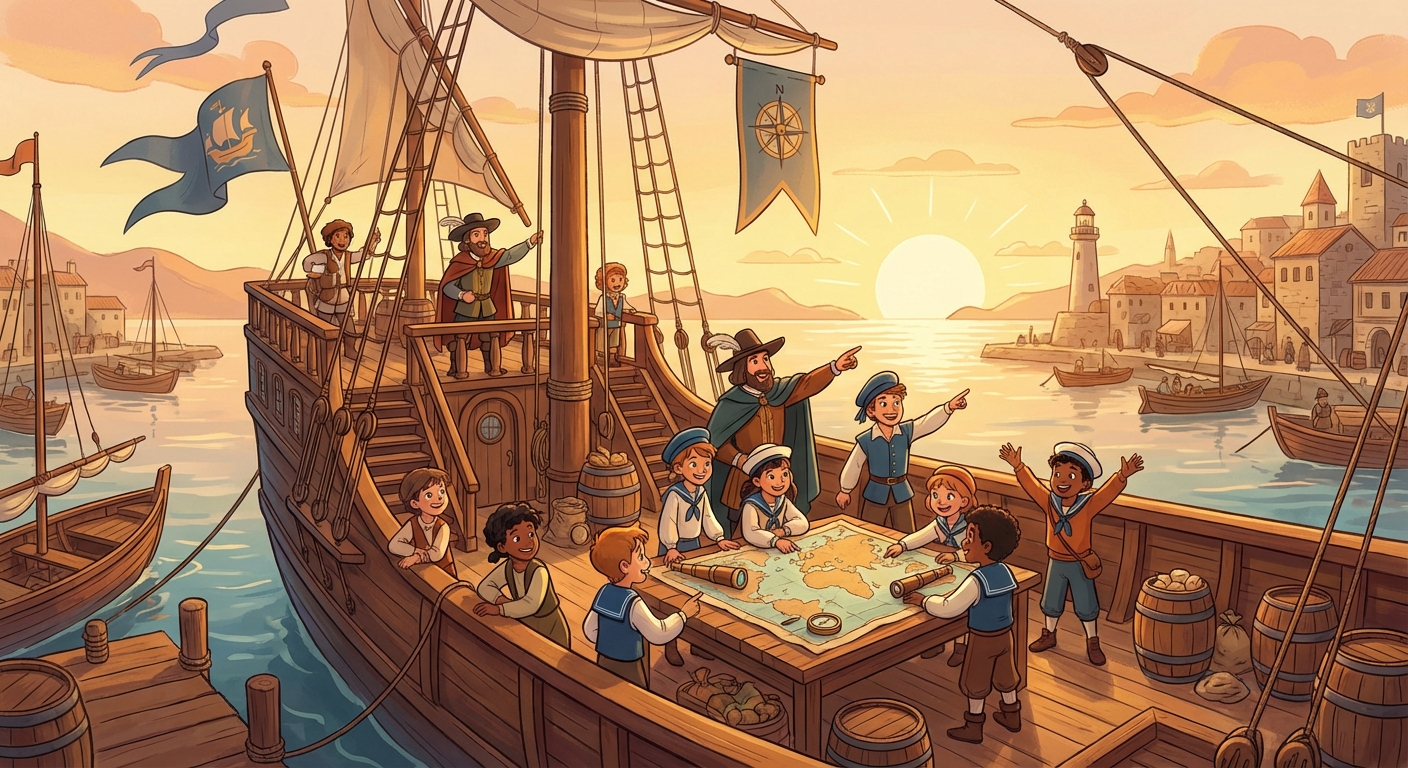
The Age of Exploration: Setting Sail into the Unknown
Around 500 years ago, brave sailors left their home ports to discover new lands, trade routes, and peoples. This period—called the Age Of Exploration (≈ 15th‑17th centuries)—changed the world forever. Let’s dive into why they sailed, who they were, what they found, and how their journeys still affect us today.
1. Why Did People Set Out? – The Spark of Curiosity
| Cause | Explanation |
|---|---|
| Spice Cravings | Europeans loved exotic flavors like pepper, cinnamon, and nutmeg. These spices were Precious (very valuable) because they were hard to get. |
| Trade Competition | Nations such as Portugal and Spain wanted to Monopolize (control completely) the spice trade, so they looked for sea routes that avoided middlemen. |
| Religious Zeal | Some explorers hoped to spread Christianity to new peoples. |
| Technological Advances | New tools—like the Caravel (a fast sailing ship) and the magnetic Compass—made long voyages safer. |
Cause → Effect: The desire for spices + better ships Led To daring voyages across unknown oceans.
2. Famous Explorers and Their Epic Journeys
| Explorer | Country | Notable Voyage | What They Found |
|---|---|---|---|
| Bartolomeu Dias | Portugal | Rounded the Cape of Good Hope (1488) | Showed that Portuguese ships could reach the Indian Ocean around southern Africa. |
| Christopher Columbus | Spain | Crossed the Atlantic (1492) | Reached the Caribbean, thinking he’d found a new route to Asia. |
| Vasco Da Gama | Portugal | Sailed around Africa to India (1498) | Completed a direct sea voyage from Europe to India, expanding Portuguese trade and empire. |
| Ferdinand Magellan | Spain | Began the expedition that completed the first recorded Circumnavigation (1519‑1522) | Magellan died during the voyage; Juan Sebastián Elcano led the surviving ship back to Spain. |
Vocabulary Boost:
- Circumnavigation – sailing all the way around the globe.
- Monopolize – to have exclusive control over something.
3. What Was Discovered? – The Ripple Effects
- Encounters And Invasions – Europeans encountered societies in the Americas, Africa, and Asia that already had their own lands, knowledge, and trade networks. Some voyages led to conquest and colonization.
- Exchange Of Goods – The Columbian Exchange swapped foods (potatoes, tomatoes, maize) and animals (horses, cattle) across continents, reshaping diets worldwide.
- Maps Got Better – Explorers’ logs helped cartographers draw more accurate world maps, turning “blank spaces” into known territories.
- Colonial Competition – Nations raced to claim lands, leading to Colonialism (control of one country by another) and lasting cultural impacts.
Cause → Effect: The discovery of new routes Caused a boom in trade, which Triggered the spread of plants, animals, ideas, and unfortunately, also conflict.
4. Did You Know? 🤔
- A Tiny Fruit Changed History – The peppercorn, a tiny spice, motivated Portugal to send explorers around Africa.
- A Map Named America: Martin Waldseemüller’s 1507 map was the first known map to use the name “America.” Gerardus Mercator published his influential projection in 1569.
- Magellan Never Saw The Finish Line: Ferdinand Magellan was killed in the Philippines in 1521. Juan Sebastián Elcano then led the expedition’s one surviving ship back to Spain, completing the first recorded circumnavigation.