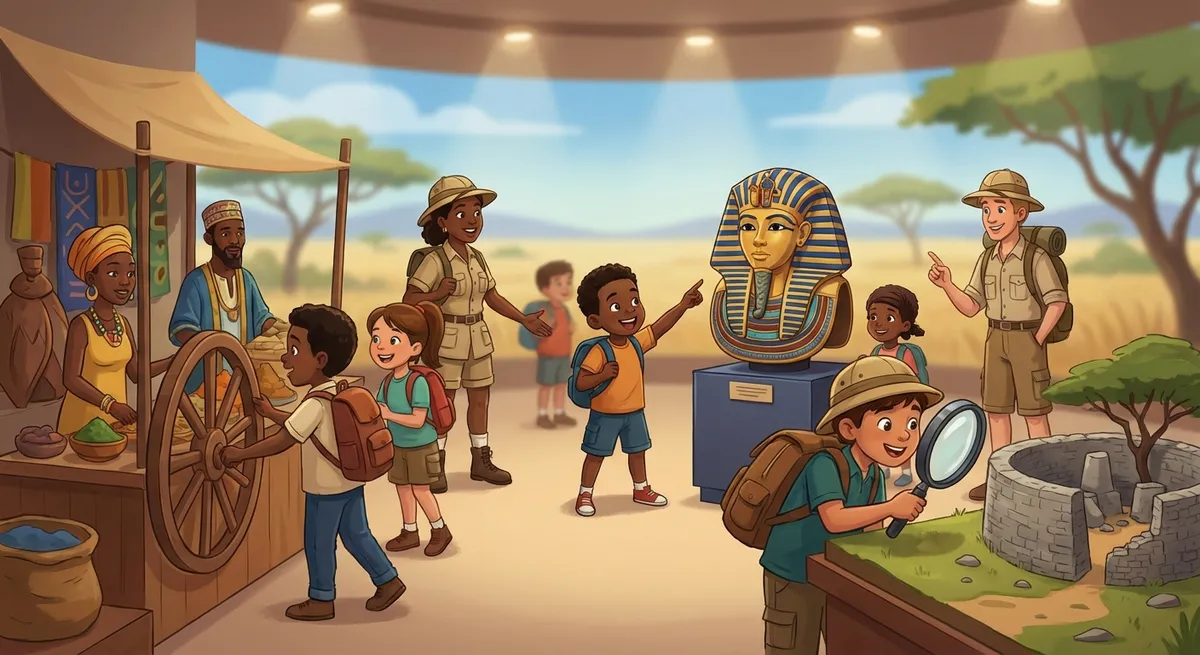
Ancient Africa: A Journey Through Time
Welcome, young explorers! Africa is the continent where Humans First Walked and where many amazing Civilizations (organized societies with cities, writing, and laws) grew. In the next few pages, we’ll travel back thousands of years, meet powerful kingdoms, discover clever inventions, and see how everyday life was shaped by the land and the Environment (the natural world around us).
1. The Cradle of Humanity
What Happened?
Scientists call East Africa the Cradle of Humanity because the oldest fossils of our ancestors—like Australopithecus and Homo Habilis—were found there. These early humans learned to Tool‑make (create objects to help them survive) and to Hunt and Gather food.
Cause And Effect:
- Cause: The region had a mix of forests, grasslands, and rivers.
- Effect: Early people could find many kinds of food and materials, which helped them survive and spread to other parts of the world.
Did You Know?
The famous fossil named “Lucy” is over 3 million years old and was discovered in Ethiopia in 1974.
New Word: Fossil – the preserved remains or impression of a once‑living plant or animal, usually found in rock.
2. Great Kingdoms of the Nile
Ancient Egypt (c. 3100 – 30 Bc)
The Nile River flooded every year, leaving Fertile (rich, good for growing crops) soil on its banks. Egyptians used this to grow wheat and barley, which fed millions of people.
- Hieroglyphics: A picture‑writing system. Each symbol stood for a sound or an idea.
- Pyramids: Massive stone tombs built for pharaohs (kings). They were constructed using Levers and Ramps—early engineering marvels.
Cause And Effect:
- Cause: Predictable Nile floods.
- Effect: Stable food supply → large cities → powerful rulers → impressive monuments.
Kingdom of Kush (c. 1070 BC – 350 Ad)
South of Egypt, along the Nile, the Kushites built a kingdom with its own pyramids and iron‑working skills. They even ruled Egypt for a time!
Did You Know?
Kushite queens, called Kandakes, were known as fierce warriors and diplomats.
New Word: Iron‑working – the process of shaping iron into tools and weapons, a major technological advance.
3. West African Trade & Gold
From the 8th to the 16th centuries, the Mali and Songhai empires thrived in the Sahara’s desert edge.
- Gold: West Africa produced so much gold that it was called “the golden coast.”
- Salt: A precious mineral used to preserve food. It was traded for gold, creating a Trade Network (a system of exchanging goods over long distances).
Cause And Effect:
- Cause: Rich gold mines and access to desert trade routes.
- Effect: Wealthy cities like Timbuktu grew, attracting scholars, traders, and artists.
Did You Know?
Mansa Musa, the ruler of Mali, made a famous pilgrimage to Mecca in 1324, giving away so much gold that the
… giving away so much gold that the value of gold in Egypt and other places dropped for several years.
The wealth from gold and salt made cities like Timbuktu famous for their libraries and schools, where scholars studied mathematics, astronomy, and poetry.
4. Great Zimbabwe (c. 1100 – 1500 AD)
In southern Africa, the people built the stone city of Great Zimbabwe. Its massive walls and towers were made without mortar, using only carefully placed granite blocks.
- Trade: The city traded gold, ivory, and cattle with traders from the Swahili coast, who brought in cloth, beads, and spices.
- Everyday Life: Families lived in round huts with thatched roofs, and children helped gather water, tend animals, and learn stories from elders.
Cause And Effect:
- Cause: Access to rich gold mines and a central location for trade routes.
- Effect: A powerful kingdom that could build impressive stone structures and influence a wide region.
Did You Know?
The name “Zimbabwe” comes from a Shona word meaning “stone houses.”
New Word: Masonry – the craft of building with stone.
Ancient Africa Quiz
From the first footsteps of our ancestors to the rise of mighty kingdoms, Africa’s history is a vibrant tapestry of people, inventions, and landscapes that shaped the world. Keep exploring, and you’ll discover even more amazing stories!