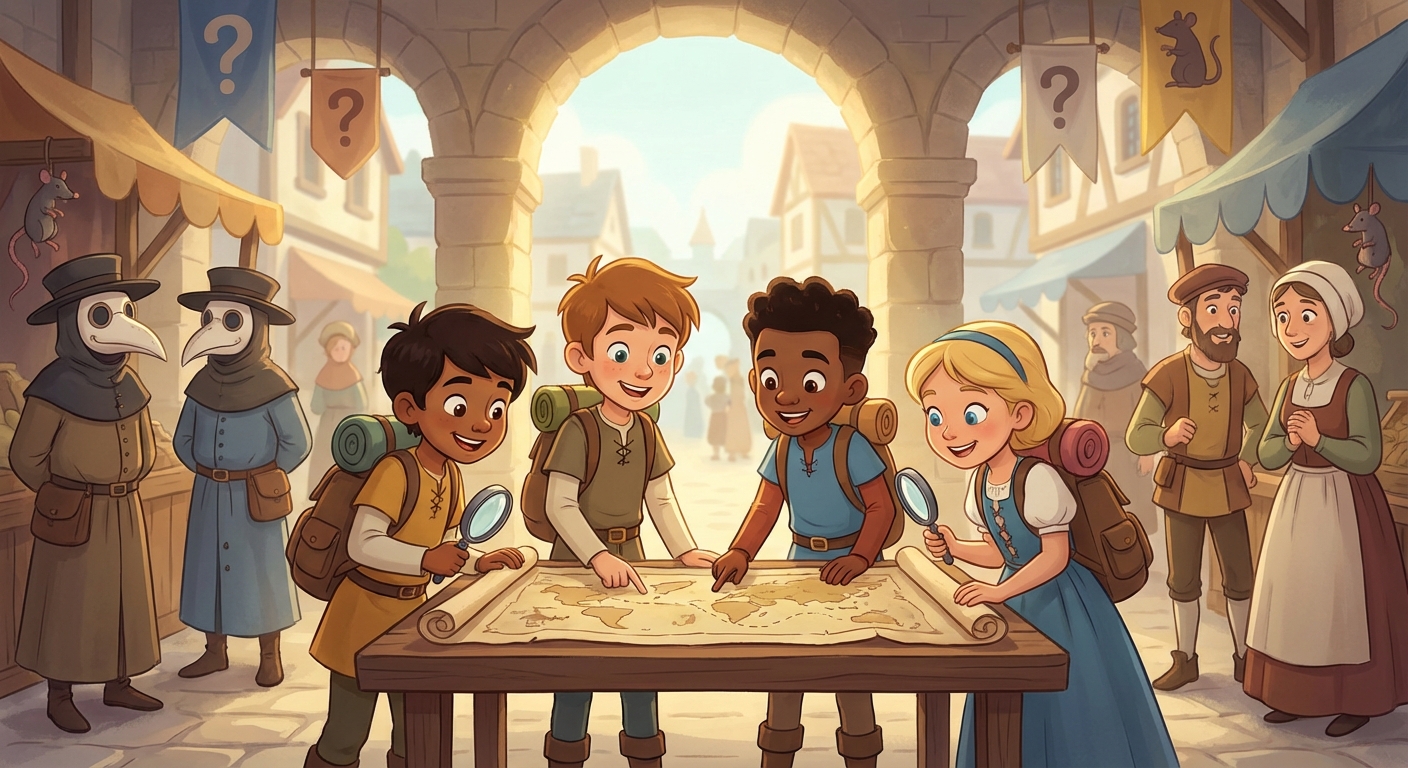
The Black Death: A Medieval Mystery
A long time ago, in the 1300s, a terrible sickness called the Black Death swept across Europe, Asia, and Africa. It changed the lives of millions of people and even shaped the world we live in today. Let’s travel back in time to discover what caused this pandemic, how it affected societies, and what we can learn from it.
1. What Was the Black Death?
The Black Death was a Pandemic—a disease that spreads over a huge area and affects many people at once. It was caused by a tiny germ called Yersinia pestis, a type of Bacterium (a microscopic living thing that can make us sick).
One form, bubonic plague, can cause painful swollen lymph nodes called buboes (pronounced “byoo-bohs”), often in the groin, armpit, or neck. The name Black Death became common after the medieval pandemic; explanations of the name’s exact origin are debated.
Did You Know? The word “plague” comes from the Latin plaga, meaning “a blow” or “a strike.” The Black Death was truly a massive “blow” to medieval societies.
Vocabulary Boost
| Word | Meaning (in kid‑friendly language) |
|---|---|
| Pandemic | A disease that spreads across many countries at the same time |
| Bacterium | A tiny living thing that can cause illness |
| Buboes | Swollen, painful lumps that appear on the skin |
| Quarantine | Keeping sick people away from others to stop the spread |
| Vector | A living carrier, such as a flea, that can transmit a pathogen between hosts |
2. How Did It Spread?
The Black Death moved along trade and travel routes. Yersinia pestis can spread through bites from infected fleas, contact with infected animals, and respiratory droplets when a person has pneumonic plague. Rodents and fleas were important, but researchers continue to study the relative roles of different animals, human parasites, and person-to-person transmission during the medieval pandemic.
Crowding, housing, trade, nutrition, climate, war, animal and flea populations, and limited medical knowledge may all have affected transmission and outcomes. One simple cause does not explain the whole pandemic.
Cause and Effect Chain
- Cause: Yersinia pestis reaches new hosts through a transmission route.
- Effect: Some exposed people develop plague, while symptoms and outcomes vary.
- Effect: Travel and contact can carry infection to other places.
- Effect: High mortality changed households, work, farming, trade, religion, and government in different ways.
3. Life During the Black Death
- Population Drop: Between one‑third and one‑half of Europe’s people died in just a few years.
- Changing Work: Labor shortages strengthened some workers’ bargaining power, while laws and local conditions limited others.
- Social Responses: Communities used religious practices, care, flight, quarantine, burial rules, and other responses. Effects varied across regions and groups.
Example: The Flagellants
Some Christian groups called flagellants practiced public self-punishment because they believed the plague reflected divine anger. This did not treat the bacterial disease, and some groups also attacked Jewish communities or other scapegoats. Blaming a group for disease is false and harmful.
4. Did You Know?
- Estimates are uncertain, but historians often place the Black Death’s European death toll in the tens of millions.
- Historians debate how the pandemic influenced later economic, political, religious, and cultural changes. It should not be presented as the single cause of the Renaissance.
Mini Activity: Map How Contact Can Spread Infection
(This paper model uses no real germs.)
- Draw six circles representing people in a town.
- Connect two circles for every imagined close contact during one day.
- Color one circle, then trace all the people it could reach through the contact lines.
- Remove some lines to model staying home when sick or avoiding crowded contact. Compare the result.
This is only a simple network model. Real infections spread in different ways, and risk also depends on ventilation, distance, time, immunity, and the particular germ.
Black Death Quiz
Keep Exploring
Share one way communities helped each other during the Black Death and ask what kindness you’d try today. Linking past courage to now keeps the story alive.