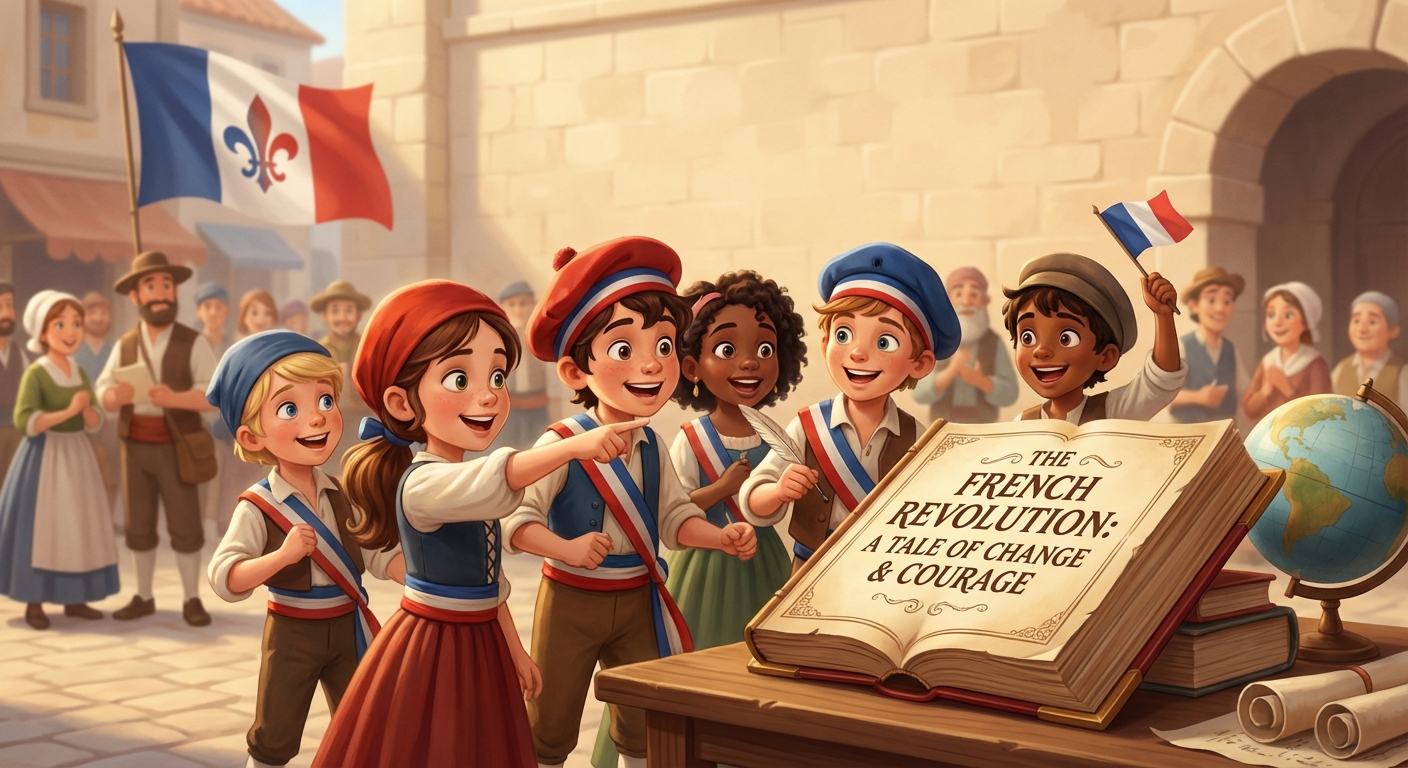
The French Revolution: A Tale of Change and Courage 🇫🇷
Imagine living in a kingdom where a tiny group of people own almost everything, while most families struggle to buy food. In the late 1700s, this was life in France. A series of events called the French Revolution turned that world upside‑down. Let’s travel back in time, discover why people rose up, and see how their bravery reshaped a nation.
1. France Before the Revolution – A Kingdom of Unequal Chances
- The Three Estates: French society was divided into three “estates.”
- First Estate – the clergy (church leaders).
- Second Estate – the nobility (princes, dukes, and wealthy landowners).
- Third Estate – everyone else: merchants, craftsmen, peasants, and city workers.
Only the First and Second Estates paid Little Or No Taxes, while the Third Estate shouldered most of the cost. This created a huge Inequality (a big difference in wealth and power).
- Money Troubles: France had spent a lot of money fighting wars, especially helping the American colonies win independence. The royal treasury (the king’s bank) was almost empty, so the king, Louis XVI, tried to raise taxes even higher.
Did You Know? The king’s palace, Versailles, had a garden so large that it needed its own fleet of gardeners! 🌳
2. Why the People Got Angry – Causes That Sparked a Revolution
| Cause | What Happened | Effect (What It Led To) |
|---|---|---|
| Heavy Taxes | Peasants paid taxes on bread, livestock, and even their own homes. | Hunger and anger grew. |
| Food Shortages | Bad harvests made bread—people’s main food—scarce and expensive. | Long lines at markets and riots. |
| Ideas Of The Enlightenment | Philosophers like Voltaire and Rousseau wrote about Rights (fair treatment) and Liberty (freedom). | People began to question the king’s absolute power. |
| The Estates‑general Meeting (1789) | The king called a meeting of all three estates to solve money problems. | The Third Estate realized they had only 1 vote compared to the combined First and Second estates—unfair! |
When the Third Estate declared itself the National Assembly, they said, “We are the true representatives of France!” This bold move was the first big Cause‑and‑effect step toward revolution.
3. The Storming of the Bastille – A Symbolic Victory
- The Bastille: A massive stone fortress in Paris that held political prisoners and, more importantly, lots of gunpowder (explosive material).
- July 14, 1789: Angry crowds marched to the Bastille demanding weapons. After a fierce fight, they captured it.
Why It Mattered:
- It showed that ordinary people could challenge the king’s authority.
- The fall of the Bastille became a Symbol (a powerful picture) of freedom—much like a superhero’s emblem.
Mini‑experiment: Build Your Own “Bastille”
- Gather 20–30 building blocks or LEGO bricks.
- Stack them into a small tower (the “prison”).
- Invite a friend to act as the “crowd” and gently knock it down.
- Discuss how the tower falling felt—just like the real Bastille’s fall gave hope to many.
4. After the Revolution – New Ideas Take Root
- Declaration Of The Rights Of Man And Of The Citizen: The National Assembly wrote a new document saying that “men are born and remain free and equal in rights.” It promised freedom of speech, religion, and fair laws.
- The End Of Monarchy: Eventually, the King and Queen lost their power, and France became a Republic (a country ruled by elected leaders, not a king).
Cause And Effect: The French Revolution inspired people all over the world to fight for their own rights. It showed that when people unite, they can change even the most powerful governments.
The French Revolution was a messy but important time in history. It taught the world that fairness and freedom are worth fighting for. Although it took a long time for peace to return, the ideas of Liberty, Equality, And Fraternity still shape how we think about rights today. Vive la France! 🇫🇷 ## Quiz
-
What event is celebrated in France on July 14th?
a) The signing of the Declaration of the Rights of Man
b) The storming of the Bastille ✓
c) The coronation of Louis XVI
d) The first French election -
Which three words best describe the ideas that came from the French Revolution?
a) Power, Wealth, Tradition
b) Liberty, Equality, Fraternity ✓
c) Faith, Loyalty, Duty
d) Courage, Honor, Glory -
Who were the members of the Third Estate?
a) Kings and queens
b) Nobles and princes
c) Clergy and bishops
d) Peasants, merchants, and city workers ✓
Answer Key: 1‑b, 2‑b, 3‑d.
Keep exploring history and keep asking questions!