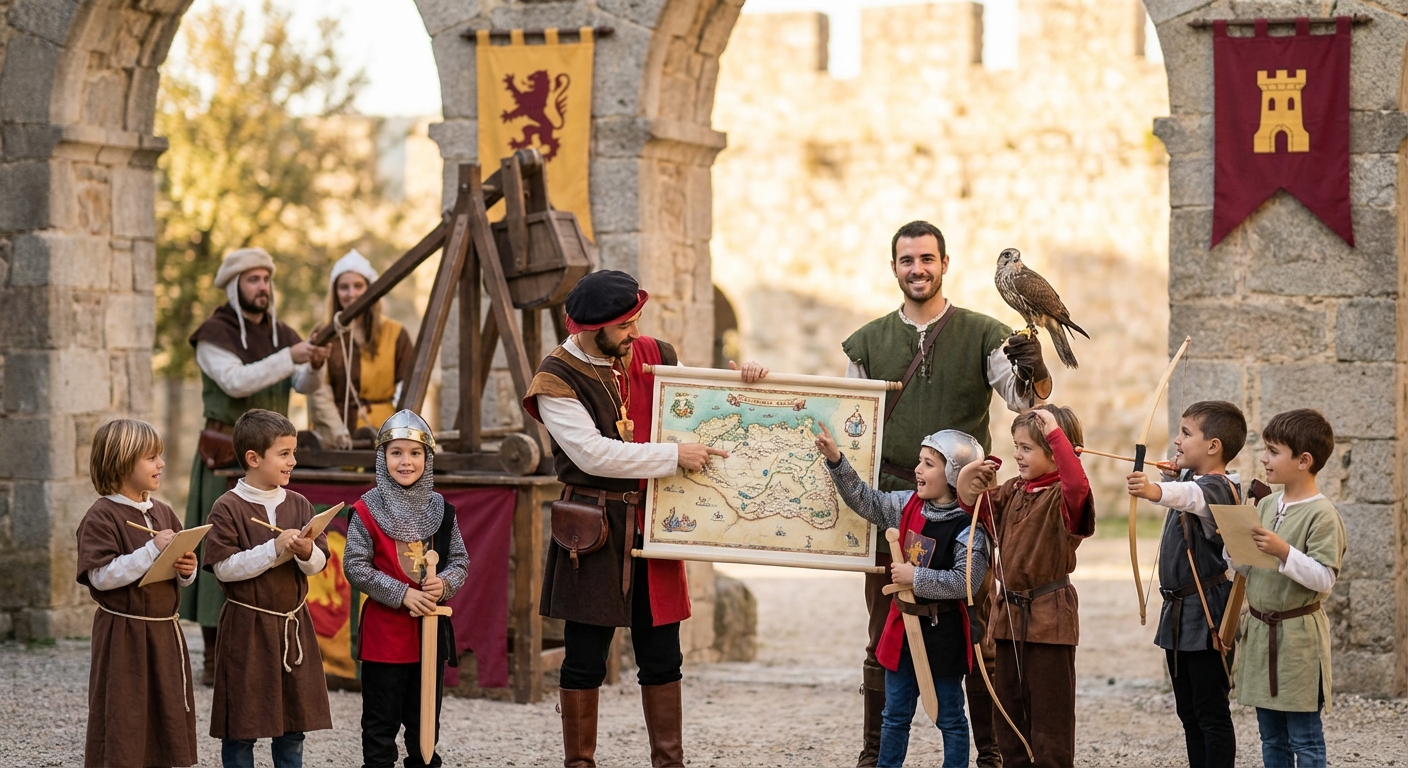
Medieval Times: A Journey Back to the Age of Knights and Castles
Imagine a world of towering stone castles, brave knights on shining armor, and bustling market squares where people trade spices, wool, and stories. This was the Medieval Period—also called the Middle Ages—that lasted from about the 5th to the 15th century. Let’s travel back in time and discover how people lived, worked, and played during this exciting era!
1. Life Inside a Castle
What a Castle Was
A castle was a huge stone Fortress built on a hill or near a river to protect the ruler (the Lord) and his family. Inside were:
- Great Hall – the main room where feasts were held.
- Keep – the strongest tower where the lord slept and stored valuables.
- Bailey – an open courtyard surrounded by walls.
Vocabulary Boost
- Fortress – a strong building designed for defense.
- Keepsake – a small object kept for memory (different from “keep,” the tower!).
Cause & Effect
Because enemies often tried to invade, castles had Moats (deep water ditches). The moat made it harder for attackers to reach the walls, which Protected the people inside.
Did You Know?
Some castles had secret Passageways that let the lord escape silently if the castle was captured!
2. Knights, Squires, and the Code of Chivalry
Who Was a Knight?
A knight was a trained warrior who rode a horse and wore armor. Before becoming a knight, a boy started as a Page, then a Squire, learning how to use a sword, care for a horse, and behave politely.
Vocabulary Boost
- Squire – a young man who assists a knight and learns to become one.
- Chivalry – a set of rules telling knights to be brave, loyal, and courteous, especially to women and the weak.
Example
Sir William, a knight, rescued a village from a band of robbers. Because he followed chivalry, he helped the villagers rebuild their homes instead of taking their food.
Cause & Effect
When knights protected towns, people felt safer and could focus on farming and crafts, which Boosted the local economy.
Did You Know?
The word “knight” comes from the Old English cniht, meaning “boy” or “servant”!
3. Daily Life for Everyone Else
The Feudal System
Most people were Serfs—farmers who worked the land owned by the lord. In return, the lord gave them a place to live and protection. This relationship is called Feudalism.
Vocabulary Boost
- Serf – a farmer who is bound to the land and works for a lord.
- Feudalism – a social system where land is exchanged for service and loyalty.
Example
Emma the serf worked the fields of wheat and barley. She woke up before sunrise, tended the animals, and helped harvest the crops. In return, the lord gave her a small cottage and protection from raids.
More About Village Life
- Villagers – besides serfs, villages had Artisans (blacksmiths, weavers, potters) who made tools, clothing, and pottery.
- Women And Children – women baked bread, spun wool, and cared for the home. Children helped with chores, learned to read at the church school, and played games like “tag” and “hide‑and‑seek.”
- Market Days – once a week, a market sprang up in the town square where people traded food, cloth, spices, and stories.
- Festivals – celebrations such as May Day and Harvest Festival featured music, dancing, and feasting, giving everyone a chance to relax and have fun.
Quick Quiz: Test Your Knowledge
-
What was the main purpose of a castle’s moat?
a. To provide fish for dinner
b. To make the castle look prettier
c. To keep attackers away ✓
d. To store water for farming -
Which job did a Squire have?
a. Baking bread for the lord
b. Assisting a knight and learning to become one ✓
c. Guarding the castle gates
d. Teaching children to read -
In the feudal system, what did a Serf receive in exchange for working the land?
a. A gold coin each month
b. A place to live and protection ✓
c. Free travel across the kingdom
d. A personal horse
Now you’re ready to imagine life in medieval times!