The Amazing Printing Press: How Words Went from Handwritten to Everywhere 📚
Imagine a world where every book, newspaper, or flyer had to be copied By Hand—one letter at a time. It would take months, maybe years, to share a new story! Luckily, a clever invention called the Printing Press changed all that, letting ideas travel fast and far. Let’s travel back in time to see how words leapt from scribbles to the pages we love today.
1. Before the Press – The Hand‑written Age
Long before machines, monks in dimly lit monasteries used quills (sharp feather pens) and ink to copy holy texts.
- Cause: There were no machines that could make many copies quickly.
- Effect: Books were Scarce (hard to find) and Expensive; only rich people or churches owned them.
Did You Know? The Old English words for book and beech are closely related. The exact reason is uncertain, but wood or bark may once have been used as writing surfaces.
2. Johannes Gutenberg and Movable Type in Europe
In the 1440s, German inventor Johannes Gutenberg developed an influential European printing system using Movable Type—small metal letters that could be rearranged and reused. Movable-type printing had already been invented centuries earlier in East Asia.
- Cause: Gutenberg wanted a faster, cheaper way to make books.
- Effect: He could print a whole page in minutes, not days.
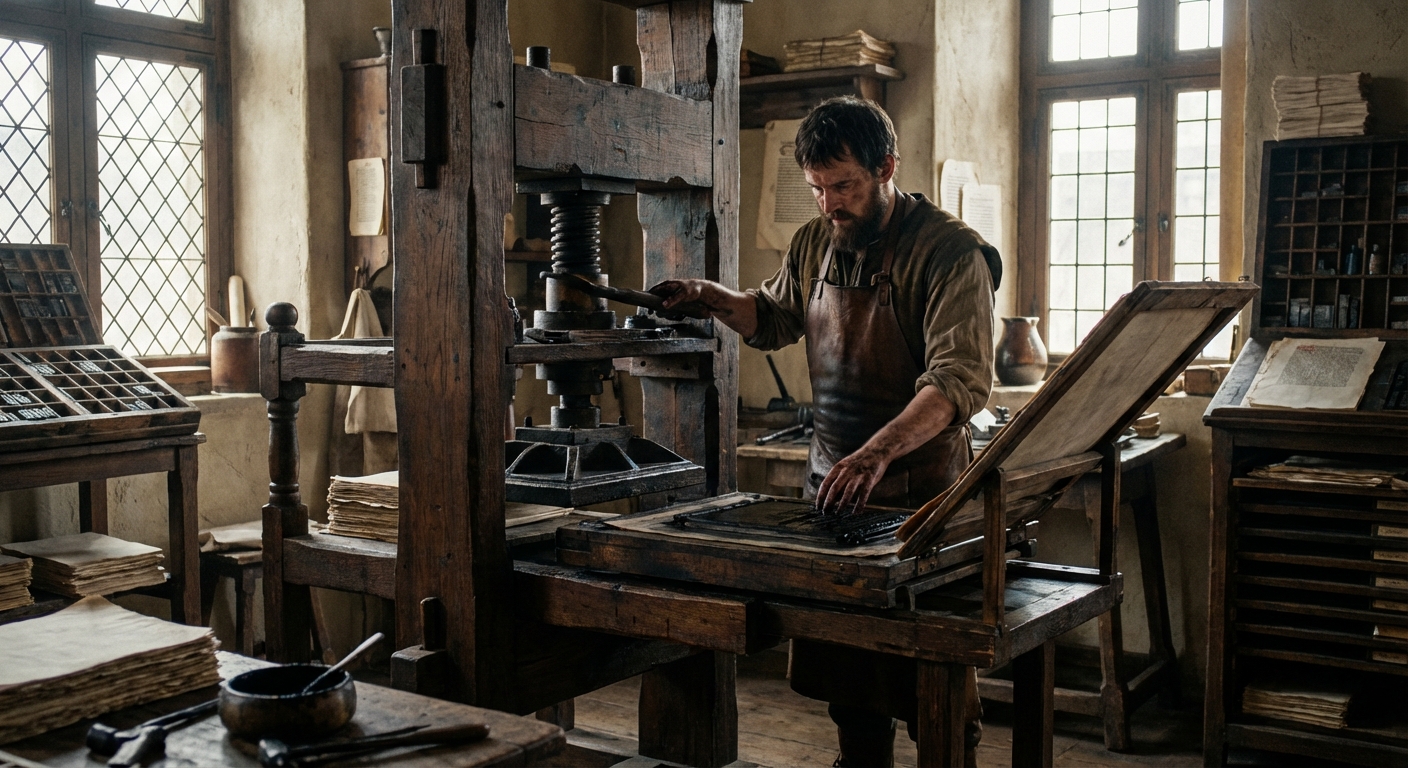
Complex Word: Movable type – small metal pieces shaped like letters that can be moved around and reused.
Example
Gutenberg’s first big success was the “Gutenberg Bible.” He printed about 180 copies; today, only 49 still exist, and they’re worth millions!
3. The Press Spreads Across the World
Soon after Gutenberg, other countries built their own presses. By the 1600s, newspapers appeared in England, France, and the Netherlands.
- Cause: The press made information cheap to produce.
- Effect: More people could read about Science, Politics, and Adventure, sparking the Enlightenment (an age of new ideas).
Mini Experiment – Make Your Own “Press”:
- Use ready-made foam letter stickers or ask an adult to cut simple letter shapes from craft foam.
- Attach each letter backward to a small cardboard square.
- Add a thin layer of washable paint.
- Press it onto paper, keeping paint away from your eyes and mouth.
You’ve just created a tiny Letterpress! Try making a whole word by moving the rubber letters around—just like Gutenberg did.
4. From Paper to Digital – The Legacy Lives On
The printing press didn’t stop at paper. It paved the way for Mass Media (radio, TV, internet). Today, we can share a story with a click, but the principle is the same: reproducing information quickly for many people.
- Cause: The success of printed books showed that ideas could travel fast.
- Effect: Inventors kept improving the technology, leading to today’s digital world.
Did You Know? Publick Occurrences Both Forreign and Domestick was printed in Boston in 1690, before the United States existed. Authorities stopped it after one issue because it lacked their required approval.
Simple Activity – “story Chain”
- Write a short sentence on a slip of paper (e.g., “The cat chased the moon”).
- Pass the slip to a friend; they add one new word.
- Keep passing the slip, each person adding a word, until you have a funny story.
- Compare the final story to the original—just like how printing lets many voices add to a single book.
The printing press turned a world of hand‑written scrolls into a bustling marketplace of ideas. Every time you pick up a book, read a comic, or scroll a webpage, you’re standing on Gutenberg’s shoulders. Who knows what the next “press” will be? Maybe You will invent a new way to share stories with the whole planet! 🌍✨
Keep asking questions, keep reading, and keep creating. The adventure of words is just beginning.