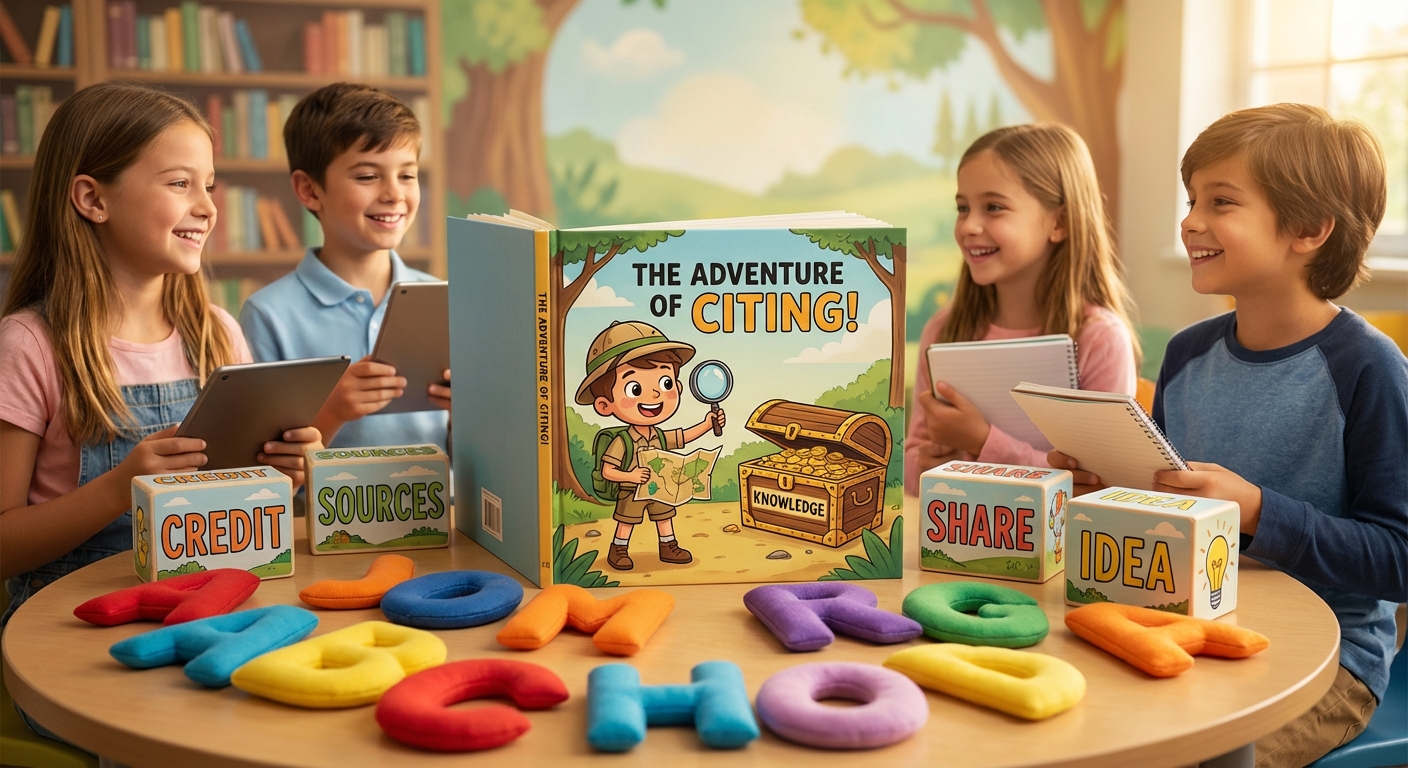
Why Giving Credit Matters: A Kid’s Guide to Citing Sources
Learn how to show where your ideas come from and become a research superhero!
When you write a story, a report, or even a cool school project, you often use Information that you found in books, websites, or videos. Citing Sources means telling your readers exactly where that information came from. It’s like giving a high‑five to the original author and helps everyone know that the facts are trustworthy.
1. What Is a Source? 🤔
A Source is any place where you get ideas, facts, pictures, or words.
- Primary Source – the original thing (a diary, a video, a scientific experiment).
- Secondary Source – someone’s summary or interpretation of the original (an encyclopedia entry, a news article).
Did You Know? The word “source” comes from the French source, meaning “the beginning of a river.” Just like a river starts somewhere, every piece of information starts somewhere too!
Why Cite? – Cause & Effect
- Cause: You use someone else’s words or data.
- Effect: If you don’t say where it came from, people might think the ideas are your original thoughts, which isn’t fair.
- Effect: Proper citations let readers check the facts themselves, making your work Credible (trust‑worthy).
2. The Building Blocks of a Simple Citation
For school projects, you can use a Basic Citation that includes three parts:
| Part | What to Include | Example |
|---|---|---|
| Who | Author’s name (or the creator) | Jane Goodall |
| What | Title of the book, article, or video | “The Secret Life of Elephants” |
| When | Year it was published | 2022 |
A short in‑text citation might look like this: (Goodall, 2022). Then, at the end of your paper, you list the full details in a Reference List.
3. How to Turn a Fact into a Citation – Step‑by‑step
-
Find The Fact – for example, the Moon is Earth’s only natural satellite.
-
Locate The Source – NASA’s Moon Facts page supports the fact.
-
Write The In‑text Citation – “The Moon is Earth’s only natural satellite” (NASA, “Moon Facts”).
-
Add The Full Reference at the end of your paper:
- NASA. “Moon Facts.” NASA Science. Add the page link and the date you accessed it.
Quiz: Test Your Citation Skills
-
Which part of a citation tells you Who wrote the information?
a) Title
b) Author ✓
c) Year
d) Page number -
If you used a video from YouTube made by Science Kids in 2020, how would the in‑text citation look?
a) (Science Kids, 2020) ✓
b) (2020, Science Kids)
c) (Video, 2020)
d) (YouTube, Science Kids) -
Why is it important to cite your sources?
a) To make the paper longer
b) To show you stole ideas
c) To give credit and help readers check facts ✓
d) To confuse the teacher
Now you’re ready to be a citation superhero in every project!