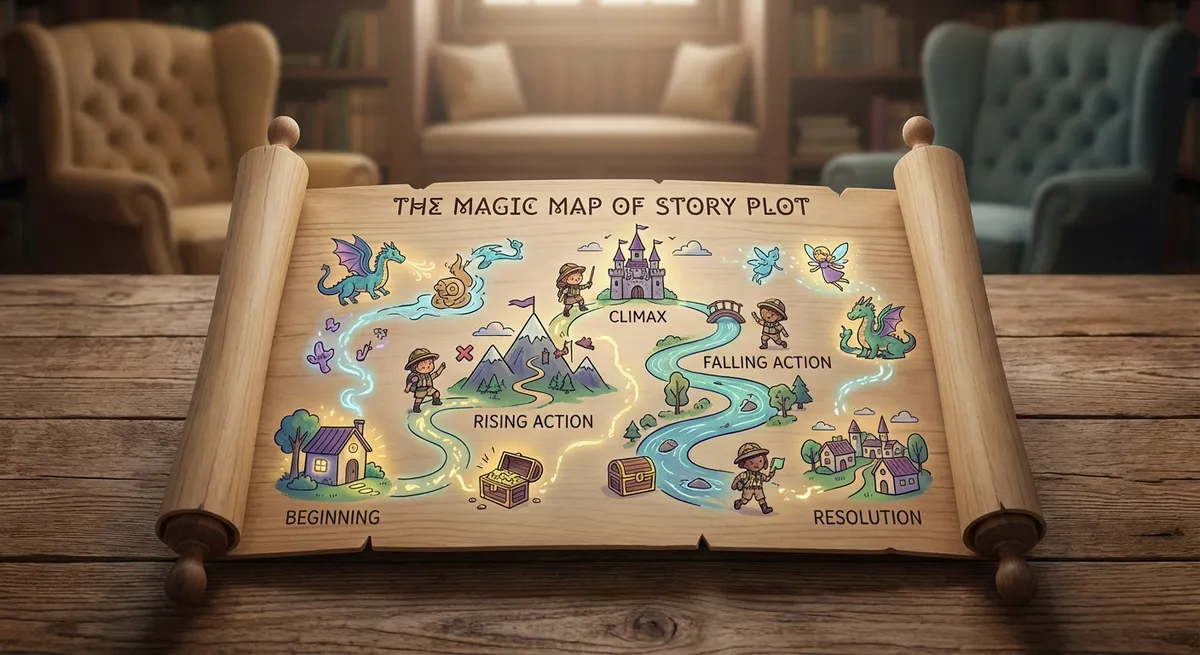
The Magic Map of a Story: Plot Structure
Every great story—whether it’s about a brave dragon, a clever detective, or a kid who discovers a secret garden—has a hidden map that guides the adventure. That map is called Plot Structure. Knowing the plot’s shape helps you understand why characters act the way they do and how the story reaches its exciting finish.
1. The Four‑part Plot (the Classic “story Mountain”)
| Part | What Happens? | Why It Matters (Cause ➜ Effect) |
|---|---|---|
| Beginning (Exposition) | We meet the characters, setting, and the main problem. | Cause: The world is introduced → Effect: Readers know who cares about the problem. |
| Middle (Rising Action) | The hero tries to solve the problem, but obstacles appear. | Cause: Obstacles get tougher → Effect: Tension builds, keeping us hooked. |
| Climax | The biggest, most dramatic moment when the hero faces the problem head‑on. | Cause: All the tension peaks → Effect: The outcome is decided. |
| Ending (Resolution) | The problem is solved (or not), and the story winds down. | Cause: The climax resolves → Effect: We feel satisfied or think about the lesson. |
Did You Know? The “story mountain” shape looks just like a real mountain—starting low, climbing high, then coming back down.
2. Characters & Conflict: The Engine of Plot
- Protagonist – the main character who wants something. (Think “hero”)
- Antagonist – the force (person, animal, or situation) that blocks the protagonist. (Think “obstacle”)
- Conflict – the problem that drives the plot. It can be Internal (inside a character’s mind) or External (outside the character).
Example: In “The Lost Kitten”
- Protagonist: Maya
- Antagonist: The rainstorm that hides the kitten
- Conflict: Maya must find the kitten before night falls.
Each step of the plot shows Maya trying, failing, learning, and finally rescuing the kitten—showing cause and effect at every turn.
3. Plot Vocabulary Boost
| Word | Simple Definition | Sentence |
|---|---|---|
| Exposition | The part that sets the scene. | The exposition tells us Maya lives on a farm. |
| Climax | The most exciting part. | The climax is when Maya spots the kitten in a tree. |
| Resolution | How the story ends. | The resolution shows Maya cuddling the kitten safely. |
| Narrative | A story told in words. | This narrative follows Maya’s adventure. |
| Foreshadowing (advanced) | A hint about something that will happen later. | The dark clouds foreshadow the storm. |
Try underlining these words when you read a book and see how they fit the story!
4. Mini Experiment: Build Your Own Story Mountain
What You Need:
- A blank sheet of paper
- Colored pencils or markers
- Sticky notes (optional)
Steps:
- Draw A Mountain – a simple triangle with a line across the middle.
- Label The Parts – write “Beginning,” “Middle,” “Climax,” and “Ending” on the sides.
- Create A Short Story (5–7 sentences) about anything you love—maybe a soccer game or a space mission.
- Place Each Sentence on the appropriate part of the mountain.
- Check Cause ➜ Effect: Does each sentence lead logically to the next? If not, add a missing step.
What You’ll Learn: Seeing