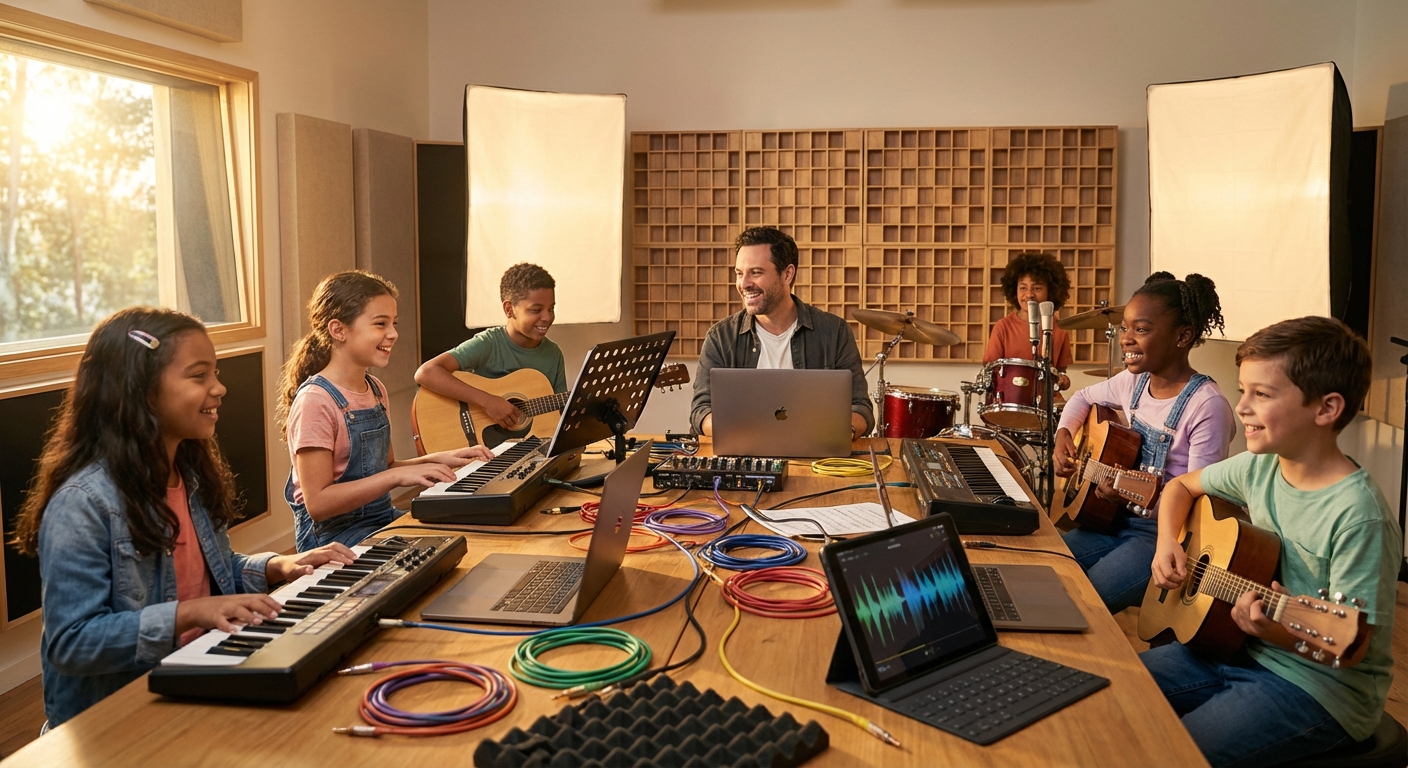
How a Song Is Made: Music Production Basics
Introduction
Ever wondered how your favorite song goes from a tiny idea to the music that fills your headphones? That journey is called Music Production – the art and science of turning sounds into a finished track. In the next few minutes you’ll learn the key ingredients, the tools that help creators, and even try a tiny experiment of your own!
1️⃣ What Is Music Production?
Music production is the process of Recording, Arranging, and Mixing sounds to create a complete song. Think of it like cooking: you gather ingredients (vocals, drums, synths), follow a recipe (the arrangement), and then taste‑test and adjust the flavors (mixing).
Did You Know? An 1860 phonautograph trace of “Au Clair de la Lune” is the earliest known recognizable recording of a human voice. The machine drew sound waves but was not designed to play them back; researchers reconstructed the sound much later.
Vocabulary Boost
- Arrange – to decide the order of musical parts.
- Mix – to blend all the recorded sounds so they sound good together.
2️⃣ the Building Blocks: Tracks & Sounds
A Track is a single layer of sound, like a vocal line or a drum beat. When you stack many tracks, they form a Multitrack session.
Example
| Track # | What It Contains | Why It Matters |
|---|---|---|
| 1 | Drum loop (kick, snare, hi‑hat) | Gives the song its Tempo (speed). |
| 2 | Bass line | Adds depth and helps listeners feel the groove. |
| 3 | Lead vocals | Carries the words and melody. |
| 4 | Synth pad | Fills the background with atmosphere. |
Cause & Effect: If you make the drum track faster (increase tempo), the whole song feels more energetic. If you lower the Frequency of the bass (make it deeper), the music feels richer and more powerful.
3️⃣ Tools of the Trade: DAW & Mixer
A Daw (Digital Audio Workstation) is a computer program where you record, edit, and mix music. Popular DAWs for beginners include Garageband, Audacity, and Cakewalk.
Inside a DAW you’ll find a Mixer – a virtual board with sliders (called Faders) that control the loudness of each track.
Mini‑glossary
- Daw – software that lets you capture and shape sound.
- Fader – a slider that changes volume.
- Compression – a tool that makes loud parts quieter and quiet parts louder, so everything sits nicely together.
Did You Know? The first digital audio workstation (DAW) systems, like Soundstream’s Digital Editing System, appeared in the late 1970s, using large computers for editing sound.
4️⃣ Adding Magic: Effects & Editing
Effects are like the spices in a recipe. Common ones include:
| Effect | What It Does | Example |
|---|---|---|
| Reverb | Simulates the echo of a room or hall | Makes a vocal sound like it’s sung in a cathedral. |
| Delay | Repeats a sound after a short pause | Creates a “ping‑pong” echo on a guitar. |
| EQ (Equalizer) | Boosts or cuts specific Frequencies (high, mid, low) | Makes a bass line punchier. |
Cause & Effect: Adding too much reverb can make a song sound “washy” and hard to hear the words. Using a little EQ can bring clarity to each instrument.