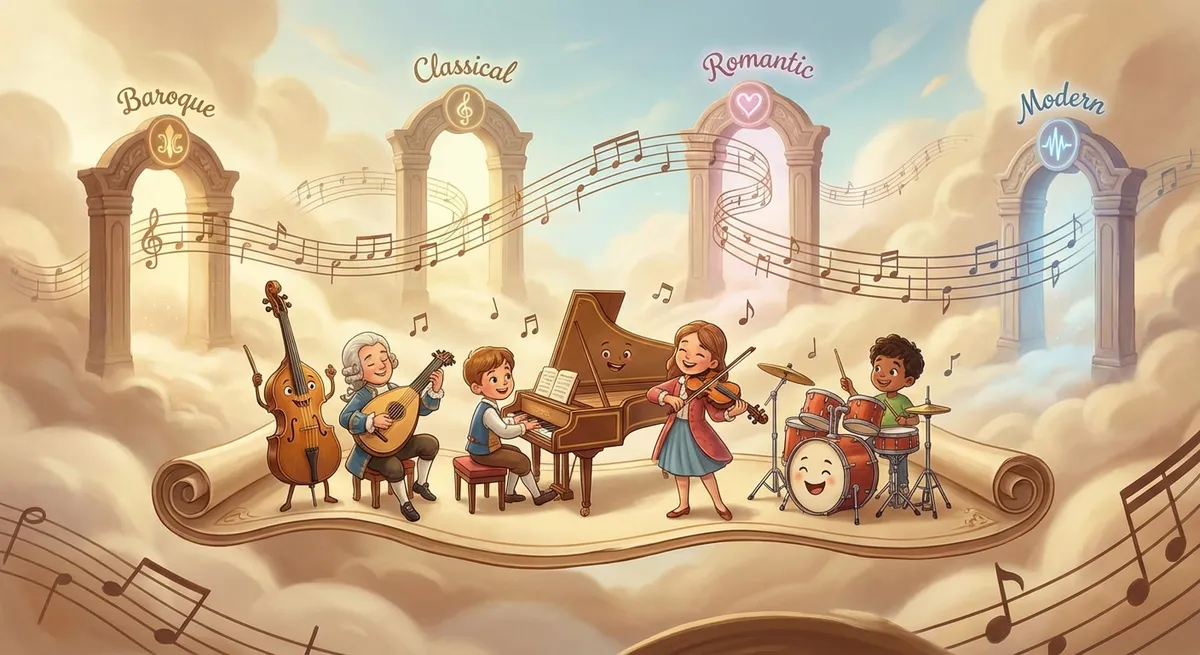
Journey Through the Musical Periods
Music is like a giant story that has been told for hundreds of years. Just as books have different “chapters,” music has Periods—big stretches of time when composers wrote in similar styles. In this adventure we’ll explore four important musical periods, discover why they sounded the way they did, and even try a tiny experiment of our own!
1. The Baroque Period (≈ 1600‑1750)
What It Sounds Like – Fancy, ornate music with lots of Counterpoint (two or more melodies that weave together). Think of a musical maze!
Famous Composers – Johann Sebastian Bach, George Frideric Handel.
Why It Happened – During the Baroque era, churches and royal courts wanted music that sounded grand and powerful to impress listeners. This cause (big, important patrons) created the effect of elaborate, highly decorated music.
Example To Listen To – Bach’s “Air on the G String.” Try to spot the smooth, flowing melody that repeats over a gentle accompaniment.
Did You Know? The word baroque comes from the Portuguese word “Barroco,” meaning “oddly shaped pearl.” Musicians thought the music was “shiny” and a little wild!
2. The Classical Period (≈ 1750‑1820)
What It Sounds Like – Clear, balanced, and elegant. Think of a tidy room where everything has its place.
Famous Composers – Wolfgang Amadeus Mozart, Franz Joseph Haydn.
Why It Happened – The Enlightenment was a time when people liked logic and order. Composers responded by writing music that was Structured (organized) and easy to understand.
Example To Listen To – Mozart’s “Eine kleine Nachtmusik.” Notice the bright, singable Melody and the predictable Form (the way the music is built).
Mini Vocabulary
- Orchestration – the art of deciding which instruments play which notes.
3. The Romantic Period (≈ 1820‑1900)
What It Sounds Like – Passionate, dramatic, and full of emotion. Imagine a roller‑coaster of feelings!
Famous Composers – Ludwig van Beethoven (late works), Pyotr Ilyich Tchaikovsky, Frédéric Chopin.
Why It Happened – People began to value personal expression and the power of nature. Composers wanted to tell stories and paint pictures with sound, so they used Dynamics (loud‑soft changes) and exotic scales.
Example To Listen To – Tchaikovsky’s “Dance of the Sugar Plum Fairy.” Hear the mysterious Celesta (a keyboard that sounds like bells).
Cause & Effect – The rise of Nationalism (pride in one’s country) caused composers to incorporate folk melodies, giving each nation its own musical “flavor.”
Did You Know? Beethoven was almost completely deaf when he wrote his famous Ninth Symphony, yet he imagined the music in his mind!
4. The 20th‑century & Beyond (≈ 1900‑present)
What It Sounds Like – A huge mix! From jazzy syncopation to electronic beats, composers experiment with Tonality (the “home” note) and new instruments.
Famous Composers – Igor Stravinsky, John Williams (film music), Kanye West (hip‑hop).
Why It Happened – Technology (recordings, synthesizers) gave musicians tools they never had before, so they could create fresh sounds.
Example To Listen To – Stravinsky’s “The Rite of Spring” (the opening is a thunderous drum pattern).
Mini Vocabulary
- Syncopation – placing the beat where you don’t expect it, making the rhythm feel “