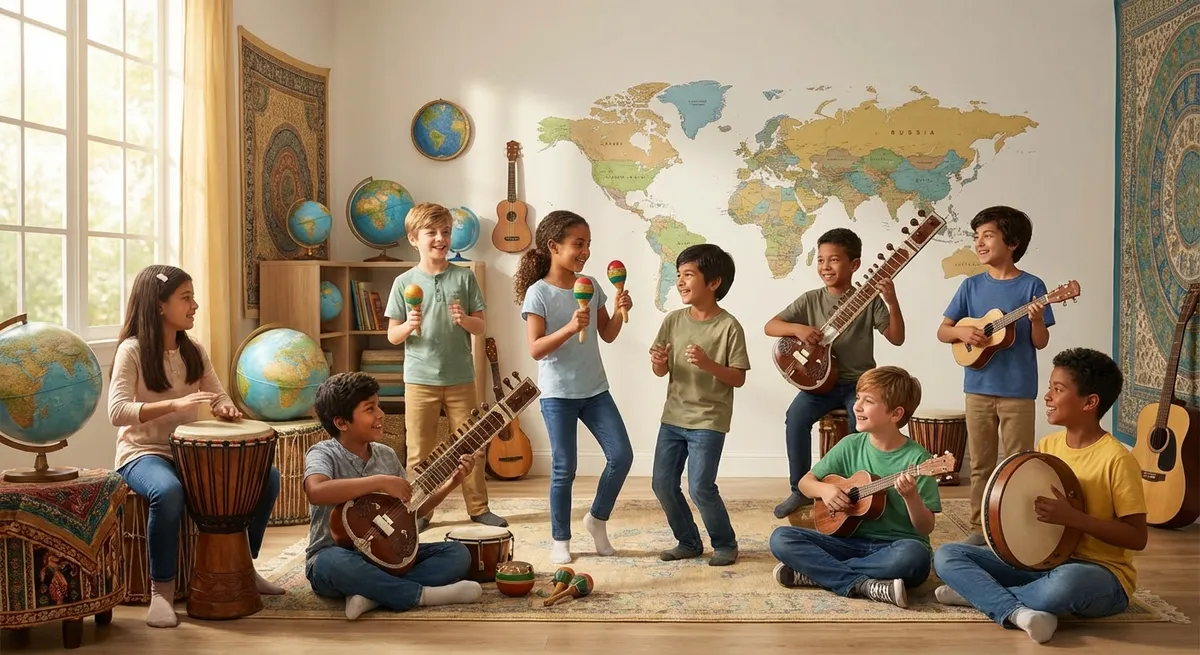
Around the World in Rhythm
Music is a universal language, but every country has its own special Tradition—the way people create and share sounds. From the beating drums of Africa to the delicate koto strings of Japan, these traditions tell stories, celebrate festivals, and bring communities together. Let’s travel the globe without leaving our chairs and discover how music shapes cultures!
1. African Drum Circles – The Heartbeat of a Village
What’s Happening?
In many African societies, drums are the Foundation (the base) of musical life. A drum circle is a group of people playing different sized drums together, creating layered rhythms.
Cause and Effect
- Cause: A leader beats a steady pattern on a large drum called a djembe.
- Effect: Others join in, adding faster or slower beats, which makes the music feel alive and encourages dancing, singing, and even storytelling.
Vocabulary Boost
- Polyrhythm – two or more different rhythms played at the same time.
- Call‑and‑response – a musical conversation where one player “calls” a phrase and another “responds.”
Did You Know? 🤔
The word “djembe” comes from the Bambara language of Mali and means “everyone together.”
2. Indian Classical Music – A Musical Raga Adventure
What’s Happening?
In India, classical music is built around Raga—a set of notes that creates a particular mood, like sunrise or rain. Musicians use instruments such as the sitar, tabla, and bansuri (a bamboo flute).
Cause and Effect
- Cause: A performer chooses a raga that matches the time of day.
- Effect: Listeners feel the intended emotion (peaceful, joyful, or contemplative), helping them connect with nature’s cycles.
Vocabulary Boost
- Raga – a melodic framework, like a musical “recipe.”
- Improvisation – creating music on the spot, like making up a story while you tell it.
Did You Know? 🤔
The tabla’s two drums are called the dayan (right) and bayan (left). Their different shapes give them distinct sounds, just like a high‑pitched whistle and a deep drum.
3. Latin American Percussion – The Fiesta of Beats
What’s Happening?
From Brazil’s samba to Cuba’s conga, Latin American music thrives on Syncopation—placing emphasis on normally weak beats, which makes the music feel “bouncy.”
Cause and Effect
- Cause: Musicians accent off‑beats on instruments like the maracas or tambora.
- Effect: The audience can’t help but tap their feet or move their hips, turning a simple song into a lively dance party.
Vocabulary Boost
- Syncopation – a rhythm that surprises you by stressing unexpected beats.
- Clave – a repeating rhythmic pattern that serves as the music’s backbone.
Did You Know? 🤔
The word “samba” comes from an African word meaning “to rub together,” referring to the friction of drum skins that create the sound.
4. Japanese Koto – Strings of Serenity
What’s Happening?
The koto is a long, wooden harp with 13 strings, each plucked with finger picks. Traditional Japanese pieces often imitate sounds of nature—like flowing water or wind through pine trees.
Cause and Effect
- Cause: A player slides a finger along a string while plucking it.
- Effect: The pitch glides smoothly, producing a Glissando, which can make listeners feel calm and reflective.
Vocabulary Boost
- Glissando – sliding between notes, like a musical slide.
- Pentatonic – a five‑note scale commonly used in East Asian music.
Did You Know? 🤔
Originally, only aristocratic women played the koto, but today anyone can learn it, and many schools teach it as part of music class.
Mini Experiment: Build Your Own Rhythm Box
Materials
- Empty tin can or plastic container