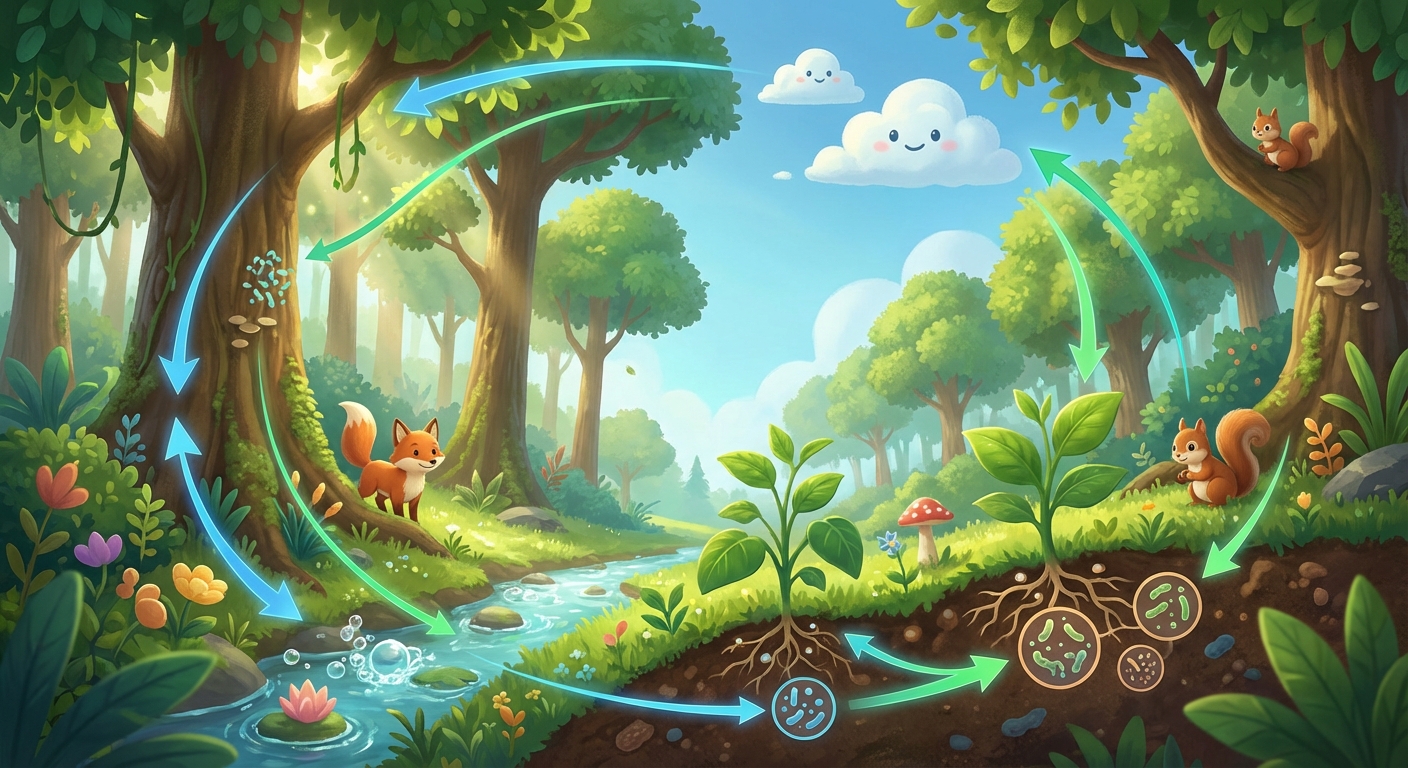
The Amazing Nitrogen Cycle
Every living thing—plants, animals, even the soil—needs a special gas called Nitrogen to grow strong. But nitrogen doesn’t just sit around; it moves in a giant loop called the Nitrogen Cycle. In this adventure we’ll follow nitrogen’s journey through the air, the ground, and living creatures, learn new words, and even try a simple experiment at home!
1. Nitrogen Starts in the Sky 🌤️
- Atmosphere – the blanket of air surrounding Earth. About 78 % of the atmosphere is nitrogen gas (N₂).
- Why Can’t Plants Use N₂? The nitrogen atoms in N₂ are tightly bonded, like a locked door. Most plants can’t open the lock, so they need help.
How the Lock Is Opened
Nitrogen-fixing bacteria live freely in soil or water, and some live with plants such as legumes. Their enzymes break the strong N≡N bond and convert nitrogen gas into ammonia (NH₃), which becomes forms such as ammonium (NH₄⁺) that plants can use.
Word Box
- Bacteria – microscopic living organisms, often invisible without a microscope.
- Enzyme – a protein that speeds up a chemical reaction, like a tiny catalyst.
2. From Soil to Plant to Animal
- Ammonification – When plants or animals die, decomposers (fungi and bacteria) break down their bodies, releasing ammonia back into the soil.
- Nitrification – Other microorganisms change ammonia or ammonium into nitrites (NO₂⁻) and then nitrates (NO₃⁻). These are nitrogen-containing ions, not food; plant roots can absorb nitrate, and some plants can also use ammonium.
- Assimilation – Plant roots soak up nitrates, use the nitrogen to build proteins (the building blocks of life), and grow leaves, stems, and fruits.
- Consumption – Animals eat the plants, taking the nitrogen into their own bodies to make muscles, feathers, and more.
3. Returning Nitrogen to the Air
- Denitrification – In water‑logged soils, a different set of bacteria turn nitrates back into nitrogen gas (N₂) and release it into the atmosphere, completing the cycle.
Cause & Effect
- Too Much Fertilizer → excess nitrates can leach into rivers, causing “eutrophication” (over‑growth of algae that depletes oxygen).
- Land-use Change → removing vegetation, disturbing soil, or adding excess fertilizer can change which nitrogen compounds are stored, washed into water, or released into the air.
4. Did You Know? 🤔
- Lightning can also break the N≡N bond! Each lightning strike creates tiny amounts of nitrogen oxides that later become nitrates in rain.
- The word “nitrogen” comes from the Greek nitron (soda) and genes (forming), meaning “forming soda”.
Mini Experiment: Grow Your Own Bean Plant 🌿
What You Need
- 2 small pots
- Potting soil
- 4–5 beans (e.g., lima or kidney beans)
- Water
Steps
- Fill both pots with soil.
- Plant 2 beans in each pot, about 2 cm deep.
- Water each pot the same amount.
- With an adult, add a correctly diluted, age-appropriate plant fertilizer to one pot according to its label. Leave the other pot unfertilized as the comparison. Do not taste the plants or soil, and wash your hands afterward.
- Place the pots in a sunny spot and observe for 2‑3 weeks.
What To Watch For
- Which plants grow taller?
- Do the leaves look greener?
- Discuss whether the plants differ. This small test cannot show that nitrogen alone caused a difference because fertilizer may contain several nutrients and individual seeds vary. Too much fertilizer can harm plants and waterways.