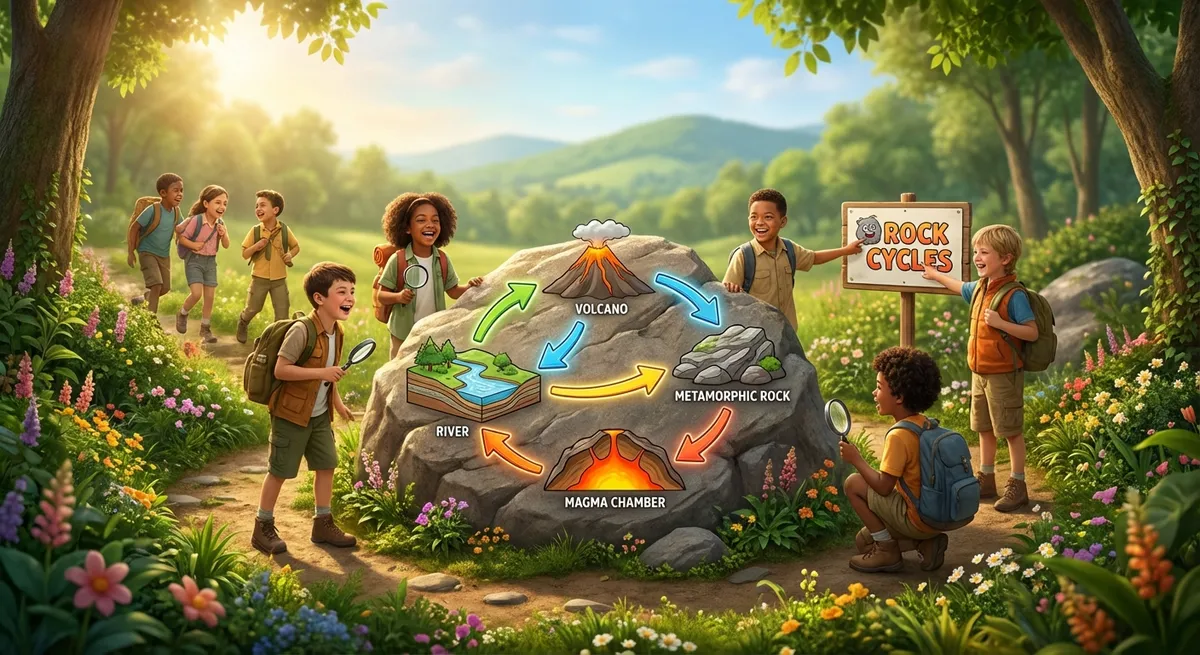
Rock Cycles
What Are Rocks?
Rocks are solid pieces of Earth’s crust. They can be big like a mountain or tiny like a pebble you find in a garden. Every rock tells a story about how it was formed.
Three Types of Rocks
Igneous
Igneous rocks are born from molten lava or magma. When the hot liquid cools and hardens, it becomes rock. Examples are basalt and granite.
Sedimentary
Sedimentary rocks form from layers of sand, mud, and tiny shells that settle in water. Over time, pressure squeezes these layers together into rock. Sandstone and limestone are common sedimentary rocks.
Metamorphic
Metamorphic rocks start as igneous or sedimentary rocks that get heated and squeezed deep inside Earth. The heat and pressure reshape them without melting. Slate and marble are metamorphic rocks.
How Rocks Change
- Weathering – Wind, rain, and temperature make rocks break into smaller pieces.
- Erosion – Water or wind moves the broken pieces to new places.
- Deposition – The pieces settle in layers, often at the bottom of a river or ocean.
- Compaction & Cementation – Pressure squeezes the layers together, forming sedimentary rock.
- Heat & Pressure – Deep inside Earth, rocks melt or are pressed, turning into igneous or metamorphic rock.
These steps can happen many times, so a rock may change from one type to another over millions of years.
Why It Matters
Understanding the rock cycle helps us learn where natural resources like water, minerals, and fossil fuels come from. It also shows how Earth is always changing, even if we can’t see it in a single day. By exploring rocks, we discover the history of our planet.