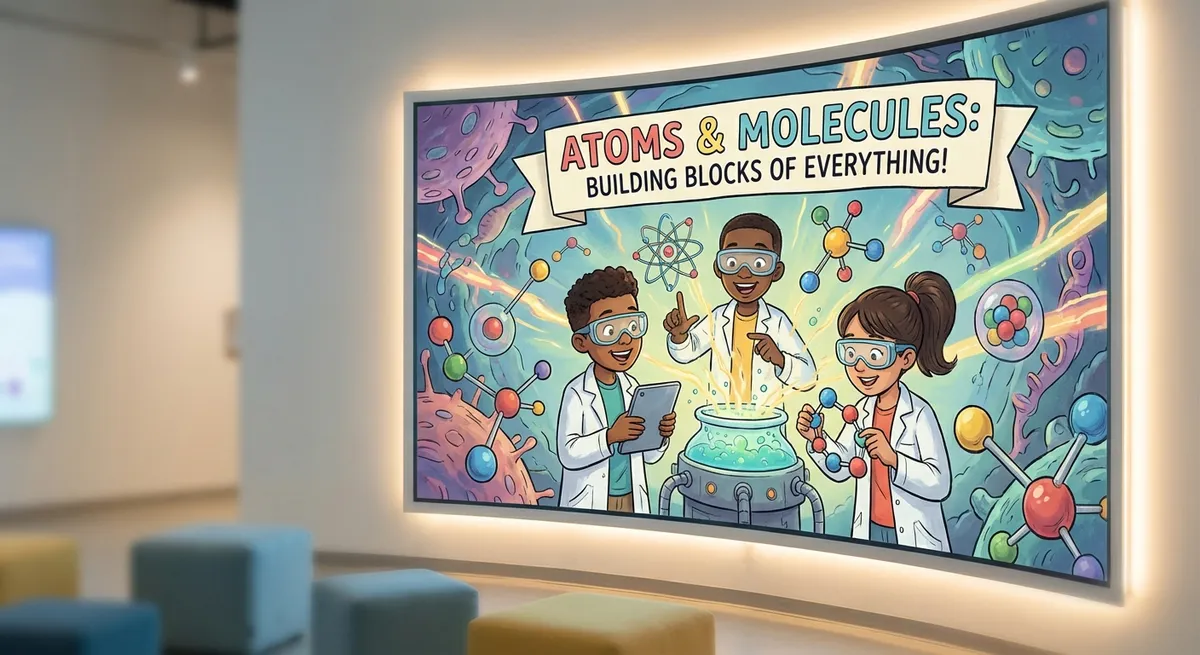
Atoms & Molecules: the Tiny Building Blocks of Everything
Everything you see, touch, taste, or smell is made of Atoms and Molecules. Even the air you breathe and the chocolate chip cookie you love are built from these invisible pieces. Let’s shrink down to the microscopic world and discover how tiny particles create the big world around us!
1. What Is an Atom?
- Atom – the smallest unit of an element that still retains its chemical properties.
- Think of an atom like a LEGO brick. Each brick has a Nucleus (the “core”) and Electrons (tiny, fast‑moving particles) that swirl around it.
| Part | What It Does | Simple Word |
|---|---|---|
| Nucleus | Holds most of the atom’s mass; contains protons (+ charge) and neutrons (no charge). | Core |
| Electrons | Zip around the nucleus; give the atom its electric “personality.” | Negatives |
Vocabulary Boost – Element: a pure substance made of only one kind of atom (e.g., gold, oxygen).
Cause & Effect:
If an atom loses or gains electrons, it becomes an Ion, which can attract or repel other ions—this is why static electricity makes your hair stand up!
2. When Atoms Join Forces: Molecules
A Molecule is two or more atoms stuck together. The way they stick is called a Bond.
- Covalent Bond – atoms share electrons to feel stable (like sharing snacks).
- Ionic Bond – one atom gives an electron to another (like giving a gift).
Examples:
- Water (H₂o) – two hydrogen atoms + one oxygen atom → a molecule that makes up oceans, rain, and your glass of water.
- Carbon Dioxide (Co₂) – one carbon atom + two oxygen atoms → the gas plants use for photosynthesis.
Did You Know? A single drop of water contains about 1.5 × 10²⁴ molecules—more than the number of stars in the Milky Way!
3. Building Bigger Things: Compounds & Mixtures
- Compound – a molecule made of different elements (e.g., table salt = sodium chloride, NaCl).
- Mixture – a physical blend of two or more substances that don’t chemically bond (e.g., cereal with milk).
Cause & Effect:
When you heat a compound, its molecules may move faster and change state (solid → liquid → gas). That’s why ice melts into water when warmed.
4. Mini‑experiment: Make Your Own “molecule” Model
What You Need
- Marshmallows (atoms)
- Toothpicks (bonds)
- Different colors of mini‑gumdrops or chocolate chips (different elements)
Steps
- Choose a “molecule” to build, like water (H₂O).
- Insert two toothpicks into a marshmallow (oxygen).
- Attach a gumdrop to each of the other ends (hydrogen).
- Snap the toothpicks together – you’ve created a model of a water molecule!
What’s Happening?
You’re visualizing how atoms share electrons (the toothpicks) to become a stable molecule.
Quick Quiz
- True Or False: An atom is the smallest part of a molecule.
- What is the bond called when atoms share electrons?
- Name one compound that is essential for life.
Answers: 1️⃣ True 2️⃣ Covalent bond 3️⃣ Water (H₂O) or Carbon Dioxide (CO₂)
Atoms and molecules may