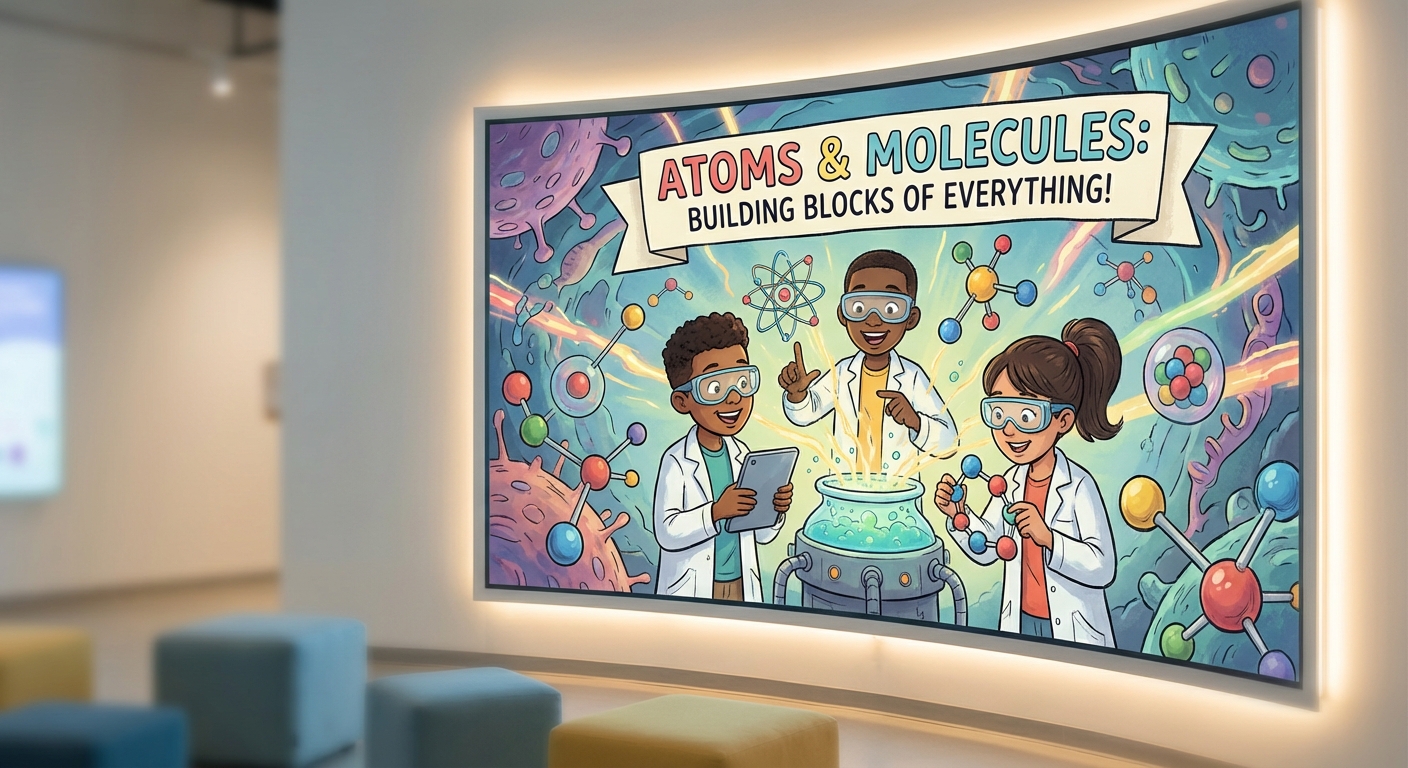
Atoms & Molecules: the Tiny Building Blocks of Everything
Everything you see, touch, taste, or smell is made of Atoms and Molecules. Even the air you breathe and the chocolate chip cookie you love are built from these invisible pieces. Let’s shrink down to the microscopic world and discover how tiny particles create the big world around us!
1. What Is an Atom?
- Atom – the smallest unit of an element that still retains its chemical properties.
- An atom has a tiny nucleus containing protons and neutrons. Electrons are found in regions around the nucleus; they do not follow simple circular paths like planets.
| Part | What It Does | Simple Word |
|---|---|---|
| Nucleus | Holds most of the atom’s mass; contains protons (+ charge) and neutrons (no charge). | Core |
| Electrons | Negatively charged particles found in regions around the nucleus; they help control bonding and electricity. | Negative charges |
Vocabulary Boost – Element: a pure substance made of only one kind of atom (e.g., gold, oxygen).
Cause & Effect:
If an atom loses or gains electrons, it becomes an ion. Positive and negative charges attract, while like charges repel. Static electricity involves an imbalance of charge on objects.
2. When Atoms Join Forces: Molecules
A molecule is a group of two or more atoms held together by covalent bonds. A chemical bond is an attraction that holds atoms or ions together.
- Covalent Bond – atoms share electrons.
- Ionic Bond – oppositely charged ions attract after electrons have been transferred. Ionic solids form repeating structures rather than separate molecules.
Examples:
- Water (H₂O) – two hydrogen atoms + one oxygen atom.
- Carbon Dioxide (CO₂) – one carbon atom + two oxygen atoms; plants use it during photosynthesis.
Did You Know? A typical small drop of water contains roughly 10²¹ molecules—about a sextillion. The exact number depends on the drop’s size, and it is billions of times larger than estimates of the number of stars in the Milky Way.
3. Building Bigger Things: Compounds & Mixtures
- Compound – a substance whose particles contain atoms of two or more elements chemically combined. Water is a molecular compound; table salt forms an ionic structure.
- Mixture – a physical blend of two or more substances that don’t chemically bond (e.g., cereal with milk).
Cause & Effect:
Heating a substance transfers energy to its particles. If enough energy is added, a solid may melt or a liquid may boil without changing which substance it is. Some compounds can instead break down if heated strongly.
4. Mini-experiment: Make a Molecule Model
What You Need
- Paper circles in two colors
- A marker
- Reusable adhesive putty or short paper strips and tape
Steps
- Choose a molecule to model, such as water (H₂O).
- Label one larger circle O and two smaller circles H.
- Connect each H circle to the O circle with putty or a paper strip.
- Compare the model with the formula: two H atoms and one O atom.
What’s Happening?
The connectors show which atoms are bonded, but the flat model does not show the molecule’s exact shape, size, movement, or electrons.
Quick Quiz
- True Or False: An atom is the smallest unit of an element that keeps that element’s chemical properties.
- What kind of bond involves shared electrons?
- How many hydrogen and oxygen atoms are in one H₂O molecule?
Answers
- True
- A covalent bond
- Two hydrogen atoms and one oxygen atom
Atoms, ions, and molecules are tiny, but their structures and interactions create the materials around us. Models help us think about them, as long as we remember what each model leaves out.