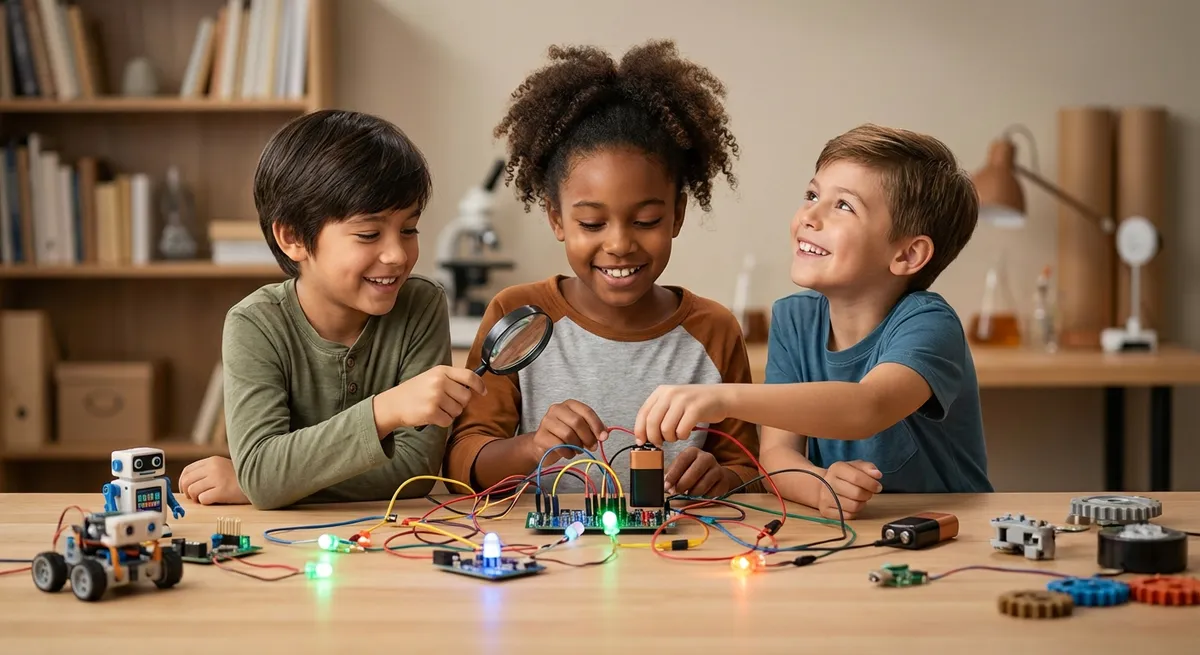
Circuits
What Is a Circuit?
A circuit is a path that lets electricity move. When the path is complete, the electricity can travel from a power source to a device, like a light bulb, and back again.
Main Parts of a Simple Circuit
- Battery – stores the electrical energy.
- Wires – connect everything together.
- Light Bulb – shows the electricity is working by glowing.
- Switch – opens or closes the circuit. When the switch is closed, the path is complete and the bulb lights up.
How Electricity Flows
Electricity starts at the positive side of the battery. It travels through the wires, passes through the switch (if it is closed), lights the bulb, and then returns to the negative side of the battery. If any part of the path is broken, the electricity stops and the bulb goes dark.
Build a Tiny Circuit (you Can Try at Home)
- Gather a small battery, a piece of wire, a tiny bulb, and a simple switch or a piece of foil.
- Tape one end of the wire to the positive side of the battery.
- Attach the other end of that wire to one side of the bulb.
- Connect another piece of wire from the other side of the bulb to the switch.
- Finally, attach a wire from the switch back to the negative side of the battery.
- Press the switch. If everything is connected, the bulb will glow!
Remember, always ask an adult for help when working with batteries and electricity. Have fun exploring how circuits bring power to the things around you!