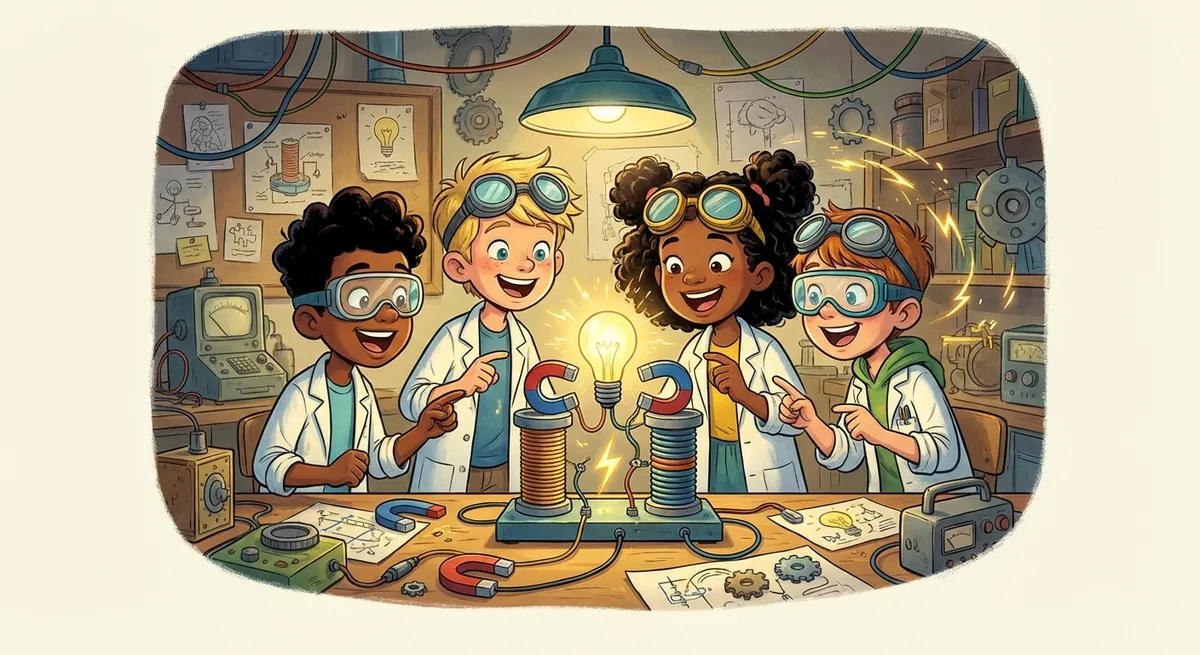
How Electricity Works
What Is Electricity?
Electricity is the movement of tiny particles called Electrons. Imagine a road full of cars. When the cars all travel the same way, they make a flow. Electrons do the same thing inside a wire, and that flow is called Electric Current.
The Electric Circuit
A circuit is a complete loop that lets electricity travel. It has four main parts:
- Power Source – a battery or a wall outlet that pushes the electrons.
- Conductors – wires that give the electrons a road to travel on.
- Load – something that uses the electricity, like a light bulb or a motor.
- Switch – a gate that opens or closes the road.
If the loop is broken anywhere, the electrons stop moving, just like cars can’t cross a broken bridge.
Fun Fact: Electricity moves almost as fast as light—about 186,000 miles per second! That’s why a light turns on instantly when you flip a switch.
Conductors and Insulators
Materials are either Conductors (they let electricity flow) or Insulators (they stop it).
Conductors – Let Electricity Flow
- Metals such as copper, aluminum, and gold
- Water (because it contains dissolved salts)
- Your body (it’s mostly water)
Insulators – Block Electricity
- Rubber, plastic, and glass
- Wood and paper (when dry)
- Air
Simple Experiment: Build a Tiny Circuit
You’ll Need: a AA or D battery, a small LED light, two short pieces of wire, and tape.
- Tape one wire to the battery’s + (positive) end.
- Tape the other wire to the – (negative) end.
- Touch the free ends of the wires to the two legs of the LED.
- The LED lights up—your circuit works!
Staying Safe with Electricity
Electricity is useful, but it can be dangerous if we’re not careful. Follow these rules:
- Never touch exposed wires or broken cords.
- Keep all electricity away from water.
- Don’t stick objects into outlets.
- Ask an adult to help with any repairs or new wiring.
When we understand how electricity works, we can enjoy its power safely and responsibly.